Expodefensa 2025 – Indumil debuts new polymer rifle
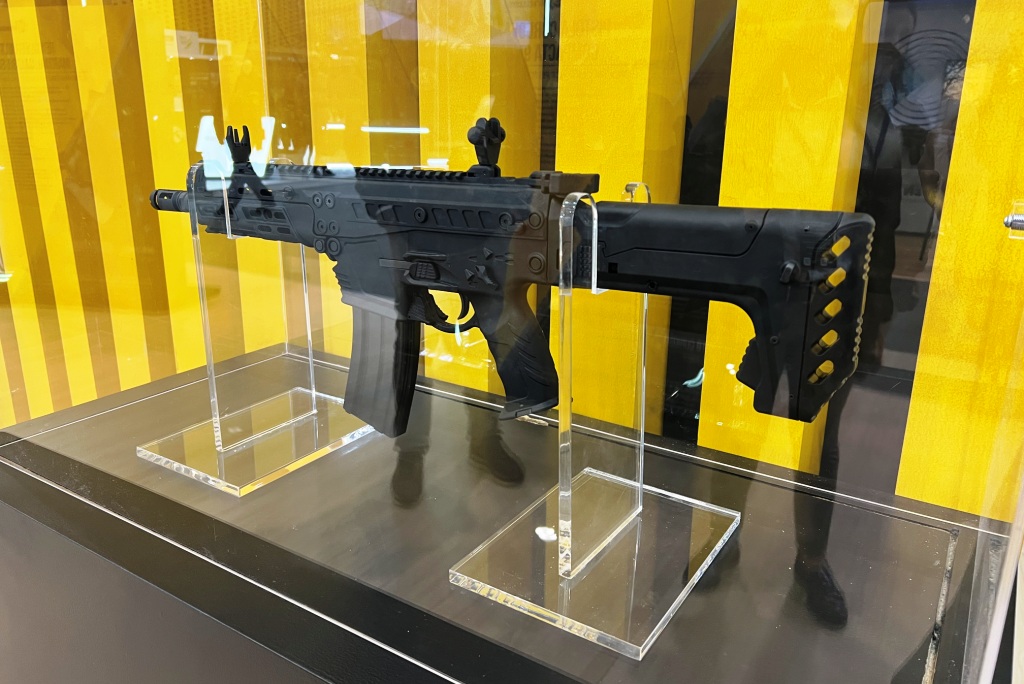
At Expodefensa in Bogotá Indumil unveiled its new 5.56×45 mm rifle, which name was announced only on the last day of the exhibition, the new assault rifle being named Miranda. The weapon developed by Colombia’s state-owned manufacturer represents a significant evolution in the company small-arms portfolio. Designed with extensive use of high‑strength polymer, the weapon aims to deliver a lighter, more versatile assault rifle optimised for the demanding environments in which Colombian and regional forces operate
At the heart of the design is a folding, telescopic and retractable body that allows the user to adapt the overall length of the weapon to mission and morphology, facilitating carriage in vehicles and manoeuvre in confined spaces. The receiver and other primary components are manufactured largely from reinforced polymer, with Indumil indicating that around 65% of the rifle’s parts use this material to reduce mass, standardise production and cut manufacturing time and cost. A hammer‑forged, chromium‑molybdenum carbon‑steel barrel with conventional rifling provides the necessary robustness and accuracy, while the architecture has been conceived to permit rapid barrel change without tools, supporting both role adaptation and simplified maintenance.
The upper assembly incorporates a fibreglass‑reinforced polymer handguard with an integral Picatinny rail compliant with MIL‑STD‑1913, enabling the mounting of day and night optics, laser pointers and accessories in line with current infantry doctrine. Feeding is via standard STANAG‑type 5.56×45 mm NATO magazines with a capacity of 30 rounds, ensuring interoperability with a wide range of in‑service weapons and existing logistic chains. To ease user‑level maintenance, field‑stripping has been simplified: access to the internal mechanisms is achieved by driving out just two pins, avoiding the need to break down the weapon into multiple small components that can be easily lost under field conditions.
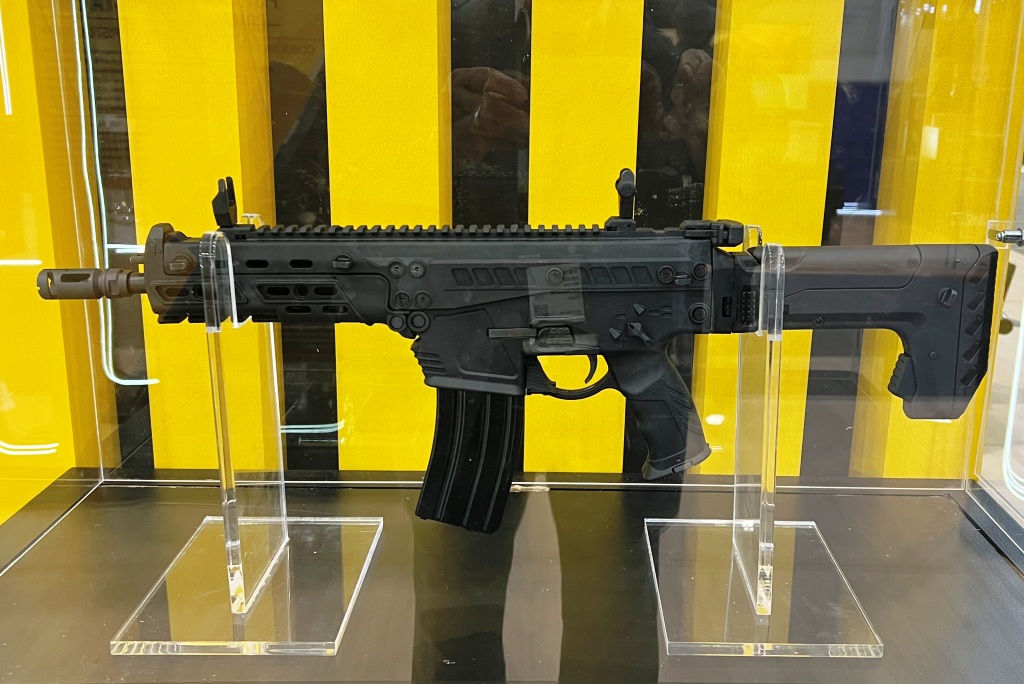
Indumil indicates effective engagement distances that vary with barrel length, with an 8‑inch configuration intended for close‑quarters roles out to around 300 metres, a 13‑inch model covering approximately 400–500 metres, and an 18‑inch variant extending this envelope to roughly 500–600 metres. This tiered approach allows forces to adopt a common family of weapons across assault, carbine and longer‑range applications while maintaining a shared training and support base. The extensive use of high‑strength polymers also improves resistance to harsh climates, with the rifle designed to withstand prolonged exposure to jungle humidity, desert heat and the corrosive maritime environment, all while preserving its external finish and reducing the risk of rust.
According to information provided by the company the Miranda has a mass, with fully loaded magazine respectively of around 3.4 kg for the 8-inch barel version, 3.5 kg for the 13-inch and 3.6 kg for the 18-inch; as a term of comparison, according to the company website, the Galil AR in the 18-inch barrel configuration has a mass of 4.68 kg, which means a saving of over 1 kg, equivalent to around 1.5 loaded magazines.
By trimming mass through its polymer‑intensive construction, the rifle enhances tactical mobility, enabling soldiers to move faster, fatigue less and react more rapidly to emerging threats, particularly in urban areas or dense vegetation where weapon handling is critical. The mass savings can be reinvested in additional ammunition, water or mission‑specific equipment, thereby increasing operational autonomy without overburdening the individual. The smoother interfaces between polymer components can also reduce handling noise compared with all‑metal designs, a benefit for forces conducting stealthy operations where any metallic “clack” from the weapon might compromise concealment.
With the Miranda Indumil clearly intends the weapon to offer a comparative advantage over legacy designs and imported competitors in Latin America. By combining NATO‑standard chambering and magazine compatibility with a modern, polymer‑centric architecture, the new rifle positions Colombia to field and potentially export a domestically developed assault weapon that reflects contemporary trends in ergonomics, modularity and life‑cycle cost control. For the Colombian armed forces, the system promises not only a lighter and more adaptable rifle, but also an additional step towards greater autonomy in small‑arms design and production.
Photos by J. Roukoz