
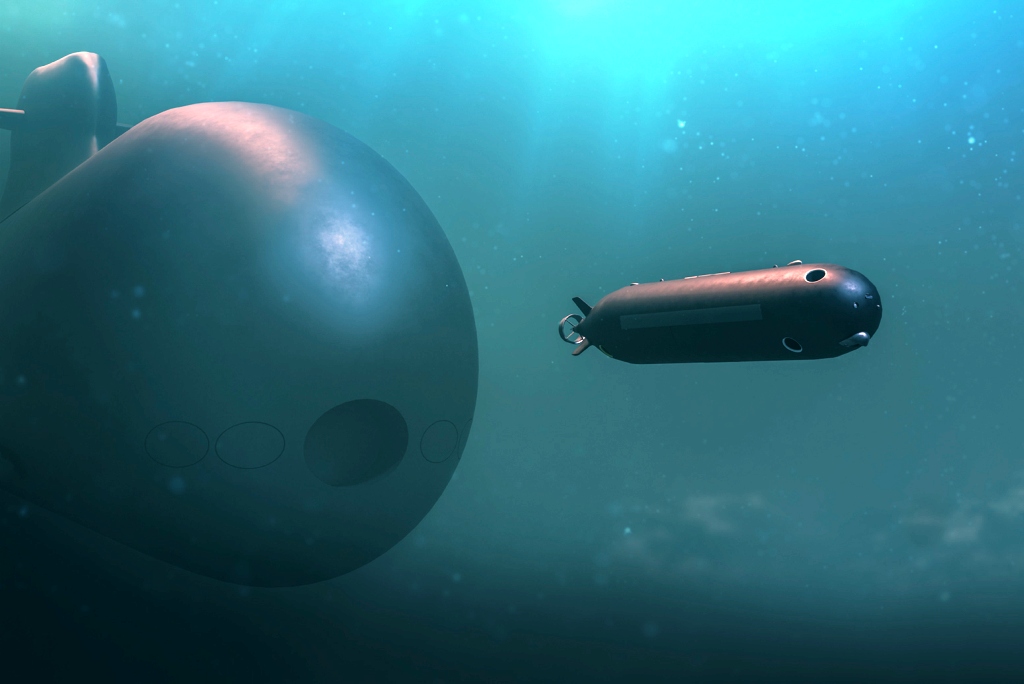
Saab unveils first details of its Autonomous Ocean Drone LUUV for Swedish FMV
The need to monitor the critical seabed infrastructures, detecting and deterring threats to the national sea boundaries and economic interests have pushed navies around the world to develop a range of unmanned platforms to complement both the surface and the underwater assets in a range of missions. On August 2025, Saab signed a contract with the Swedish Defence Materiel Administration (FMV) to develop a concept of a Large Unmanned Undersea Vehicle (LUUV), which is planned to conduct first sea trials in summer 2026. More details on the new project emerged in parallel to the Navy Tech & Seabed Defence conference and exhibition held in Gotherburg, Sweden, 3-5 February, during a media briefing to a restricted number of media
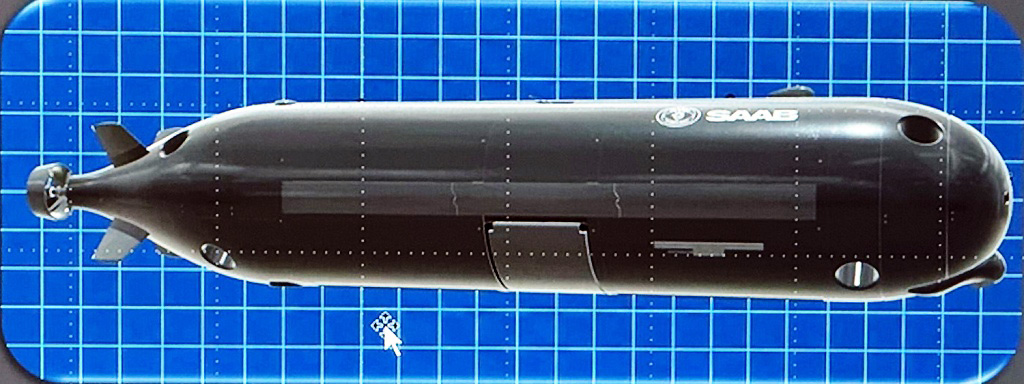
“The Autonomous Ocean Drone (AOD) (as Saab has called the concept) is a LUUV, a software defined new underwater asset with long range capabilities for an array of missions,” said Peter Karlström, Product Manager at Saab Kockums, managing the development project with the FMV and the Royal Swedish Navy. “This demonstrator platform fits Saab’s strategic roadmap in the underwater domain in the light of recent crisis and naval developments, where the company has a long history in designing autonomous as well as manned undersea vehicles. Saab brings here the multidomain Autonomous Ocean Core, a vessel agnostic control system to make craft autonomous with Artificial Intelligence (AI) which was already used for surface platforms in the naval domain. The company’s intention here is to bring the hallmark of our naval competences into this new long range LUUV,” the Saab representative explained.
“What capabilities does it bring to navy end users? At Saab we recognize the need of enhanced decision support and a far-reaching capability with sensors. The LUUV gives navies a competent undersea capability regardless if they are a submarine user or not. With the first increment, at this stage a development project with the FMV and the Royal Swedish Navy, the LUUV will bring the capability to covertly and without crew, employ underwater sensors for long range intelligence, surveillance and reconnaissance (ISR) missions or for preparing a crewed asset,” he said.
With a length and width of respectively 7 and 1.4 meters and a 6,5 tonnes mass, the new LLUV features a hull equipped with two tunnel thrusters on each end not only for platform manoeuvring but also for precise payload delivery on the seabed. It is equipped with an electric propulsion system powered by latest generation Lithion-ion batteries, providing a range of over 600 nautical miles at a patrol speed of approximately 4 knots.
It is interesting to note that the shape and the size of the LUUV have been conceived according to the mission bay of the multi-mission portal (MMP) for the next generation A-26 AIP submarines under construction for the Swedish Navy.
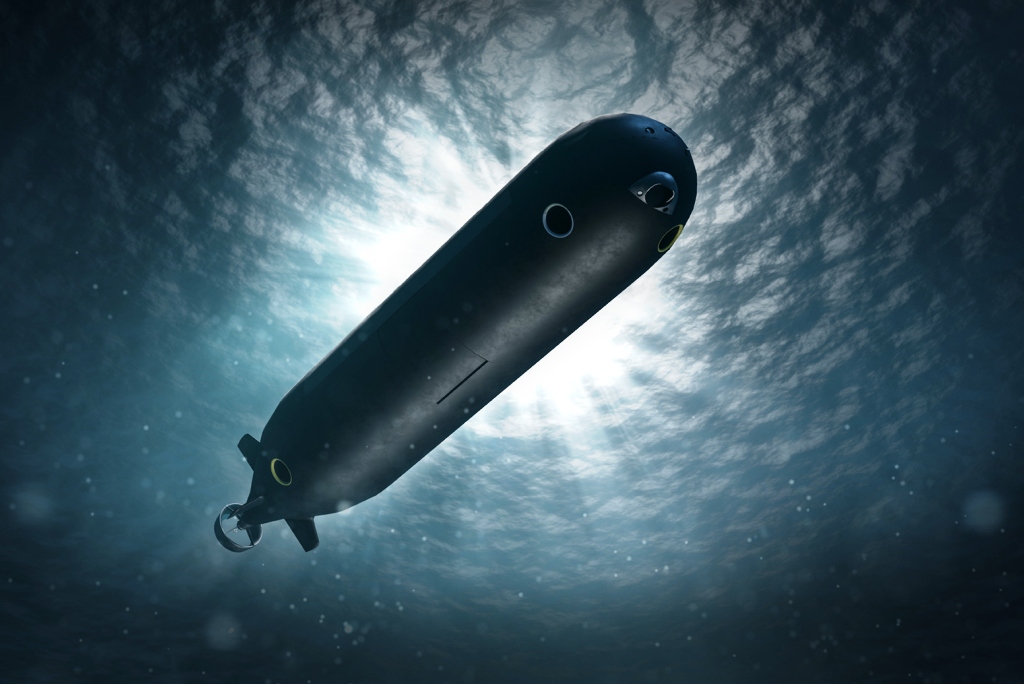
The LUUV presents a large internal undisclosed volume to carry computing capacity as well as mission payloads with an amidships physical cargo space with underneath hatch, based on released images. “We have reserved an empty space for delivering the capabilities that you want to put on the seabed, what that might be, and we have some capacity in our weight compensation system to manage the difference,” said the company representative adding that the development of the delivery system is part of the project, “because we see that as a quite useful part in the future of undersea ISR or other missions.” In the initial stage of the demonstration programme, carried out with FMV and the Royal Swedish Navy, the platform will be used as a sensor platform developed for various capabilities. It will serve as a decision support tool for operators and will not be used to carry weapon systems. The Saab Kockums representative, however indicates it as capability which can be added later on, to further expand the range of missions and provide a deterrence against underwater threats.
In addition to a neural network sensor data processing which allows long covert operations and a communication package centred on satellite links to transfer mission data to land based command and control centres or other naval and aerial platforms, the LUUV comes with a single deployable mast according to images, as well as a comprehensive suite of underwater systems and sensors. The latter includes forward looking sonar, doppler velocity log inertial measurement unit, multi aperture side scan sonar, intercept pulse sonar, multi beam echo sounder and passive flank array sonar, “as one of the missions performed by this craft is actually looking for other underwater crafts in the ASW scenario.”
“I think the unique feature with the platform is that it is developed using a lot of our experience from large submarine manufacturing, everything from how we decide the pressure-tight compartments to how we analyze the signatures and how we optimize it to be silent, but also the control systems that we have developed now with the autonomy stack.”
The key element of the mission suite is the Autonomous Ocean Core (AOC) which is the autopilot and the AI that drives the drone. The agnostic vessel control system which makes platforms autonomous, “is the common software that we will be using more and more within Saab. Right now, we are currently using it on our CB90 and other test platforms. This enables us to view our autonomy stack more like applications as you would find in the app store on your iPhone or something like that,” he underlined.
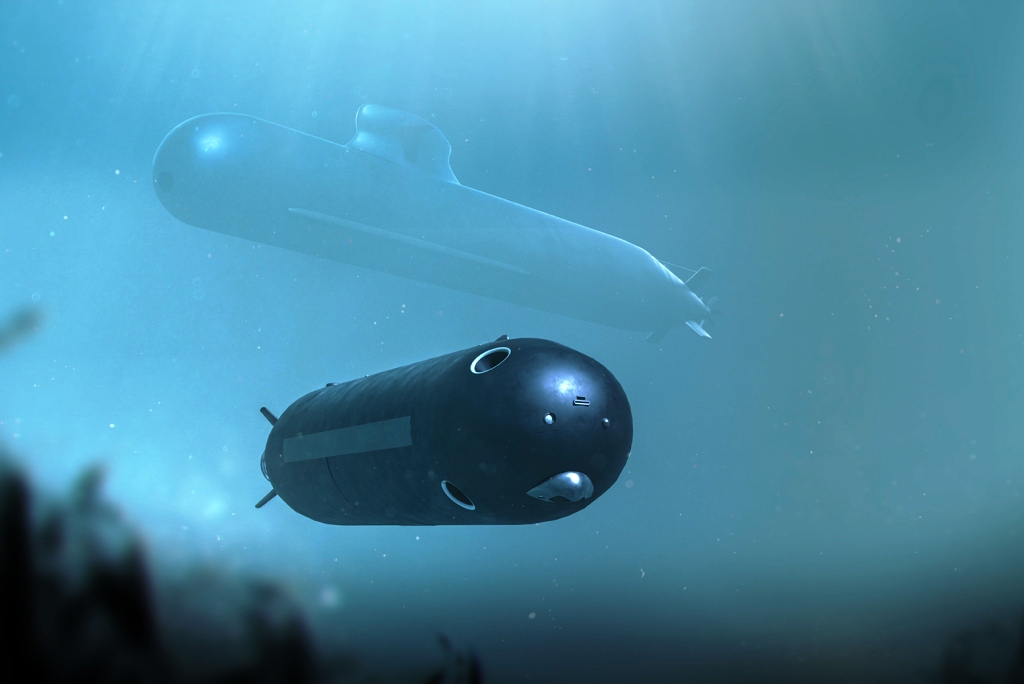
Asked about the project schedule, the Saab Kockums representative provided only few information at this stage. “The first sea trials will be carried out in Sweden in summer 2026. That is our first milestone, but also [plan] to use it as a test platform between Saab, the FMV and the Royal Swedish Navy, to continuously develop more and more capable software to conduct more autonomous operations. This roadmap is also ongoing, and will be divided into increments. Hopefully at some stage within the next couple of years we will actually start doing operations with the Navy in an exercise context to develop both concepts of operations and different procedures,” the Saab representative explained. “We see this [demonstrator] as a very important tool to keep us sharp and to have a continuous development. It’s a good tool for our R&D. And somewhere along the line, depending, of course on the interest of customers and so on, we will start of a product line,” he concluded.
Graphics courtesy Saab