WDS 2026 – Russia unveils its Sarma multiple launch rocket system alongside a complete target acquisition and C2 suite
The Russian-Ukrainian conflict has highlighted the importance of indirect fire on today battlefield. The Russian Army fields two 300 mm multiple launch rocket systems (MLRS), the 9K58 Smerch, in service since 1989, and the 9K515 Tornado-S, which jointed the Smerch in 2014. A new MLRS, the Sarma, in the same calibre, is currently entering service, the first order dating back to 2024, when Russia ordered a first small batch of the new system. The export version of the Sarma was shown for the first time in public by Rosoboronexport at the World Defense Show, together with a command-and-control vehicle and a target acquisition UAV
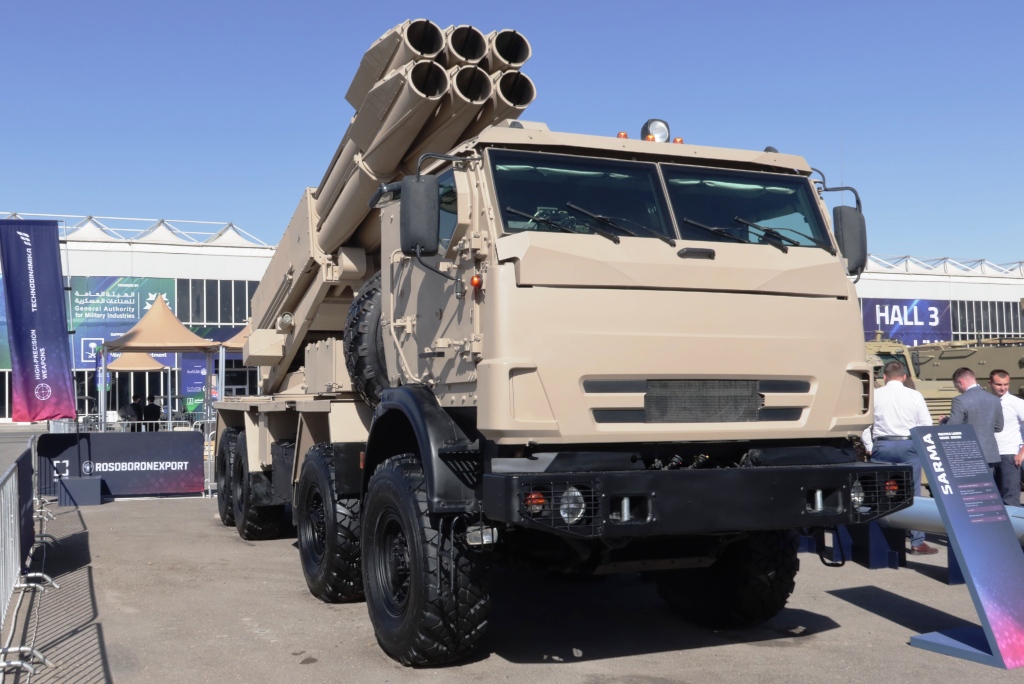
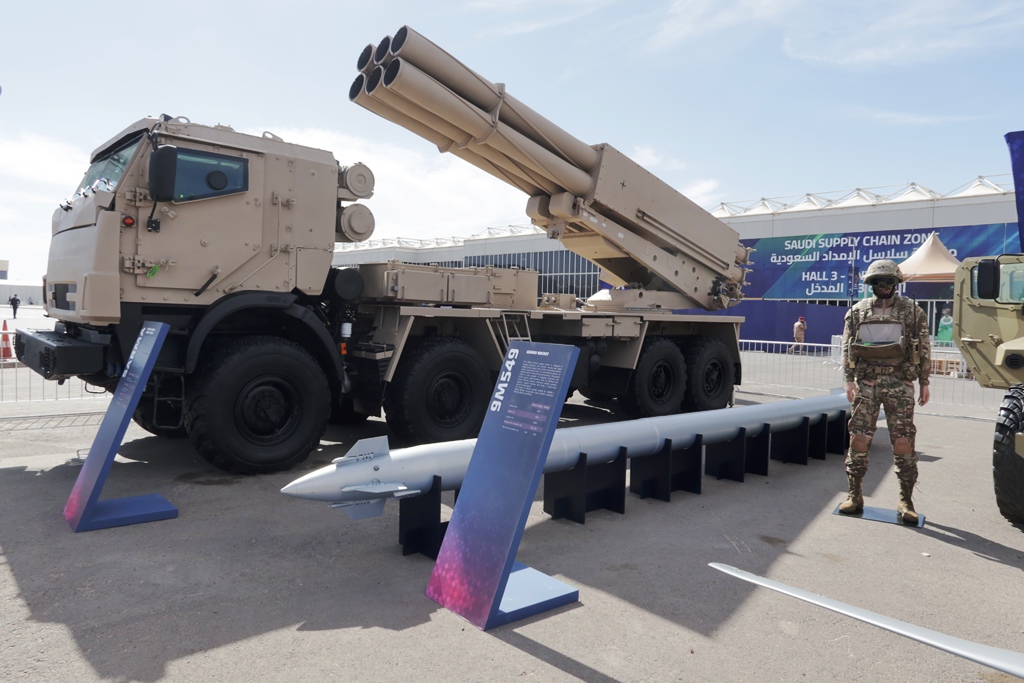
Accuracy, firepower, and short operational deployment time, these were the targets set when the design team started developing the Sarma. The number of launch tubes has been reduced to six from the 12 of the Tornado-S which, together with the new platform, the Kamaz-63501 8×8 truck, brings the combat mass of the 9A55E Sarma launch vehicle at 28,000 kg, around 6 tonnes less than its predecessor, definitely a plus when thinking at transport by air (the Sarma was transported to Saudi Arabia on board an Il-76 aircraft), not to mention the over 40 tonnes of the Smerch. The transport/loader vehicle known as 9T265E has a similar mass. Both vehicles have a maximum speed on road of 95 km/h, the 8×8 truck ensuring a good off-road capability.
This allows increasing the deployment flexibility, which also makes it more difficult for the enemy to locate the system as the Sarma has more options. The crew is made of three military, commander, driver, and launcher operator, all hosted in the front protected cabin, which is fitted with two lateral doors. The vehicle commander uses a command-and-control console to get orders from higher echelons and prepare the firing mission. The fire control system is highly automated and exploits the vehicle navigation system to get the grid of the launch position, entering target coordinates and the type of munition allowing computing the right azimuth and elevation, a key issue especially when firing unguided rockets.
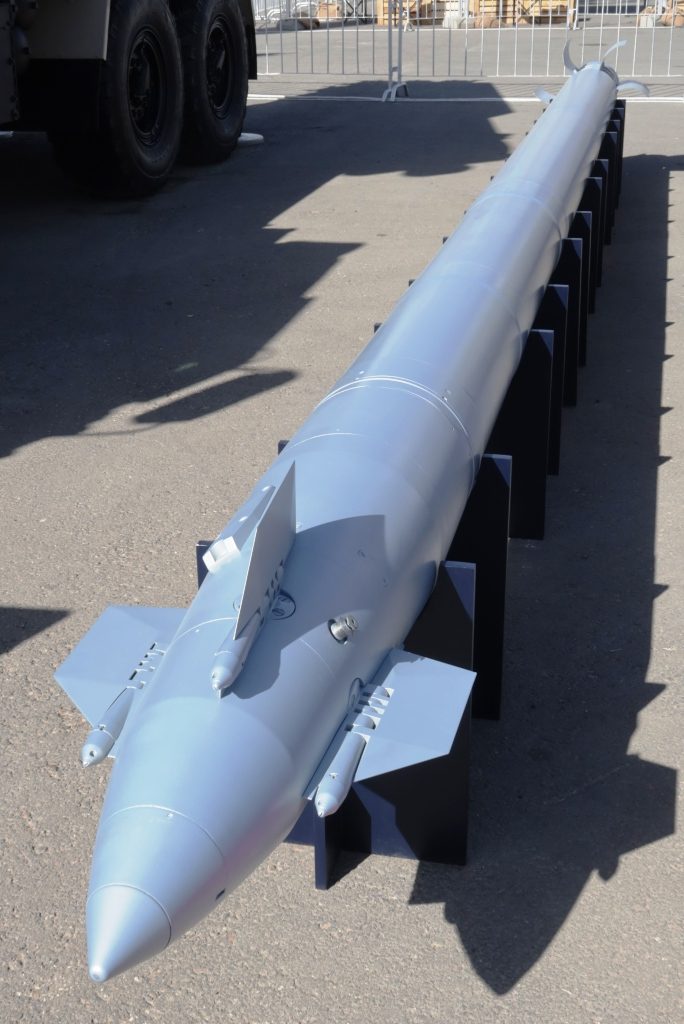
To increase crew safety, the fire mission can be conducted remotely, at 50-60 metres distance from the launcher, using a remote-control console. Since the Sarma comes to a halt, it takes only three minutes to launch the first rocket, the system being capable to launch all six rockets in 18 seconds. It takes then three more minutes to make the launcher ready to move.
First generation Smerch rockets allow reaching targets at 70 km distance, range being 20 km more for second generation munitions. Guided rockets have a range of 120 km; the 9M543, which range goes from 30 to 120 km, has a mass at launch of 828 kg, of which 234 kg represent the high explosive warhead designed to engage manpower, heavy armour, artillery, command and control posts, communication hubs, and other sensitive targets. Exhibited at the Riyadh exhibition was the 9M549 guided rocket was exhibited beside the Sarma launcher; it is similar to the 9M543 but has a heavier warhead, 243 kg, which is designed to engage heavy armour, moving and static.
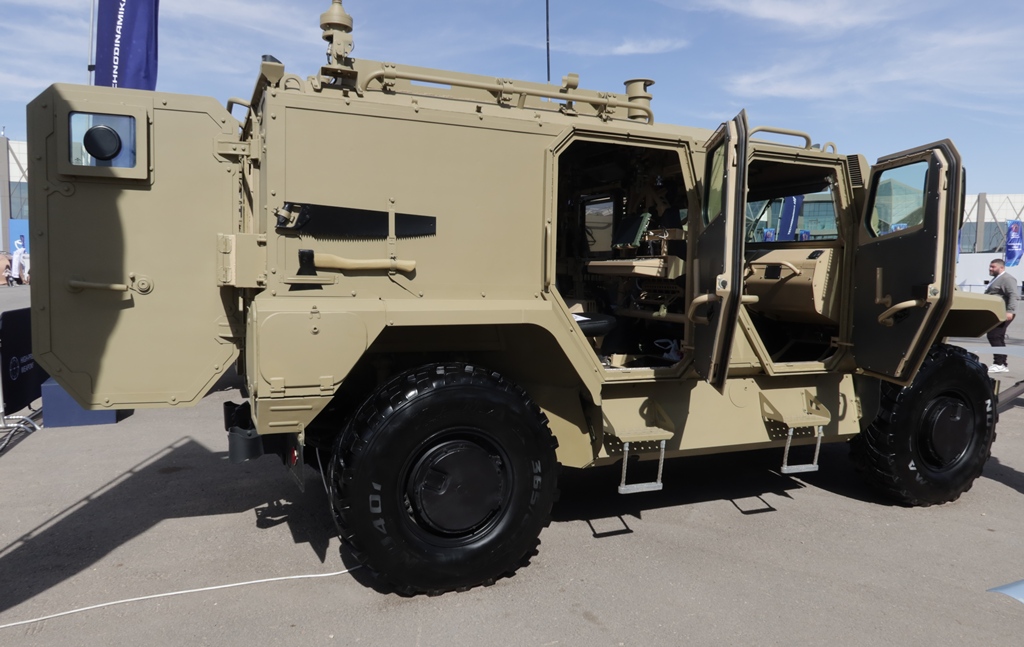
At the Rosoboronexport outdoor static exhibition at WDS the Sarma was shown alongside the ABSh-2 Atlet command and control vehicle, which is fitted with the Planshet-A artillery and mortar C2 system. This is the standard indirect fire C2 system adopted by the Russian Army that allows an artillery battery or battalion to deploy in only six minutes, while a battery can be ready to fire when deploying on unprepared terrain in only 9 minutes. Two minutes are used for geospatial survey. Once ready, it takes less than 50 seconds at battalion level and 30 seconds at battery level for generating firing data against unprepared targets. The radio net that supports the artillery C2 system is the R-187 Arzar, the vehicle version operating on HF, VHF and UHF bands.
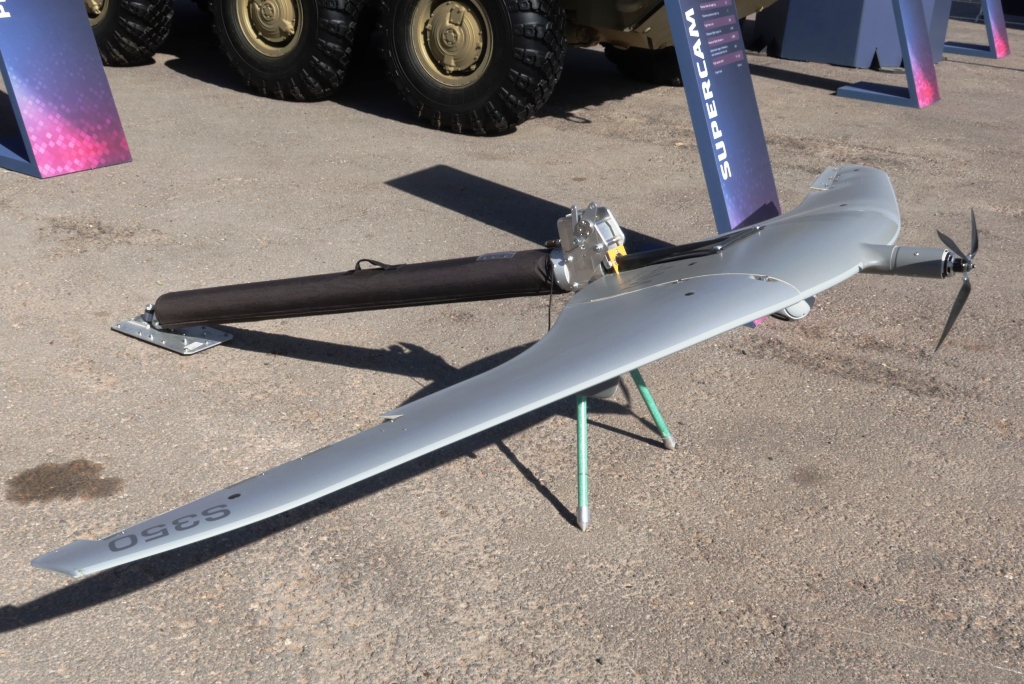
One of the assets used for target acquisition was also exhibited at WDS: the Supercam 350 UAV is a swept wing airframe powered by an electric motor located at the front oof the fuselage, activating a three-blade pulling propeller. The optronic gimbal is located under the fuselage, around the centre of gravity, payload being 2 kg over the 15 kg of the take-off mass; EDR On-Line understood that the sensor installed is either day or night, soldiers switching it depending on the mission. The Supercam 350 in the current version has an endurance of 5.5 hours at cruise speed, 75-120 km/h, operational range of the data link being 100 km while maximum flight altitude is 5,000 metres. Take-off is done by catapult, pneumatic or elastic, and lands using a parachute.
Presenting for the first time its Sarma MLRS, the Russian industry intended showing a possible complete system, including acquisition, C2 and effectors, to potential Middle East customers.
Photos by P. Valpolini