Saha Expo 2026 – Aselsan add new elements to its Steel Dome widening its C-UAS capabilities
At the Istanbul exhibition Aselsan, the leading Turkish defence electronic company, unveiled two new products that will improve the C-UAS effectiveness of its Steel Dome layered air defence system, also announcing improvements on other existing systems to make them better apt to cooperate in the lower layer
At the unveiling, which was attended by the Turkish Defence Minister Yasar Guler and by the head of the Defence Industries Secretariat (SSB) Haluk Gorgun, Ahmet Akyol, the Aselsan CEO, underlined that the Steel Dome is a system always in development, and that Aselsan is striving to mass produce the first elements such as Korkut, Hısar, Siper 1, Siper 2, Alp, and Koral systems. “At the same time, we are investing in capabilities that we believe we are lacking to address new threats. We just discussed Siper-A, Siper-3, and Siper-4 with our defence industry partners,” he said, referring to upper-layer defence systems. “However, we are here to showcase the products we have developed for the electronics layer and the drone defence layer of the Steel Dome, which we are now moving to the production stage,” he stated before describing the various new and upgraded systems presented at Saha Expo.
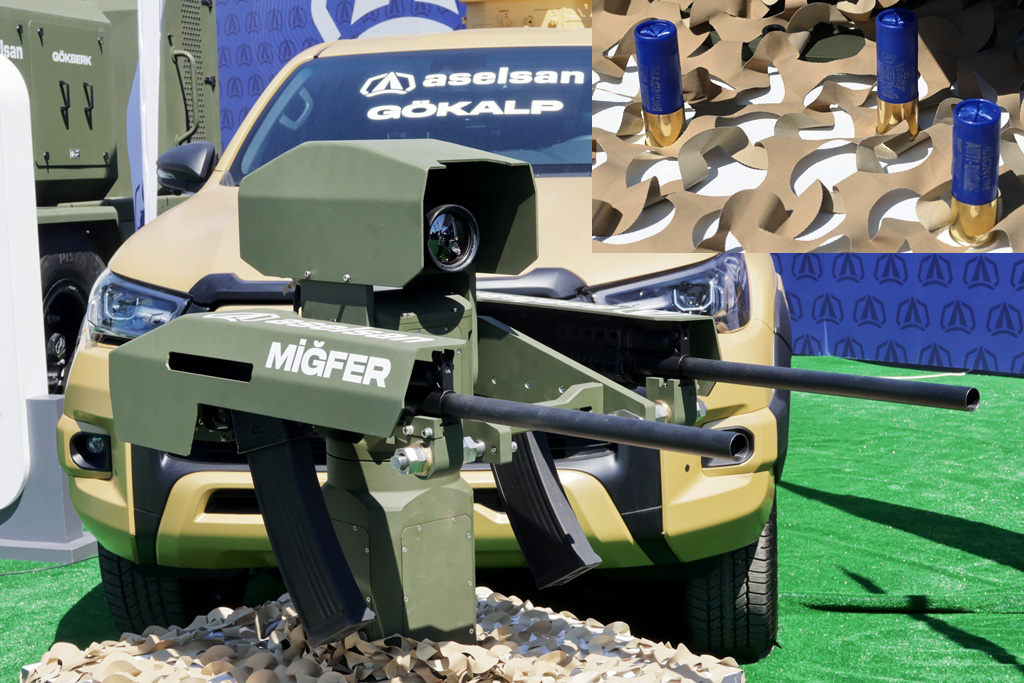
Starting from the shorter-range system, the Miğfer is a remotely controlled weapon system armed with two 12-gauge automatic shotguns, each one able to fire 600 rounds per minute. The turret can rotate 360° in azimuth, its elevation arc being -20°/+70°. Each shotgun has a rifle-type curved magazine containing 20 rounds; at Saha these were Sterling Magnum Antidrone rounds produced by Turaç, a Turkish ammunition producer specialist, those ammunition being lethal against Class 1 drones up to 100 metres range. While the two shotguns are mounted on each side of the mount, on top of it we find the electro-optic subsystem which includes a thermal camera and a laser rangefinder; target detection and tracking is carried out thanks to acoustic sensors, lidar, radar and optronic subsystems which provide the relevant target data to the turret, tracking and classification exploiting those sensors as well as the one mounted on the turret; AI-based algorithms are used for image processing as well as for target classification and prioritisation. The engagement can be fully automated, often the selected mode as at very short distances a man-in-the-loop might make reaction too slow. The Miğfer can be easily installed on any type of land platform, providing a last ditch hard-kill option against the now ubiquitous threat of FPVs and small UAVs.
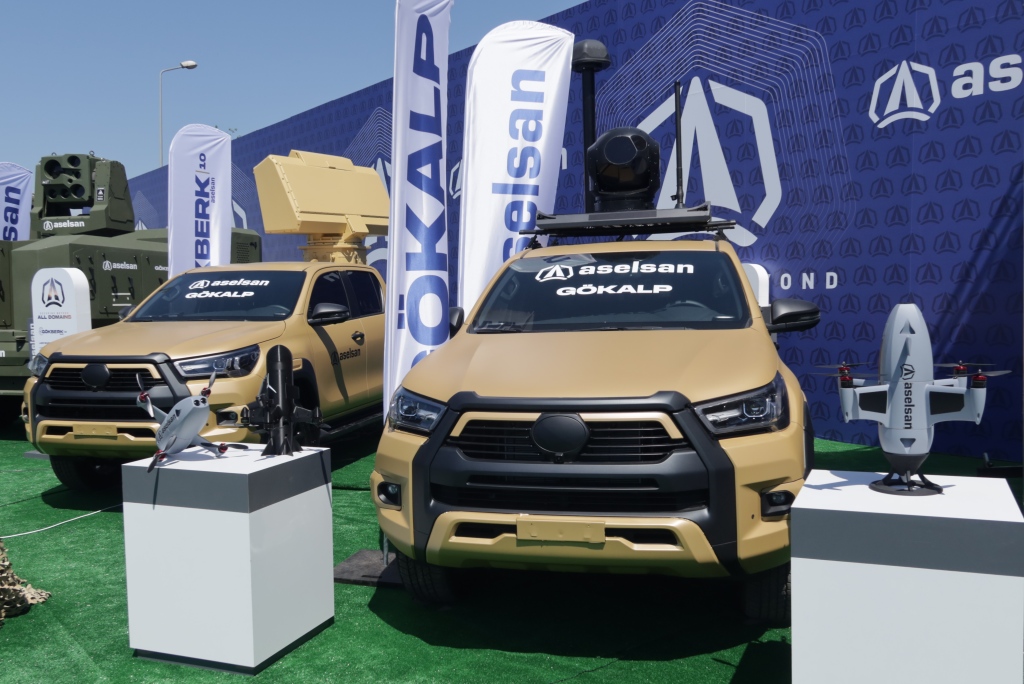
Increasing the range, we switch to the second wholly new system shown at Saha Expo by Aselsan in the C-UAS role, the Gökalp. This is an autonomous C-UAS system that can be provided in two versions, both visible in Istanbul. In the outdoor exhibition the Gökalp was exhibited on two commercial pick-ups, an affordable solution that allows deploying several Gökalp in low-risk areas. One vehicle was carrying on its flatbed a Kalkan 200-G X-band multifunctional mobile search radar capable to detect small UAVs at 40 km range, while the second was equipped with a platform mounted on the roof on which was fitted with an ASELFLIR 410 optronic gimbal, a mast-mounted datalink antenna and a mast mounted datalink antenna. The inside Aselsan stand hosted a trailer version of the Gökalp, the single platform being fitted at the four corners with the AESA antennas of the Aura 150 multifunction surveillance radar, which has an 8-10 km range, and should be a smaller version of the Aura 200, an optronic head that looked like the Dragoneye, and the same datalink and inter-platform communication antenna.
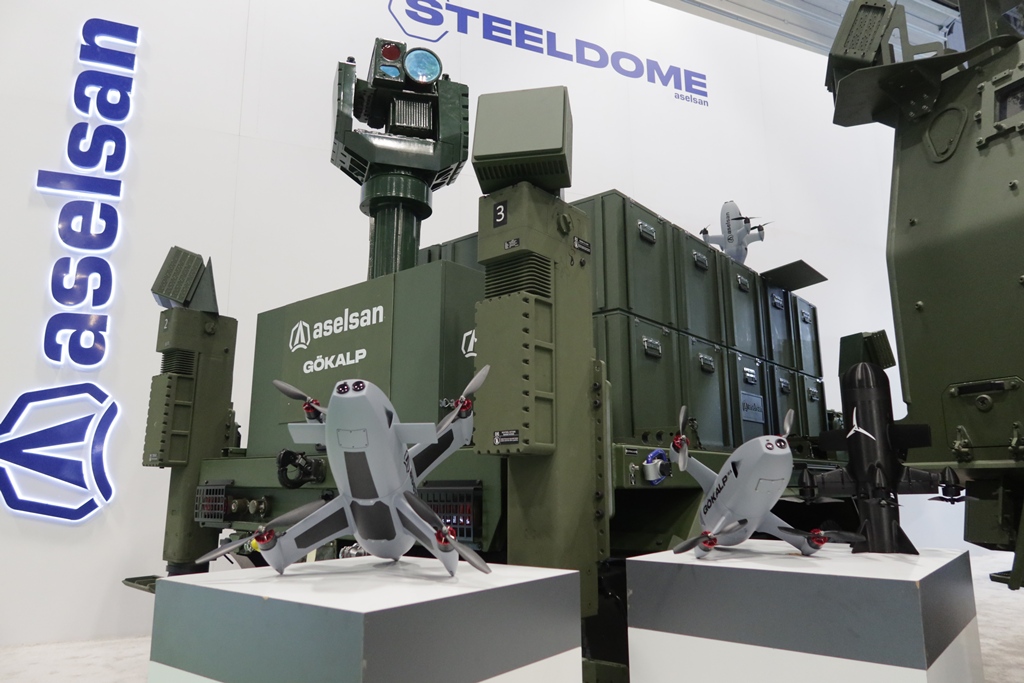
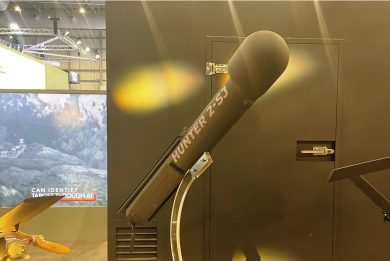
The two versions had in common the effectors, in the form of interceptor drones; these come in two different types, E1 and E2, and are vertically launched from multi-cell boxes that can be configured according to customers’ needs. In the vehicle-mounted version these boxes are carried on the flatbed of the pick-up carrying the optronic gimbal, while in the trailer mounted version most surface of the platform is exploited to carry effectors. The E1 has a mass of 2 kg, flies at a maximum speed of 40 km/h to a maximum range of 1 km; it relies only on kinetic energy to destroy the target and is designed to deal with Class 1 UAVs. The E2 has a mass and a speed twice those of the E1, can reach approaching drones at 7 km distance from the launch pod, and carries an around 1 kg warhead while keeping also the kinetic energy option. Both are fitted with a day and night camera Aselsan developed its own interceptors, however it is fully open to integrate customers assets of that type in the Gökalp, and to underline this on the outer stand a Skydagger Hunter was also visible.
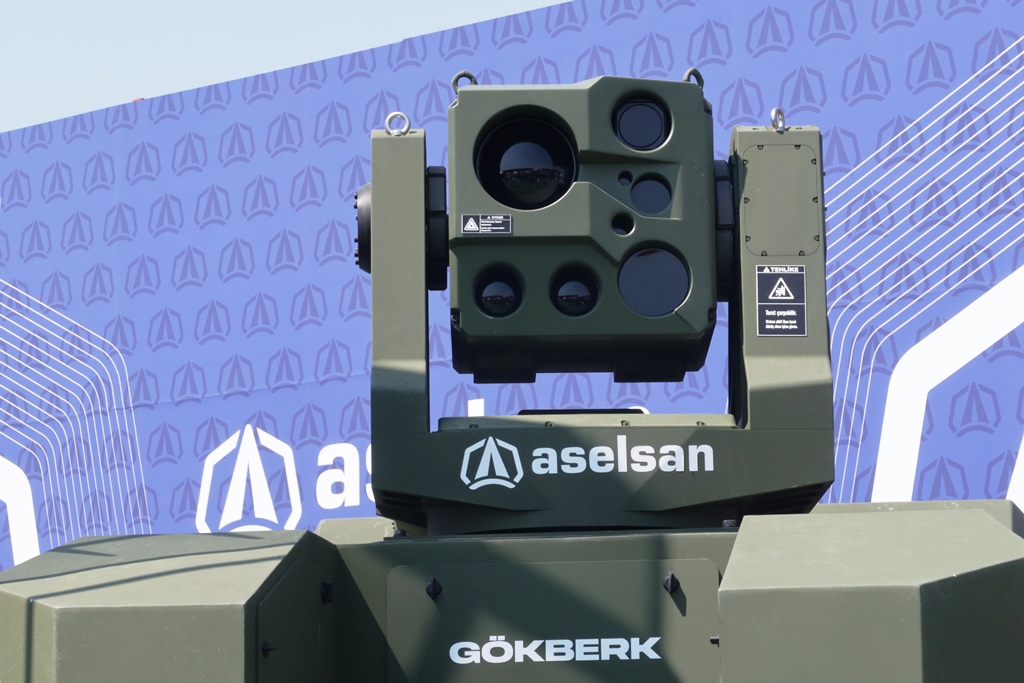
Coming to improved systems, another hard-kill asset seen at Saha was the Gökberk 10 laser weapon system; as indicated by the number the new version output goes up to 10 kW, twice that of the original Gökberk, focusing capability allowing neutralise threats at ranges between 150 and 2,000 metres. Trailer mounted, the platform contains the power system, a key element in laser-based effectors, the pan-tilt head hosting aside the focusing unit a TV camera, a thermal camera, a laser range finder, an illumination laser, and an active tracking camera, the latter ensuring a target tracking accuracy under 10 µrad, accuracy along time being key in delivering the sufficient energy to destroy the target.
Aselsan also presented an improved version of the Ejderha AD 200 high power electromagnetic system unveiled in 2025, the Ejderha AD 210. While the previous system was operated in conjunction with the Ihtar C-UAS system, the new version can operate as a stand-alone system using integrated radar and electro-optic sensors allowing it to detect incoming threats.
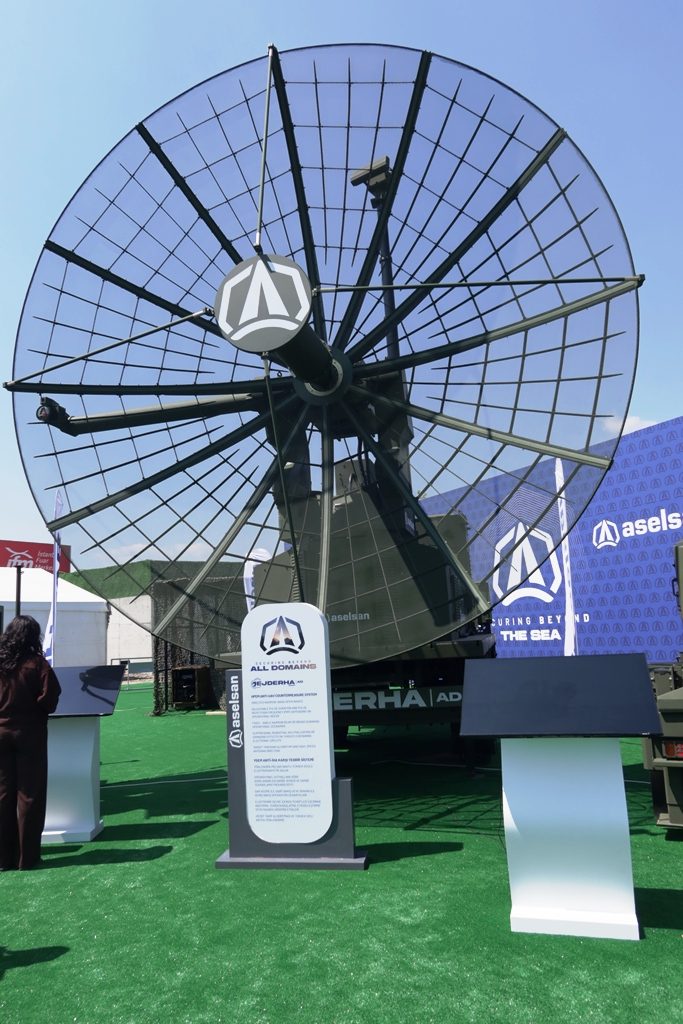
It features a much bigger antenna and is capable to send millions of Volts in milliseconds by sending directed narrowband High-Power Electro Magnetic (HPEM) waves that burn the junctions of transistors in drones’ electronic circuits at one kilometre range, while safety distance from the antenna is only 20 metres. According to Aselsan representatives such a system is the ultimate defence against swarms of drones, information from the Ukrainian front stating that the enemy is sending 100 fibre-optic guided drones at the same time, something that even a laser effector cannot counter considering the reloading time between two engagements.
EDR On-Line understood that lessons learned from the front are bringing Aselsan to widen the operating band of its jammers, as Russian systems operate in the 6.3 GHz band, a frequency forbidden by the International Telecommunications Union.
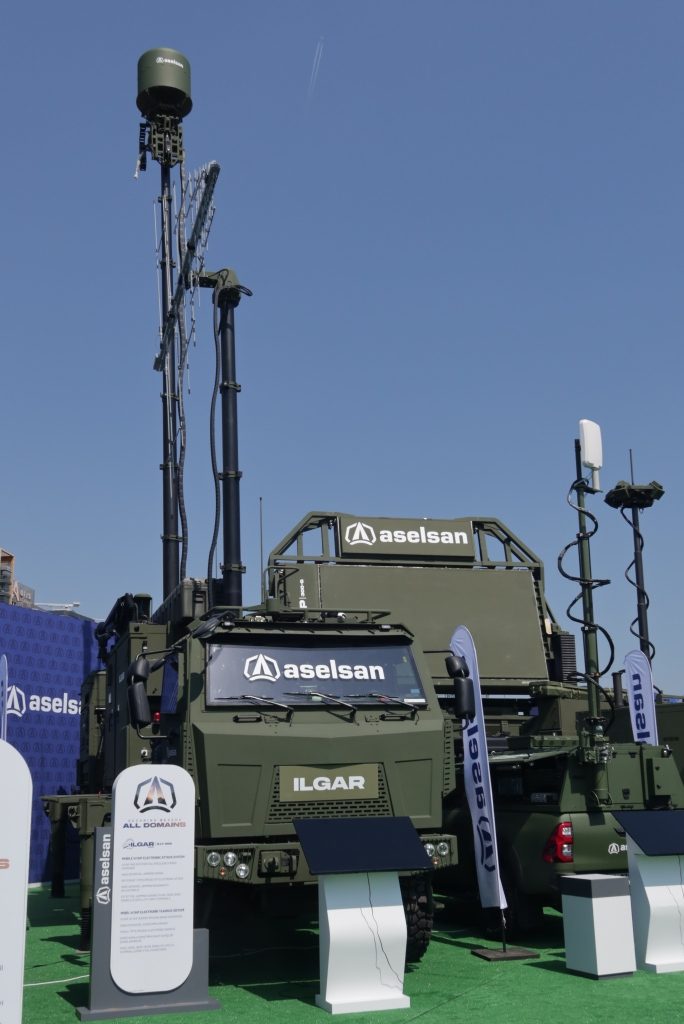
The latest products of the Turkish company are therefore covering frequencies up to 8 GHz. This drove Aselsan to upgrade its Ilgar into a fourth-generation mobile electronic attack system capable to jam all used frequencies in the VHF, UHF and partly in the SHF bands, disrupting, delaying, or deceiving enemy communications, including sophisticated frequency-hopping systems.
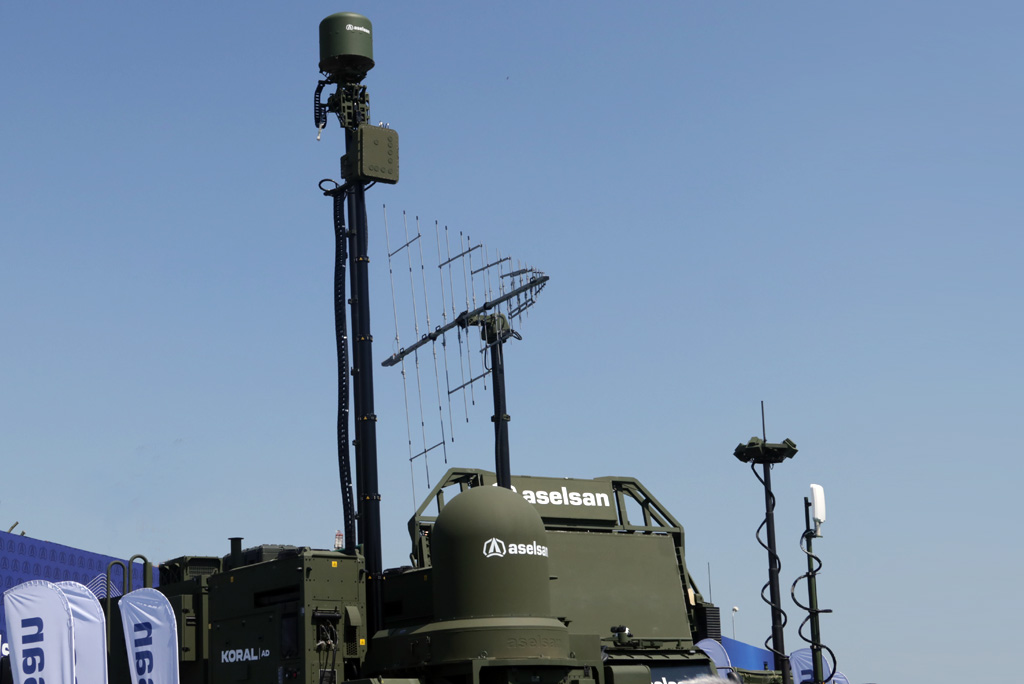
Last but not least comes the Koral AD (Air Defence) mobile radar electronic warfare system. Developed to provide customers looking for an air defence system against incoming aircraft equipped with radars; the idea is to detect and track airborne radars and jam them at hundred kilometres, considering that once his aircraft becomes blind as it loses its radar, most pilots would abort the mission as they will lose the ability to use most of their weaponry. Both the Koral AD and the fourth generation Ilgar are ready for production.
Photos by P. Valpolini