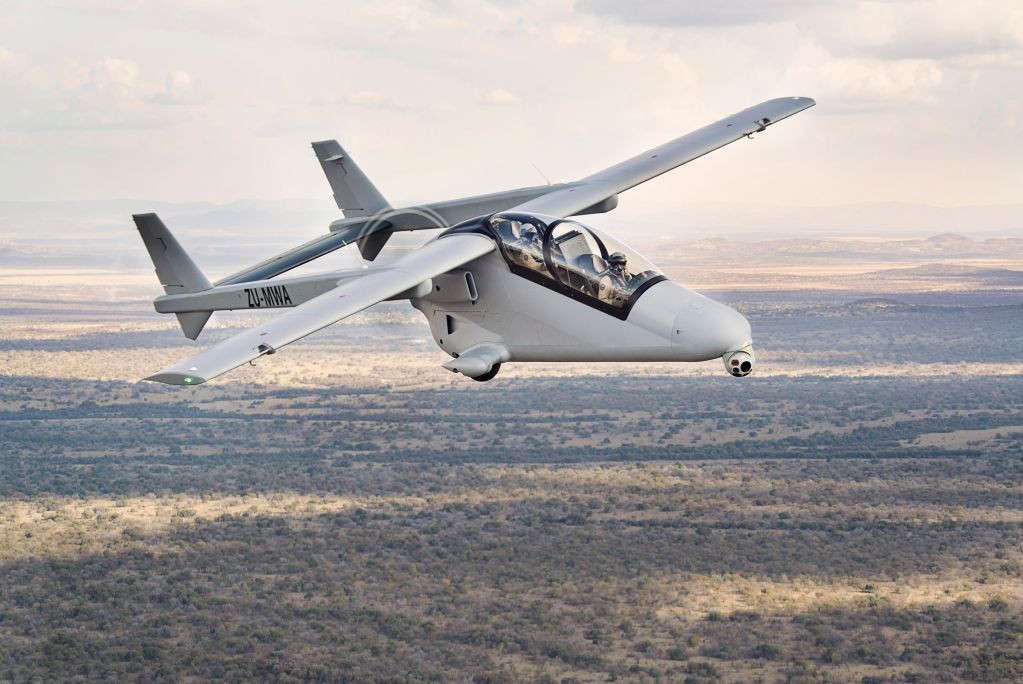
Paramount Mwari counter-drone configuration
Modular airborne counter-UAS configuration offers a scalable response to the growing threat from one-way attack drones
PRETORIA, 16 July 2026. Paramount Aerospace Industries has unveiled a dedicated Mwari Counter-UAS configuration designed to address the rapidly growing threat posed by one-way attack drones to critical national infrastructure, military installations, ports and strategic energy assets.
The configuration builds on Mwari’s multi-mission architecture to combine airborne surveillance, target identification and a range of kinetic effector options within a single, rapidly deployable aircraft platform.
An Airborne Counter-Drone Solution
The Mwari Counter-UAS configuration exploits the aircraft’s flexible mission architecture and dedicated sensor stations to support the detection, identification, tracking and engagement of low-altitude unmanned aerial threats.
An advanced electro-optical targeting system provides the crew with day and night surveillance, target identification and tracking capabilities, while the aircraft’s configurable mission systems architecture allows additional surveillance and detection sensors to be integrated according to customer requirements.
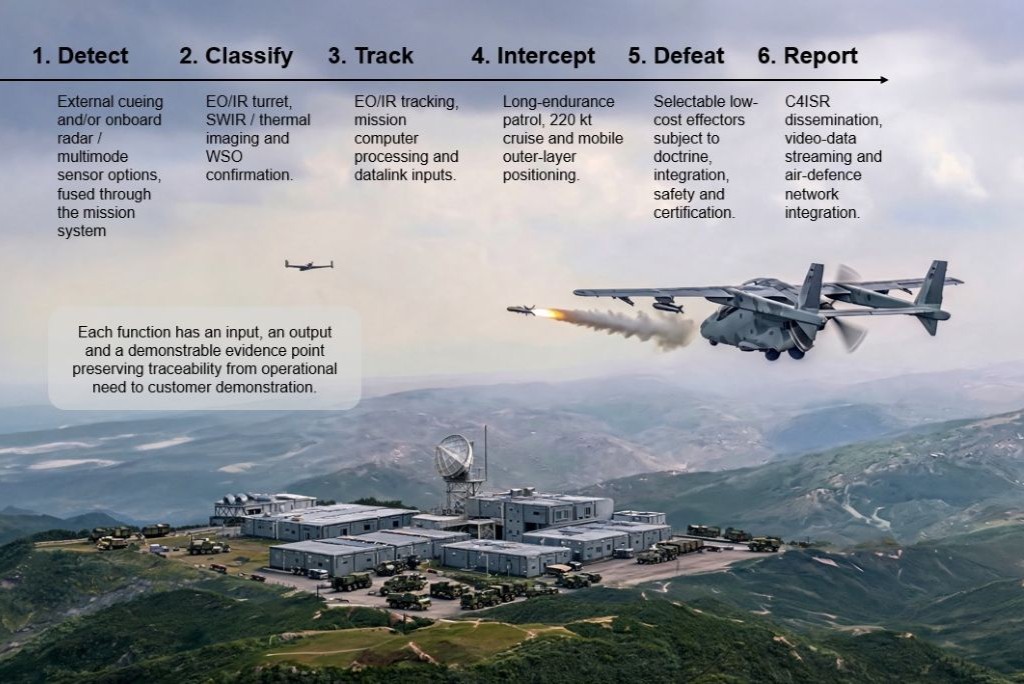
These airborne sensors can support the detection and tracking of slow, low-altitude targets and provide targeting information to the crew. Sensor information is presented to the mission operator to support positive target identification and engagement decisions, retaining the human-in-the-loop throughout the engagement process.
Lee Connolly, CEO of Paramount Aerospace Industries, said:
“The proliferation of low-cost one-way attack drones has created an acute vulnerability for defence forces and infrastructure operators worldwide. These systems are placing enormous pressure on conventional air defence networks while creating a significant cost imbalance for the defender.
“For many nations, the detection problem can be as challenging as the defeat problem. Mwari’s modular architecture allows us to configure the aircraft around the customer’s existing air defence environment and the specific threat they face.”
Addressing the Low-Altitude Detection Challenge
Many of the operators most exposed to one-way attack drones do not possess comprehensive ground-based radar or low-altitude surveillance networks.
For smaller defence forces and operators responsible for protecting discrete high-value assets, establishing an extensive ground-based sensor network can require significant infrastructure, investment and time.
Mwari offers an alternative airborne approach.
Operating independently or as part of a wider air defence network, the aircraft can conduct barrier patrols and airborne surveillance missions ahead of defended areas. Its configurable sensor architecture allows Mwari to contribute to the detection, identification and tracking of potential airborne threats before transitioning to an intercept role.
Where external radar, command-and-control or surveillance networks already exist, Mwari can operate as a networked airborne interceptor, receiving threat information and responding to targets identified by the wider air defence system.
For customers with limited ground-based surveillance infrastructure, additional airborne sensor capabilities can be configured to provide a greater degree of autonomous detection and tracking.
Configurable Effector Options
The Mwari Counter-UAS configuration has been developed around a range of configurable effector options, providing close-range and stand-off engagement capabilities that can be tailored to customer operational requirements and existing weapon inventories.
Potential configurations include gun systems for close-range engagements and guided or precision rocket systems for engagements at greater stand-off distances.
These effectors can be carried in dedicated or combined weapon pods across the aircraft’s external hardpoints, allowing the weapon configuration to be tailored to the mission and threat environment.
Mwari’s open mission architecture supports the integration of multiple compatible weapon and effector solutions from a range of international suppliers. This provides customers with the flexibility to align the aircraft with existing inventories, national procurement policies and preferred industrial partners.
The aircraft’s dedicated mission system stations also allow surveillance and detection equipment to be carried without unnecessarily compromising the external weapon configuration.
A Phased and Scalable Capability
The Mwari Counter-UAS configuration has been structured as a scalable capability that can be adapted to the customer’s existing air defence architecture.
Customers with established ground-based detection and command-and-control networks can deploy Mwari as a networked airborne interception platform, responding to threat vectors generated by existing surveillance systems.
For operators with limited low-altitude surveillance infrastructure, Mwari can be configured with additional airborne detection and surveillance capabilities to provide a greater level of operational autonomy.
The aircraft’s open architecture, Interchangeable Mission System Bay and configurable mission stations allow sensor and mission system configurations to evolve as both the threat and available technology develop.
This modular approach enables sensor and effector combinations to be tailored to different operational environments while providing a pathway for future upgrades as counter-UAS technologies and threats continue to evolve.
photo courtesy Paramount