
MSPO 2026 – Gravity takes centre stage, CAE brings the future battlespace to Kielce
CAE is presenting its Gravity solution at MSPO 2026 in Kielce, placing data-driven, multi-domain synthetic training at the centre of its engagement with Polish and international defence stakeholders. The exhibit reflects a growing requirement for armed forces to prepare personnel and validate concepts across increasingly complex air, land, maritime, space and cyber environments, while reducing the cost, time and operational burden associated with live training
Note for publication: the publicly available CAE material reviewed for this article does not provide a standalone official technical datasheet identifying “Gravity” as a discrete product. The text below therefore positions Gravity within CAE’s publicly documented high-fidelity, physics-based modelling, synthetic-environment and Live-Virtual-Constructive capabilities, rather than attributing unverified specifications to the system.
A mission-level training approach
Gravity is positioned as a digital training and mission-preparation capability designed to move beyond isolated platform simulation. Its relevance lies in the ability to represent the operational system as a whole: platforms, sensors, weapons, communications, environmental effects, command-and-control processes, supporting assets and adversary activity can be assessed within a common scenario framework.
This approach is particularly significant for forces confronting contested and congested battlespaces. Modern operations are shaped not only by aircraft, vehicles or ships, but by the interaction of ISR assets, electronic warfare, air-defence networks, uncrewed systems, cyber effects, logistics and human decision-making. A useful simulation environment must therefore support the study of dependencies between domains, rather than simply replicating the handling characteristics or procedures of a single asset.
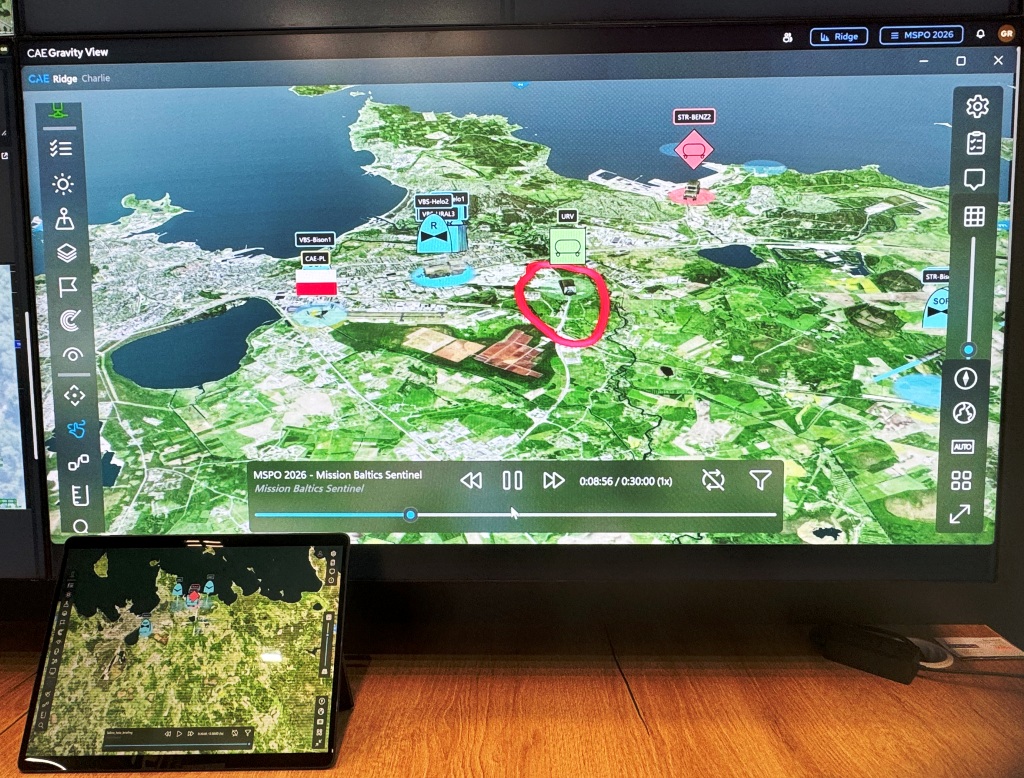
CAE’s broader modelling-and-simulation capability is built around high-fidelity, physics-based models and focuses on the total mission. Its Live-Virtual-Constructive environment is intended to combine air, land, maritime, space and cyber elements in collaborative exercises, enabling users to examine tactics, mission strategies and operational outcomes across a large number of complex scenarios.
Technical foundations
At the technical level, a capability such as Gravity is relevant because it can draw upon several core elements of modern synthetic training architecture:
- Physics-based modelling to represent the behaviour of platforms and mission entities within geophysical space, including the influence of real-world dynamics, terrain and atmospheric conditions.
- Multi-domain integration connecting live participants, virtual simulators and computer-generated constructive forces within a single training or experimentation event. This enables, for example, an aircrew simulator, a virtual command post and constructive red-force systems to interact in a common operational picture.
- Scalability for exercises involving a very large number of entities. CAE states that its IDEAtion Center simulation environment has computational capacity for well over 10,000 entities, supporting the representation of complex force structures rather than a limited set of platforms.
- Variable model fidelity, allowing users to employ detailed models where training value or technical analysis requires them, while using lower-fidelity representations for wider force elements. This is essential for balancing computational load, scenario scope and analytical relevance.
- Measures of Effectiveness and Measures of Performance, which allow scenarios to generate structured evidence for planning, concept development, training assessment and decision-making. CAE notes that its modelling environment can evaluate hundreds of configurations and platform combinations using such measures.
- Open and interoperable interfaces, a crucial consideration for sovereign defence users wishing to integrate national systems, legacy simulators, operational databases and third-party models. CAE’s synthetic-environment portfolio is designed around open interfaces intended to provide flexibility, scalability and interoperability.
- Multi-level security support, allowing the environment to be adapted to exercises and analysis conducted at different classification levels. CAE identifies this as a feature of its advanced modelling-and-simulation environment.
From training to experimentation
The importance of Gravity at MSPO extends beyond classroom instruction or pilot proficiency. Such systems can support the entire readiness cycle, from individual and crew training through collective exercises, mission rehearsal, force-development studies and concept experimentation.
For Poland and other NATO nations, the ability to test operational options in a synthetic environment is increasingly valuable. The proliferation of long-range fires, integrated air-defence systems, electronic attack, autonomous platforms and distributed command networks makes purely live training difficult to conduct at sufficient scale and frequency. Synthetic training can introduce threats, effects and force densities that would be impractical, expensive or unsafe to reproduce in the real world.
An illustrative application would be a joint counter-uncrewed-aircraft scenario. Operators could combine virtual air-defence sensors, electronic-warfare assets, ground manoeuvre forces and allied command nodes with constructive adversary drone swarms. The scenario could then be varied repeatedly to assess detection timelines, sensor coverage, communications resilience, rules of engagement and the effectiveness of kinetic and non-kinetic responses. The result is not simply a training event, but a controlled means of refining tactics and identifying capability gaps.
CAE’s stated objective for its synthetic environments is to provide secure, comprehensive and correlated virtual environments for missions spanning air, maritime, land, cyber, space, public-safety and security domains. The company describes the portfolio as ranging from individual, VR-enabled learning devices to high-fidelity full-mission simulators and distributed multi-domain operations.
Relevance for MSPO
Displaying Gravity at MSPO places CAE’s offering in a market where national resilience, NATO interoperability and rapid force generation are prominent priorities. The exhibition provides an opportunity to discuss how a common synthetic environment could connect national and allied training assets, support increasingly sophisticated unmanned and autonomous systems, and enable more frequent collective training without placing equivalent demands on platforms, fuel, airspace or training areas.
CAE’s presence is also consistent with its wider focus on multi-domain military training and simulation. The company’s MSPO profile highlights capabilities spanning air, land, sea, space and cyberspace, while CAE’s international portfolio includes immersive training technologies, full-mission simulation, constructive systems and integrated Live-Virtual-Constructive training environments.
In this context, Gravity should be viewed as part of a wider shift from platform-centric simulation towards mission-centric digital readiness. The value proposition is not confined to recreating a cockpit, a vehicle cabin or a command post. It is the ability to bring those elements together with sensors, effects, terrain, threats and decision cycles in a coherent operational ecosystem—giving commanders, crews and planners a more repeatable, scalable and evidence-based route to readiness.
By J. Roukoz