Singapore Airshow 2026 – V7, Red Cat’s strike boat for the new maritime battlefield
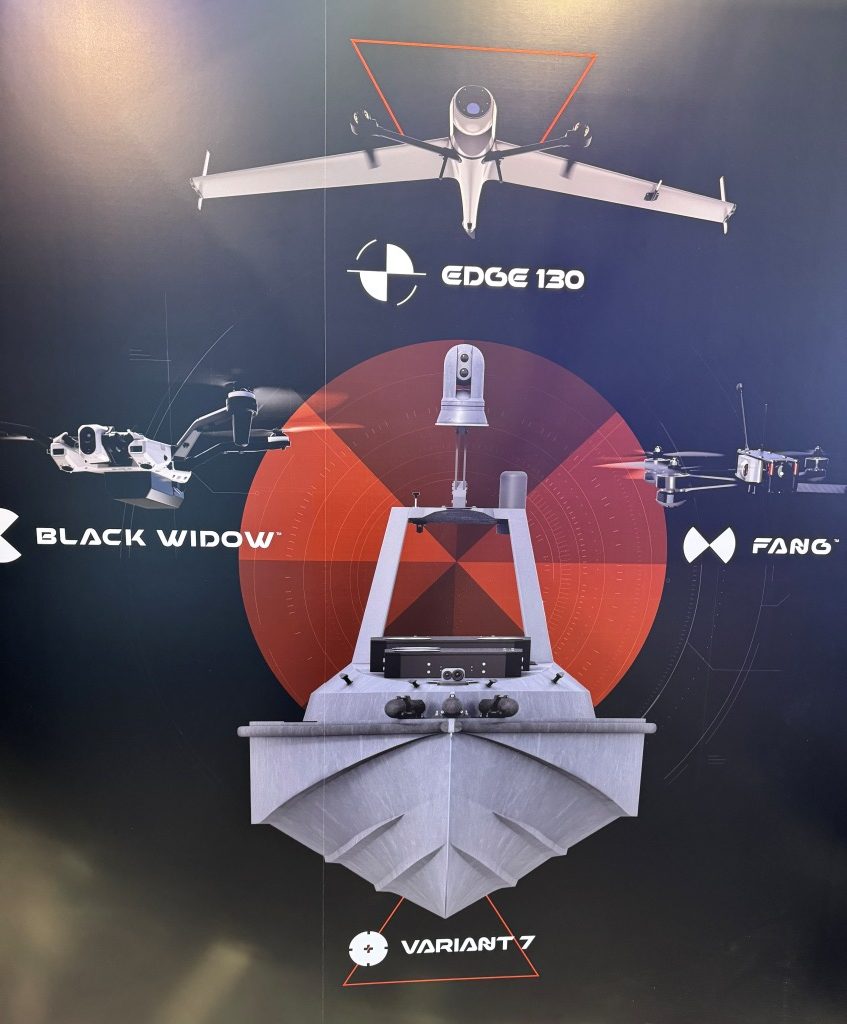
Shown as a poster on Red Cat’s booth at Singapore Airshow, the V7 represents a new generation of unmanned surface vessels designed for long‑range kinetic operations, building on strong institutional knowledge of how uncrewed systems are being deployed in Europe and other high-threat environments. The V7 is being manufactured by Blue Ops, a division that Red Cat launched in 2025 to expand into uncrewed surface vessels. The division is led by third- generation, America boat builders, Barry Hinckley and his family
The V7 is presented as a 7‑metre Expeditionary Multi‑Role Craft intended for deep‑strike missions, anti‑ship warfare, and coastal interdiction in highly contested areas. Designed to operate autonomously or in manned‑unmanned teaming (MUM‑T) configurations, it is integrated into a multi‑domain architecture combining aerial drones, ISR sensors and distributed strike assets. Red Cat highlights a platform shaped by firsthand exposure to maritime autonomy challenges.
The V7 incorporates lessons learned from global maritime security contexts. The goal is to offer US and allied navies a consumable, hard‑to‑detect, surface vector capable of saturating enemy defences through speed and mass, while remaining interoperable with existing ISR and C2 systems.
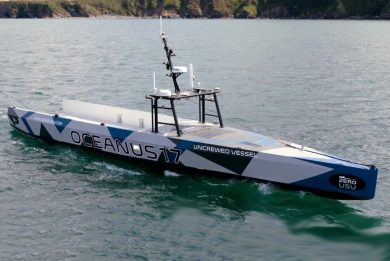
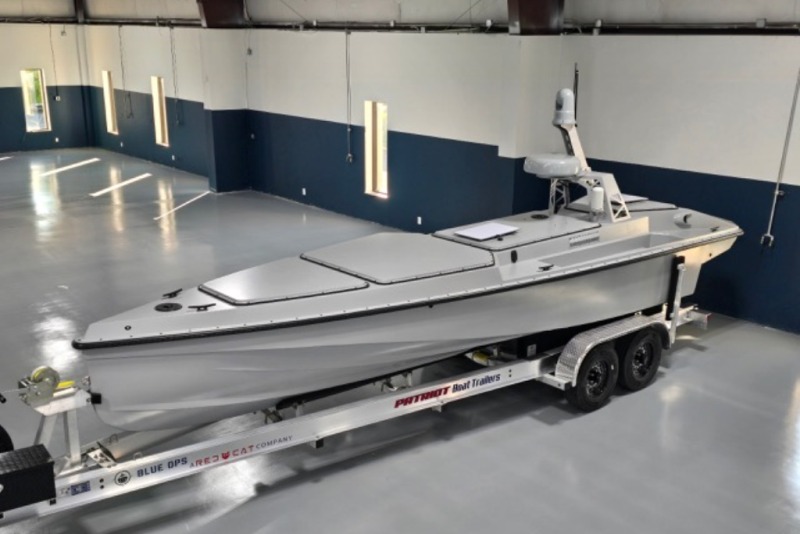
The V7 measures 7.8 metres overall, with a hull optimised for high speed and seaworthiness in degraded littoral environments. Although Red Cat focuses its communication on operational effects rather than figures, the “high‑speed, long‑range, kinetic maritime operations” positioning implies a design oriented towards high top speed, extended range, and a payload capacity superior to that of more compact 5‑metre derivatives.
The hull is engineered to carry explosive charges, missiles, tactical weapons, or heavy sensors while maintaining a low signature and very high manoeuvrability, which is essential in the terminal phase of an attack against manoeuvring surface vessels. Increased endurance enables deep‑strike mission profiles at long range, with indirect routes and offset approaches to saturate the enemy’s situational awareness and exploit axes not covered by traditional surveillance assets.
At the heart of the V7, Red Cat promotes a proprietary, semi‑autonomous command‑and‑control architecture designed to manage swarm operations and multi‑platform scenarios. The system can operate fully autonomously on pre‑programmed mission plans, while offering human‑in‑the‑loop supervision for the validation of kinetic engagements, in line with US doctrinal frameworks.
The USV is conceived as a node within a wider unmanned network: it is designed to receive data from ISR UAVs, share its own tactical picture, and cooperate with other V7s or other platforms for coordinated attacks. This “family of systems” logic builds on Red Cat’s experience in aerial drones and seeks convergence in C2 protocols, data links and mission‑planning tools.
Although Red Cat has not yet published a complete sensor fit, official descriptions emphasise the integration of “best‑of‑breed sensors, communications, and payloads” to meet ISR, force‑protection and strike needs. This suggests a suite combining stabilised electro‑optical/infrared sensors, laser rangefinders, inertial and GNSS navigation, and secure communications tailored to long‑range operations in contested electromagnetic environments.
In terms of effects, public sources mention five main roles for the 7‑metre variant: kinetic charges (high‑explosive or penetrator warheads), short‑range surface‑to‑air missiles, autonomous precision weapons systems, launch of aerial drones, dedicated ISR and automatic weapons such as machine guns. This spectrum points to a modular platform with rails or reconfigurable mission modules, able to transition from “kamikaze” naval drone to unmanned patrol craft or remote firing platform for missiles and loitering munitions.
On the industrial side, Red Cat is in the production phase of the V7 in the United States. Blue Ops has modernized an over 14,000 m2 manufacturing facility in Valdosta, Georgia, establishing a major new production hub to support and scale full-rate manufacturing of its USVs. The V7 becomes the lead variant of the USV series, alongside 5‑metre and 11‑metre versions, and forms the core of the company’s maritime offering for US Navy and allied‑navy requirements.
This marks a shift for Red Cat from a specialist in aerial drones to a multi‑domain provider capable of delivering integrated air‑sea‑land solutions with swarm and coordinated‑operations capabilities. In a context of renewed US strategic focus on naval competition, particularly in the Indo‑Pacific, the V7 is explicitly framed as a scalable, exportable, “made in USA” solution to restore a form of maritime overmatch through massed unmanned systems and the saturation of enemy defences.
Photos courtesy V7 and J. Roukoz