WDS 2026 – MKE showcases Tolga, a new layer of smart short-range air defence
The Tolga system from MKE is a short‑range air defence (SHORAD) solution designed as an integrated counter‑drone and close‑in protection system against low, slow and small aerial threats, as well as certain guided munitions and cruise missiles. The Tolga system is being showcased on the company stand at the World Defense Show in Riyadh, underlining its growing international visibility and export potential. It is intended to provide an organic protective bubble against mini and micro UAVs, tactical drones, loitering munitions, smart munitions and low‑flying cruise missiles
Tolga is conceived as a “system of systems” to protect manoeuvring land forces, convoys, forward operating bases, critical infrastructures and naval platforms. It sits in the very short‑range layer of a networked air defence architecture, providing the last protective ring around high‑value assets.
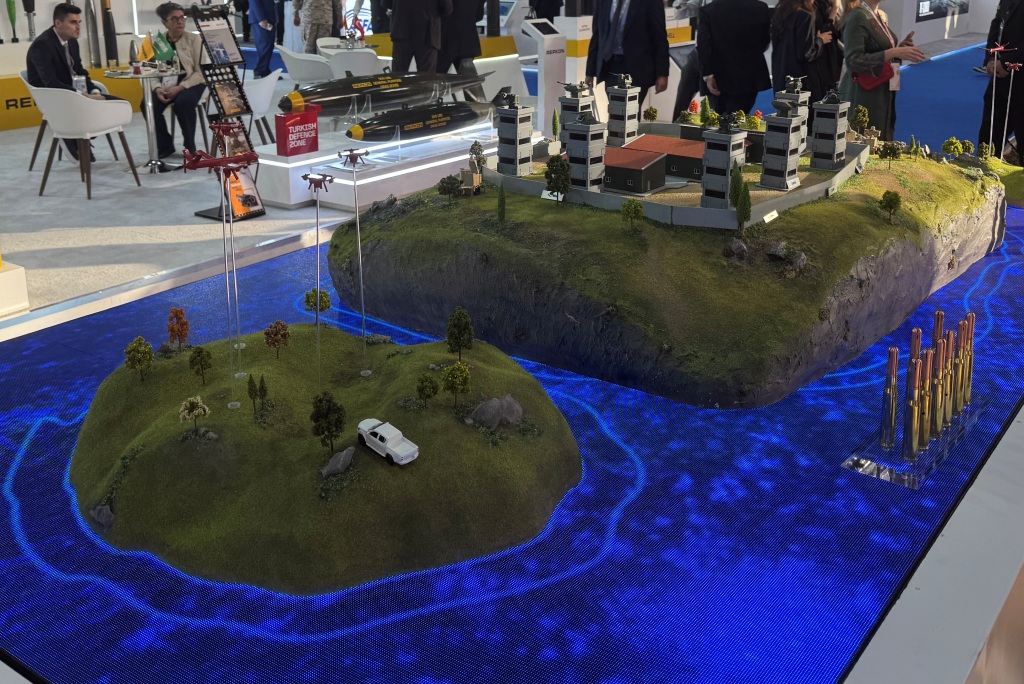
The architecture combines detection (radar and electro‑optics), electronic warfare, high‑rate‑of‑fire guns of several calibres and a dedicated command‑and‑control core into a single coherent package. This integration enables very rapid switching from soft‑kill electronic neutralisation to hard‑kill kinetic destruction, depending on the threat profile, airspace saturation and rules of engagement.
The system relies on a mobile search and tracking radar station, coupled with electro‑optical and infrared sensors for visual identification and precision tracking. Together, they provide the ability to detect and track aerial targets out to around 10 km, giving sufficient time to set up a jamming sequence or a layered kinetic interception.
Radar and EO/IR data are fused in the command‑and‑control unit, which applies identification, classification and threat‑prioritisation logic based on distance, speed, altitude and trajectory relative to defended assets. This multi‑sensor fusion is essential to cope with low‑signature, evolving targets such as modified commercial drones or small FPV platforms.
On the soft‑kill side, Tolga employs an electronic warfare suite to disrupt drones’ command, telemetry and navigation links. Once a target is detected by the radar – typically around 3 km during trials – the system can initiate an electronic attack that severs radio control links or degrades satellite navigation signals, neutralising the platform without physically destroying it.
This approach delivers a more cost‑effective defence against mass drone attacks, avoiding the need to expend expensive kinetic munitions on each low‑cost threat. It is particularly suited against commercial or improvised drones heavily reliant on vulnerable radio links, but less effective against fibre‑optic‑guided or highly autonomous systems, for which hard‑kill becomes necessary.
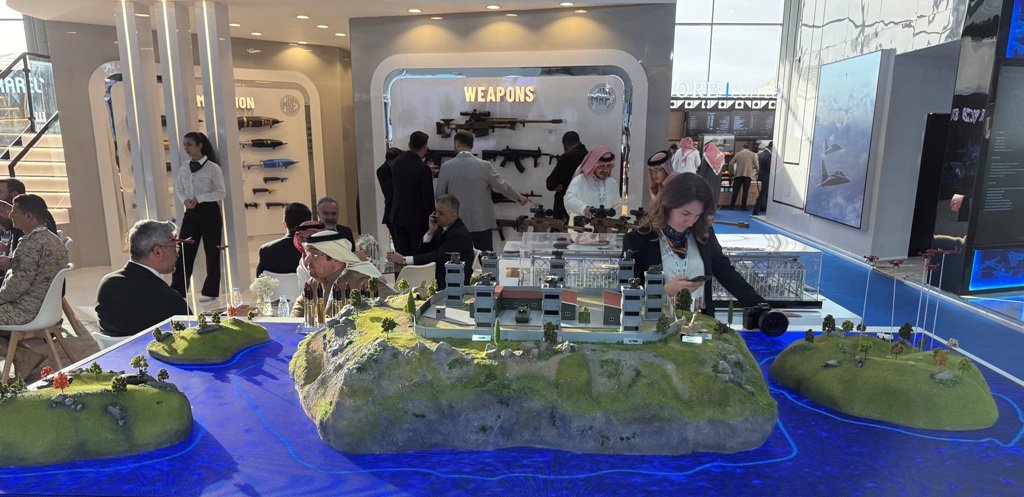
The 35 mm calibre forms the outer ring, with an effective range of about 3,000 metres against drones and other aerial threats, using programmable air‑burst ammunition that detonates at a set distance to generate a dense cloud of fragments around the target. The 20 mm calibre covers the intermediate layer, out to roughly 1,000 metres, firing fragmentation rounds that create a lethal fragment cone suited to closer or manoeuvring targets. At the innermost layer, 12.7 mm weapons – combining single-barrel guns and Gatling-type gun on the platform – deal with very short‑range threats around 300 metres, such as diving FPV drones and mini‑UAVs that have penetrated the outer layers.
Across all calibres, MKE’s anti‑drone ammunition is designed to explode at the optimal time and distance, creating a high‑density cloud of metallic particles around the target and reducing the need for a direct hit. This “cloud of fragments” principle significantly increases the probability of kill against small radar‑cross‑section, evasive targets, particularly low‑flying FPV drones.
When soft‑kill proves impossible or insufficient, Tolga transitions to hard‑kill engagement using a range of guns in different calibres, all developed by MKE and supported by a dedicated family of anti‑drone ammunition. The weapon architecture provides three overlapping engagement layers, optimised for targets of varying size and profile.
At the heart of Tolga is a dedicated command‑and‑control unit that centralises all sensor data and orchestrates engagement sequences. It manages detection, tracking, identification friend or foe, threat prioritisation, selection of soft‑kill or hard‑kill modes and fire control, while presenting an operator interface for supervision and validation of critical decisions.
Tolga can operate in manual, semi‑autonomous or fully autonomous modes, allowing commanders to tailor the degree of automation to the tactical context, airspace density and rules of engagement. In a highly saturated drone environment, semi‑autonomous and autonomous modes shorten reaction times, while still permitting human intervention for specific targets or ambiguous situations.
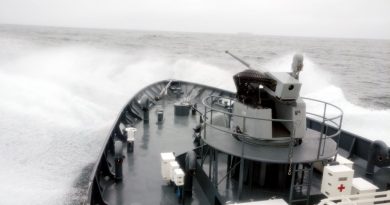
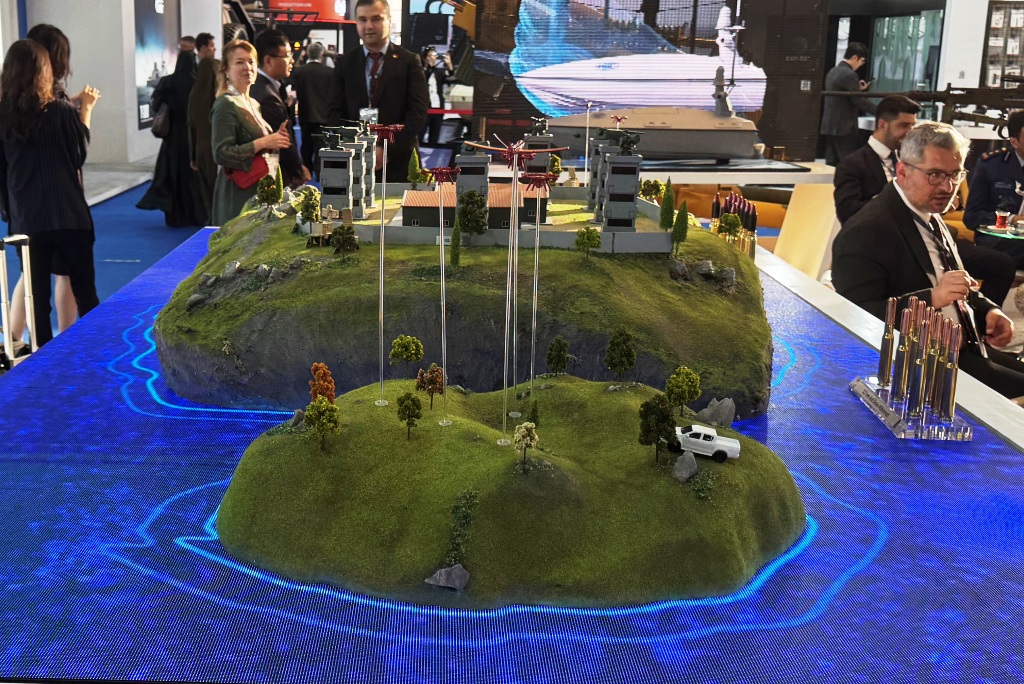
From an integration standpoint, Tolga is designed for modular installation on a wide range of platforms: wheeled or tracked vehicles, unarmoured logistics platforms, fixed infrastructure such as towers protecting critical sites, and naval vessels. This modularity enables the same core technology to be deployed in configurations tailored to the protection of bases, ports, airports, energy facilities or manoeuvring tactical formations.
The system can be interfaced with higher‑tier air defence layers within a wider networked architecture, receiving cueing from strategic or operational‑level sensors and contributing to the envisaged “steel dome” concept. In practice, multiple Tolga units can be deployed in a network around a sensitive site, their detection and engagement bubbles overlapping to create a continuous screen against very short‑range threats.
During its first live fire trials, Tolga engaged eight different threat scenarios, including fixed‑wing drones, FPV drones and targets emulating varied attack profiles, and achieved a 100% success rate. The trials demonstrated the system’s ability to conduct seamless soft‑kill and hard‑kill engagements, neutralising a drone by jamming at around 3 km and then destroying multiple targets using the different short‑range weapon layers.
Observed by representatives of the Turkish Armed Forces and other security organisations, this test campaign validated the functional maturity of the system and paved the way for serial production and initial export successes, including to Qatar and Egypt. In a battlespace increasingly saturated with drones, MKE’s Tolga is emerging as an indigenous Turkish solution that combines extended detection, electronic warfare and multi‑layer firepower to deliver effective close range air defence.
Photos by J. Roukoz