WDS 2026 – NORINCO unveils FL50 swarm-capable loitering munition in Riyadh
The FL50 is a new generation teleoperated strike system, showcased for the first time at the World Defense Show in Riyadh and developed by Chinese defence giant Norinco. Designed to be installed on an armoured carrier vehicle, the multi-canister launcher hosts a mid-class loitering munition, and embodies the convergence of artillery, tactical drones and smart munitions in a modular, export‑oriented package
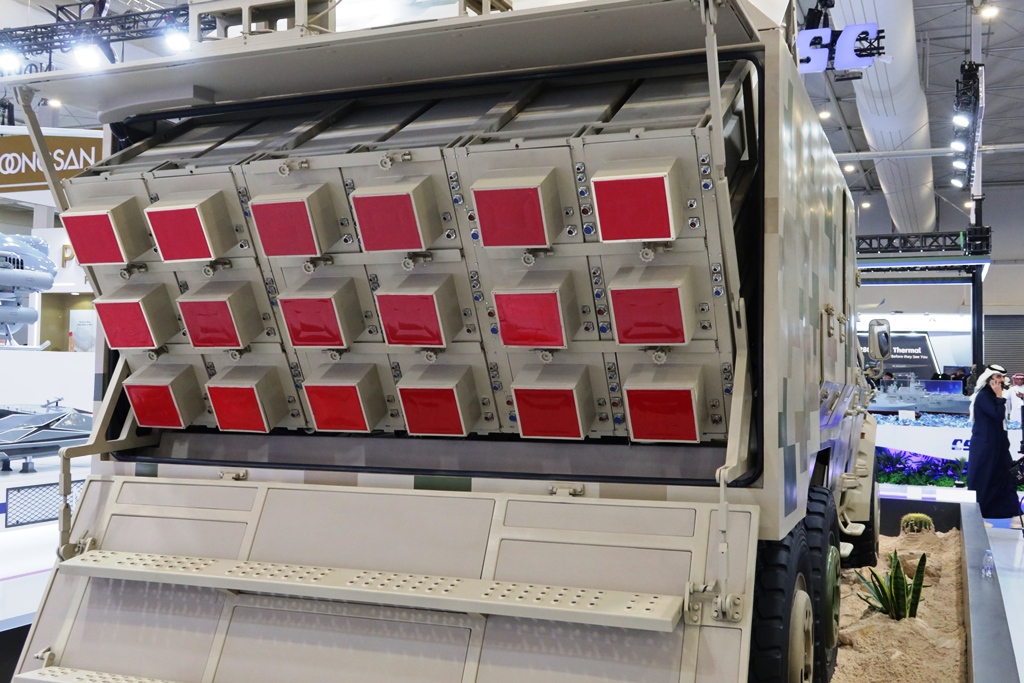
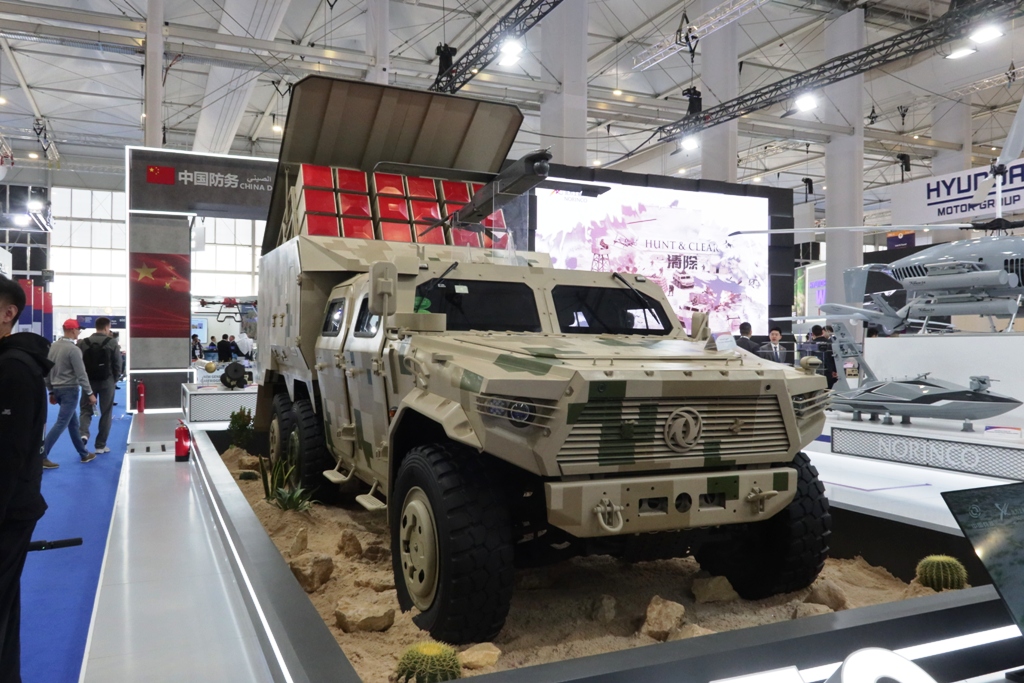
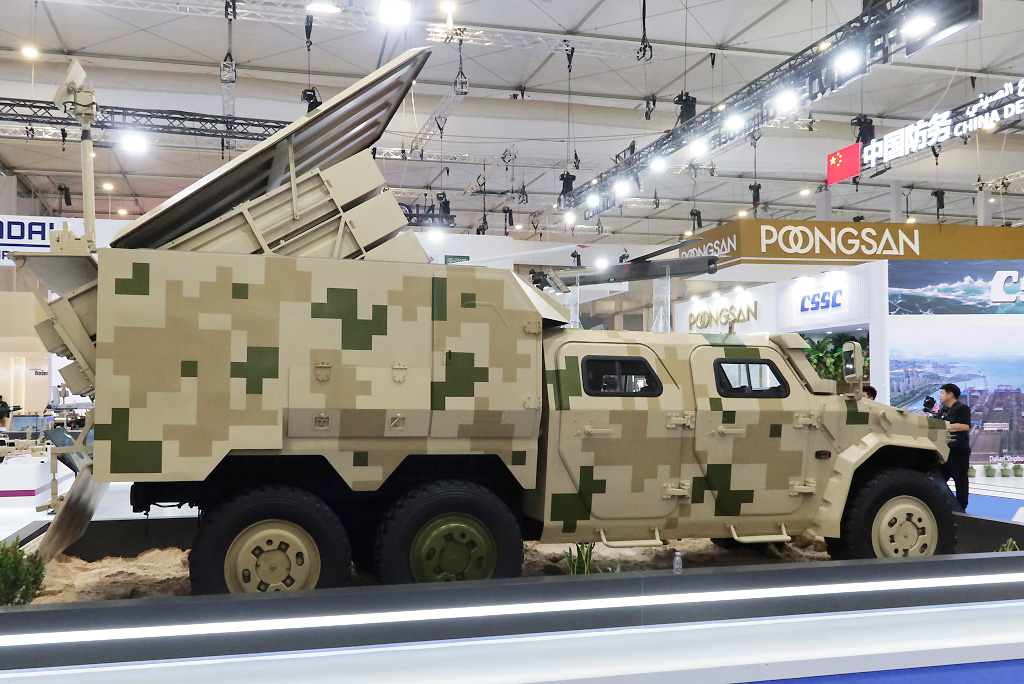
At WDS the FL50 was integrated on an 6×4 armoured platform that ensured good cross‑country mobility, crew protection and strategic deployability by road, rail, or air transport. The front armoured cabin hosts the crew and the fire-control consoles; four side doors allow personnel to ingress and egress from the vehicle, the crew being apparently made of four personnel, although no details were provided. Behind the cabin a central compartment houses power supply, data link cooling and mission computers. Finally, at the rear, we find the18-canister launcher; canisters have a square section and each one hosts a loitering munition, the launcher being reloaded from the back. Before launch the rear cover is opened, the lower part showing steps that should allow personnel to work on canisters when the system must be loaded, while at launch they let the launcher to be elevated to an angle of around 30°.
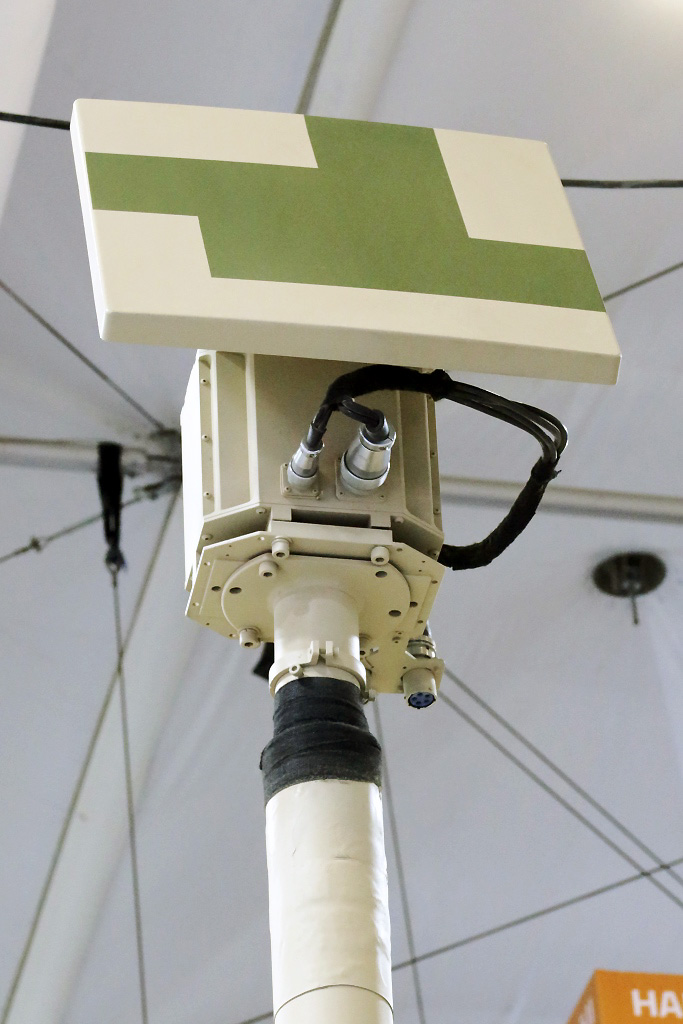
On the rear top of the launcher, we find a mast which is lowered during the movement; when the system stops for conducting a firing mission the mast rotates counterclockwise and is raised in vertical position. A flat antenna was visible, which might be that of a data link, which ensures two-way communications between the loitering munitions and the ground control station, providing situational awareness in the target area, possible retargeting, and fine-tune direction in the final attack phase, to obtain the under 1 metre CEP claimed by the company when the final phase is image-guided. Images visible on a video showed however a completely different antenna layout at the top of the mast.
Each FL50A loitering munition has a mass at launch of 37 kg and carries a 5.5 kg warhead. Considering the canister, the mass of a single munition should be around 50-60 kg, which makes a total payload mass of some 900-1,100 kg. A close look at the rear of the vehicle shows that the six by three layout of the launcher is loaded with single canisters, therefore launchers with a different number of canisters may be developed to adapt the system to even lighter platforms with a lower payload, as we must also consider the mass of the launcher structure and ancillaries. The cloud of dust visible at the rear of the vehicle during launch operations shown on a video suggest the use of a cold‑launch principle, which ejects the munition from the canister, reducing the launch signature, albeit the FL50 is designed to operate at distance from the frontline.
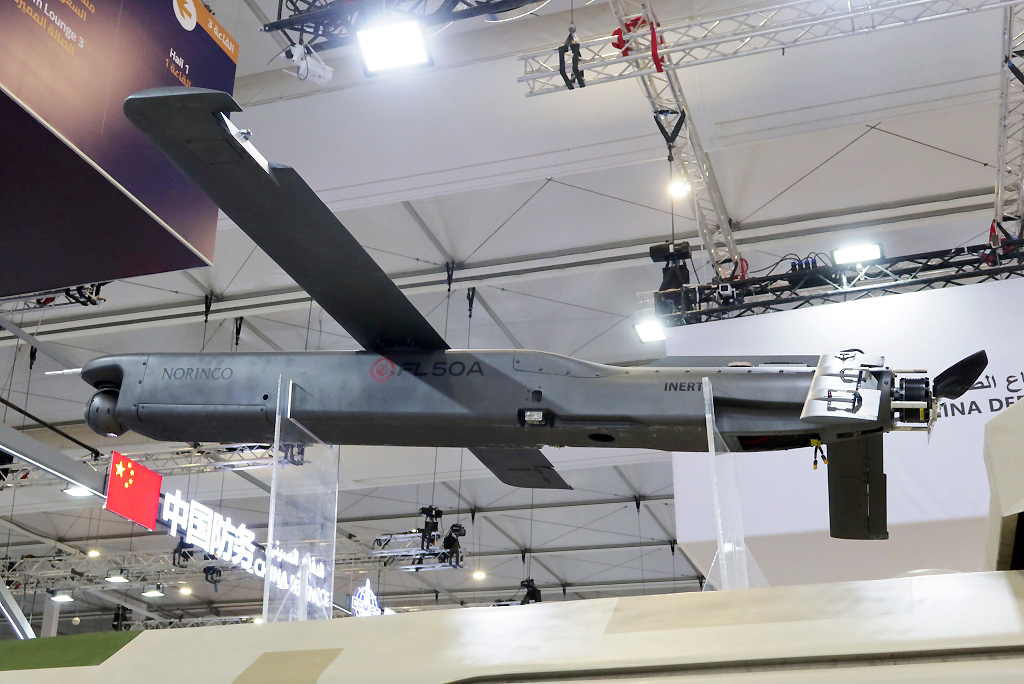
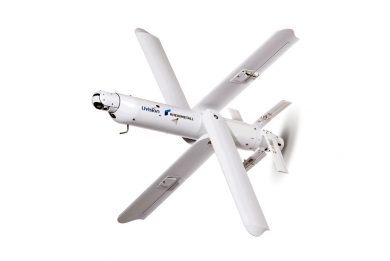
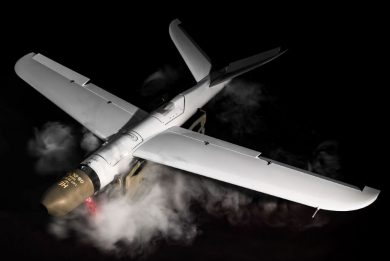
The FL50A airframe munition has the typical architecture of canister-launched unmanned systems. A square-section fuselage carries the optronic gimbal at the front, probably hosting a day and a thermal channel, lift being provided by a straight high wing which is folded when the munition is inside the launch canister, the two elements of the inverted-V tail plane rotating forward, the two blades of the propeller being also folded. No details were provided on the propulsion system, which activates the two-blade pushing propeller, NORINCO declaring a 1.5 hours endurance and an over 100 km range. The FL50A is an antitank loitering munition, therefore its warhead is purposely designed and is based on a tandem shaped charge, a fragmentation sleeve providing however some multirole capacity against light armoured targets and personnel in the opening. Available literature also says that different payloads can be adopted to better cope with other types of targets.
The FL50’s C2 architecture is designed to operate either autonomously or as part of a wider sensor network (counter‑battery radars, ISR drones, forward observers) via secure data links and possible integration into higher‑level command systems. This approach enables near real‑time “sensor‑to‑shooter” chains, significantly shortening the decision loop between detection and engagement. Mission profiles (routes, loitering areas, rules of engagement) are managed through onboard software and pre‑programmed flight plans. The 130-180 km/h cruise speed and the 1.5 hours endurance allow sufficient time for loitering over the target area; one munition can be used for ISR purposes, several other munitions following once targets have been confirmed, or intelligence on available targets can be provided by other sensors. The launcher is capable of near‑simultaneous salvos, allowing saturation of defended areas, engagement of multiple point targets or maintenance of continuous aerial presence by rotating munitions over the battlefield, which allows keeping constant pressure on the adversary.
The FL50 fits into a concept of operations where the launcher vehicle takes up position in the second echelon, shielded by terrain, while the loitering munitions penetrate deep into the enemy system. This physical separation between carrier and effector reduces crew vulnerability and improves overall system survivability against direct fire and counter‑battery threats.
Within a combined‑arms framework, the FL50 acts as a force multiplier for artillery and mechanised units, delivering precision strike capability where conventional shells or unguided rockets lack accuracy or flexibility. The combination of an armoured carrier, a multi‑tube launcher and intermediate‑size loitering munitions positions the system at the core of modern doctrines for stand‑off attack, area denial and controlled saturation of the tactical battlespace.
Photos by P. Valpolini