
SITEP ITALIA and SMA-RTY at OPEX TASK 2-25: private 5G network technology for the defence of the future
March, 09, 2026 – SITEP ITALIA and SMA-RTY successfully participated in Italian Navy’s OPEX TASK 2-25 operational experimentation campaign, conducted in October 2025 in the Gulf of Taranto, demonstrating the capabilities of private 5G networks in real operational scenarios.
OPEX (OPerational EXperimentations) are initiatives promoted by the Italian Navy to validate new technological developments in realistic multi-domain scenarios: a strategic pathway to test the operational effectiveness, resilience and interoperability of new systems and products under real operational conditions.
Following the OPEX TASK 1-25, held in La Spezia, which tested the management of various unmanned vehicles, ISR capabilities, and C-UAVs systems, OPEX TASK 2-25 aimed at enhancing cooperation between different naval platforms.
The event, which involved several Italian Navy vessels, represented a unique opportunity to field-validate private 5G technology – entirely Made in Italy – demonstrating superior performance compared to traditional solutions in terms of energy efficiency, compactness and operational effectiveness in dynamic environments.
Tactical 5G: Performance in a Compact Format
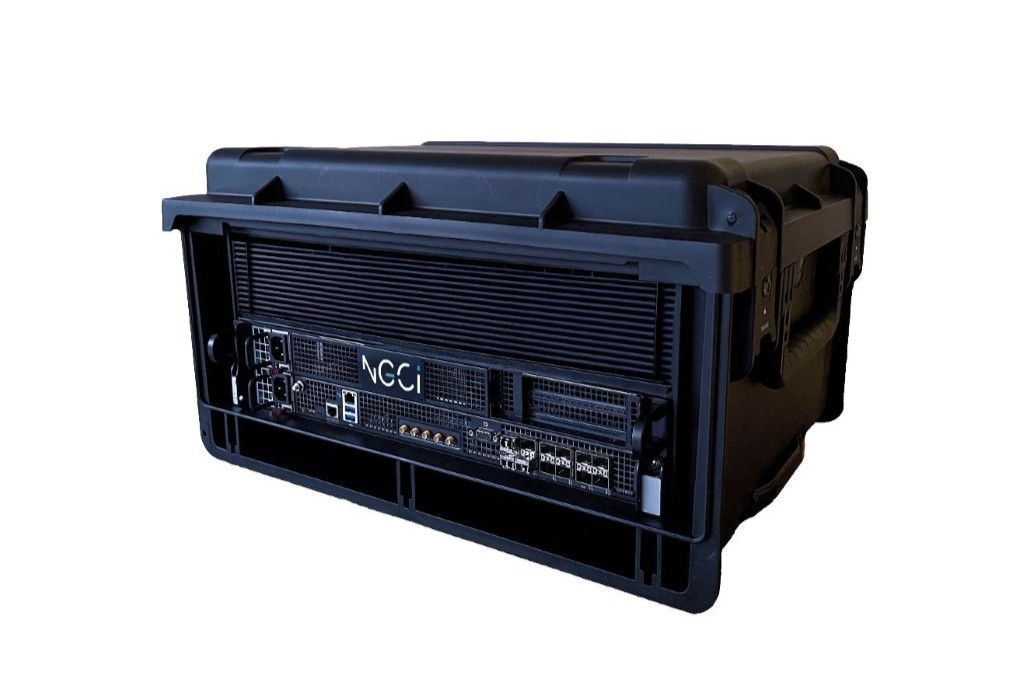
The private 5G solution deployed during OPEX TASK 2-25 stands out for its advanced technical features: a compact and easily transportable system within a flight case, incorporating a technological core capable of deploying a fully autonomous 5G network within seconds, with a power consumption of just 200W.
These figures represent a significant competitive advantage over traditional enterprise solutions which typically requires 15U racks and consume up to 10 kW. In tactical environments and resource-constrained deployments, this difference translates into greater operational flexibility and sustainability.
Five operational scenarios were implemented during the exercise, demonstrating the versatility of the technology:
Intra-Ship Communications: real-time sharing of video streams from cameras distributed on board, ensuring full situational awareness for embarked personnel.
Ship-to-Ship Communications: bidirectional transmission of four simultaneous high-resolution video streams between naval units, maintaining consistent quality and reliability even in dynamic operational conditions.
Remote Telemetry: connection between the control centre on one vessel and an advanced anti-drone jamming system on another, demonstrating remote control capabilities for Electronic Warfare applications. In this scenario, the proposed 5G system enables the collection, processing, and decision-support of information gathered from sensors distributed across multiple units. In this scenario, the telecommunications infrastructure provides connectivity to devices but can also function as an information source itself (profiling connected users, locating assets, protection against cyber-attack, etc.), supporting operational decision-making.
Server-less Videoconferencing: live audio-video communication between two naval units without centralised infrastructure ensuring operational capability even in degraded scenarios and maximum privacy.
Performance Testing: validation of network performance at increasing distances with excellent results: 196 Mbps at distances of several kilometres, using limited bandwidth resources and lightweight passive antennas.
These offshore performances are particularly significant: they demonstrate that the solution proposed by SITEP ITALIA and SMA-RTY can guarantee high-capacity, low-latency connectivity even in challenging environmental conditions, particularly prone to interference, motion, and signal degradation.
Toward the Future of Autonomous Defence
The experience gained during OPEX TASK 2-25 consolidates the positioning of SITEP ITALIA and SMA-RTY as strategic system integrators for modern defence.
Using products developed thanks to funding obtained in the Defence sector through three different programs of the National Military Research Plan (PNRM), the companies are now able to offer an ecosystem consistent with the emerging needs of the nation in the field of advanced robotics, providing private 5G communications systems specifically designed to connect naval platforms, infrastructure, and unmanned systems in both fleets and autonomous swarms.
The ability to ensure highly reliable communications, low latency and optimised energy consumption positions our technology as an enabler for next-generation autonomous platforms, where resilient connectivity and intelligent resource management are critical success factors.
Finally, while this trial focused on ship-to-ship communications, the results represent a critical step toward broader applications, including multi-domain operations where reliable, real-time connectivity between naval, air, and land platforms is essential.
photo courtesy SITEP ITALIA
