Saha Expo 2026 – MKE unveils Attila, a high mobility truck-mounted 155/52 mm howitzer
With artillery importance on the rise following recent conflicts, most armies are looking at increasing their indirect firepower. Turkish Land Forces make no exception, therefore MKE developed the prototype of a high mobility truck-mounted 155/52 mm howitzer, the Attila, unveiled at the 2026 edition of Saha Expo in Istanbul

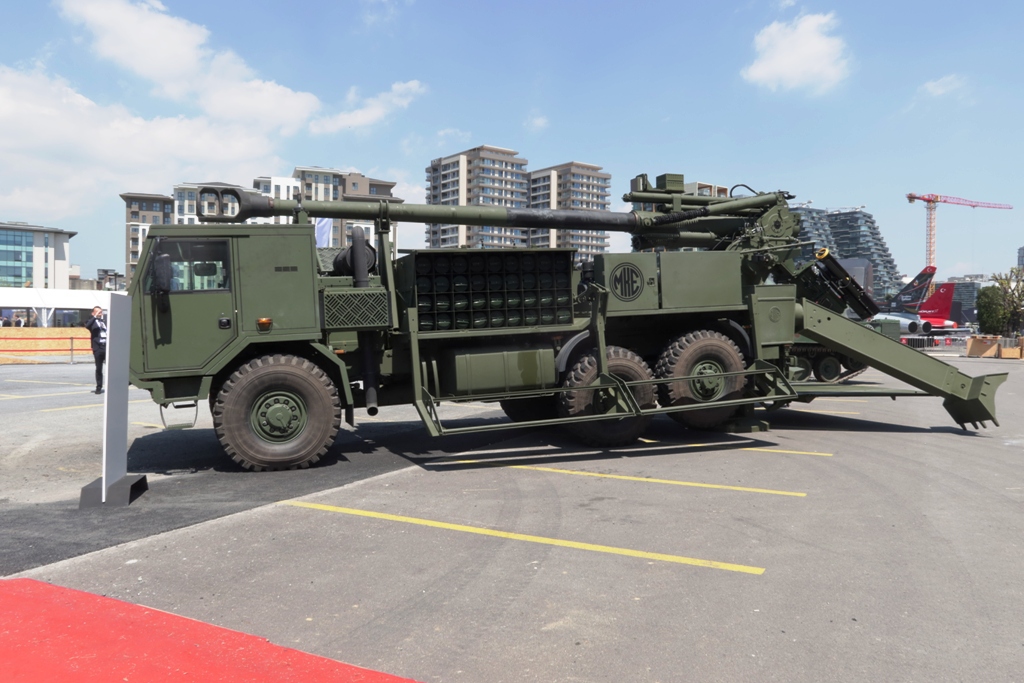
Beside the Gürhan 155/52 mm tracked self-propelled howitzer a new artillery system from MKE could be seen, the Attila. An absolutely brand new system, it became ready five days before the exhibition opening, the Attila exploits the barrel and recoil system of the T-155 Panter towed howitzer, installed on a 6×6 T815 chassis produced by Czech company Tatra Defence Vehicles;
mobility was probably at the base of such choice, the Tatra chassis being based on a backbone tube chassis with independent swing half-axles, providing high mobility, nearly comparable to that of independent suspensions vehicles, but at lower cost.

Selecting a well known artillery system allowed reducing development risks and time, however the Attila contains several purposely developed solutions, the more important and visible one being the gun loading system. The loading is carried out in a semi-automatic mode; the two loaders put respectively the ammunition and the charge on the two trays, the one on the right for ammunition and that on the left for charges, then the system does all the rest automatically, bringing the ammunition and then the charges to the breech and ramming them in the chamber. This allows to obtain a rate of fire of 4 to 6 rounds per minute.

Thirty-six ammunition are located in a honeycomb-type magazine, this architecture ensuring the maximum density of rounds per area, located on the right of the howitzer behind the engine, while symmetrically on the left side we find the charges magazine which contains the same number of full modular charges. To access these magazines a hydraulically powered two-step platform is lowered, an operation taking only three seconds. The same time is needed to lower the rear platform, that allows loaders to reach the automatic loading system, as well as the two spades which provide stability during firing.


Two compartments can be seen on the left side, behind the charges magazine. The first one hosts the fire control system computer which allows the gunner to input all data needed; the Attila is equipped with a radar allowing to measure muzzle velocity. The elevation arc is -3°/+65° while in azimuth the howitzer can be aimed ±17° from the vehicle axis. EDR On-Line understood that the Attila is not yet networked, however it is clear that this will be done as soon as the system will overcome prototype stage. Another series of boxes is fitted on the right side, one of them hosting a touch screen that allows conducting all operations related to the chassis; should the computerised system, which ensures the right sequence of folding/lowering/raising the various platforms, sensors blocking the process should something not be correctly done, the howitzer can be operated in full manual mode, however it is then to the operator to check that the sequence is correct.
The Attila is ready to fire 60 seconds after coming to a complete alt, and is ready to leave the firing position in 45 seconds. The system is 11,500 mm long, 3,000 mm wide and 3,800 mm high, and in combat configuration has a mass of 29 tonnes. The prototype does not feature a protected cabin but this can be eventually adopted at a later date on production howitzers. When Saha Expo will close its doors, it will be time for the Attila to join for the first time the firing range.
Photos by P. Valpolini