
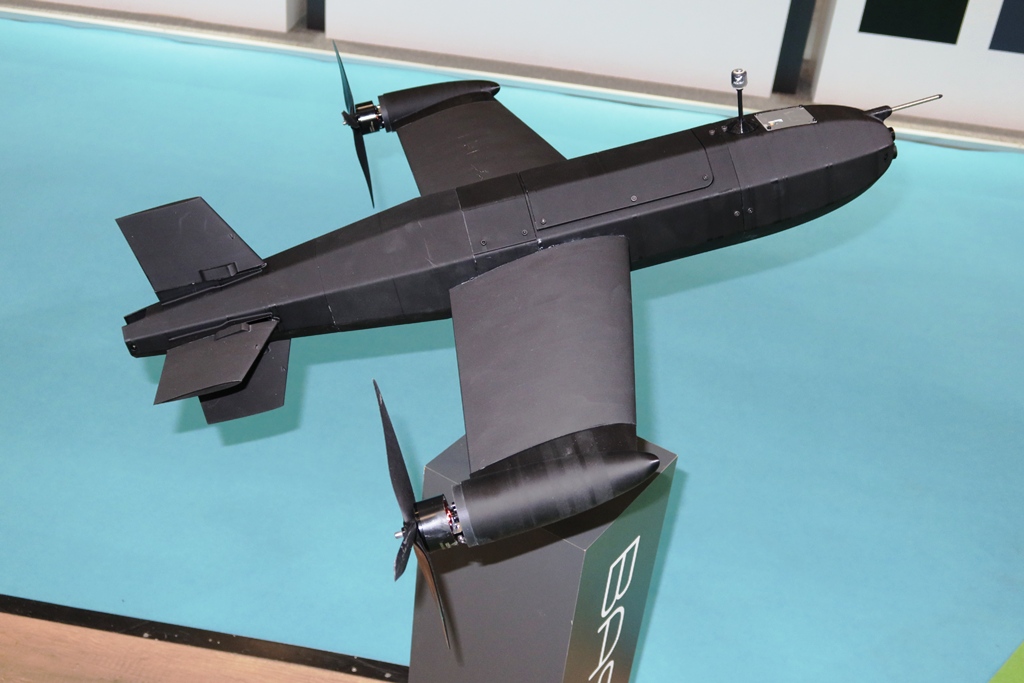
Saha Expo 2026 – Solid Aero introduces Basat Bi fixed wing interceptor drone
Countering the drone threat has become more and more an issue, considering that attack drones, loitering munitions and FPVs accounted for a percent of casualties equal if not greater than artillery in the Russia-Ukraine conflict. At the Istanbul exhibition Solid Aero, which until now operated in the ISR, attack and sea UAV domain, unveiled its first interceptor drone, the fixed wing Basat Bi
While most interceptor drones are based on a short fuselage with an X-wing architecture at the rear, each of the four short wings carrying an electric motor and propeller, the Basat Bi, designed and produced by the Ankara-based Solid Aero, has a fixed wing layout. Its fuselage is 750 mm long with mid wings, slightly swept, with a 700 mm span, each one carrying at its tip a nacelle hosting an electric motor which activates a pushing propeller. At Saha Expo the system exhibited featured three-blade propellers, however EDR On-Line understood that when top speed is required 2-blade propellers are installed, the 3-blade option being to have a better torque. A detail that Solid Aero representatives underlined strongly is that all component, except motors, propellers, and batteries, are produced in house.

At the rear the airframe, which is all made of carbon fibre, an X-shaped tailplane is fitted, all surfaces being movable. On top of the fuselage, slightly ahead of the wing, an aperture was visible; this is where the warhead is located, the type of ordnance being a customers’ choice, Solid Aero considering that the Basat Bi can be lethal also relying on kinetic energy only, thanks to its 4 kg mass and its dash speed of 300 km/h, cruise speed being 120 km/h. The Basat Bi is designed to neutralise FPVs, mini-UAVs and tactical drones.
The Solid Aero interceptor takes off vertically using a rifle-like ramp when employed in the man portable configuration, or from a fixed station, the airframe leaving it under the thrust of its propeller, no add-on thrust being required. In the initial flight phase, it follows the data provided by a ground-based radar through the data link, which antenna is visible at the front of the airframe, a GNSS/INS navigation system being installed on the drone. When closing to the target, this is acquired by the day/night cameras that are installed at the front, providing target images to the on-board AI-based autonomy module, the drone becoming fully autonomous once it is locked-on to the target; the current autonomy module is provided by a third party, EDR On-Line understood, but the company is developing its own AI module that will be available since the first production items. The Basat Bi is defined as a “tactical short-range” system, no data on range and endurance being provided.
The model seen at Saha Expo was representing the final product, the Basat Bi being ready for production.
Photos by P Valpolini