Saha Expo 2026 – Turkey looks at hypersonic with Yıldırımhan long-range hypersonic ballistic missile and DeltaV propulsion systems
Probably the biggest system showcased at the Istanbul exhibition, the Yıldırımhan is the Turkish long-range hypersonic ballistic missile currently under development, that will allow Ankara to considerably improve its strategic posture in a wide area, as it will give the Turkish Armed Forces the possibility to reach targets at great distance. A must considering that in early March this year NATO air defence assets shot down Iranian ballistic missiles aimed at Turkey, something Teheran denied. DeltaV, specialised in space propulsion, exhibited its HISTEP, a hypersonic test platform that adopts a hybrid propuslion system, another hypersonic player in the Turkish industry

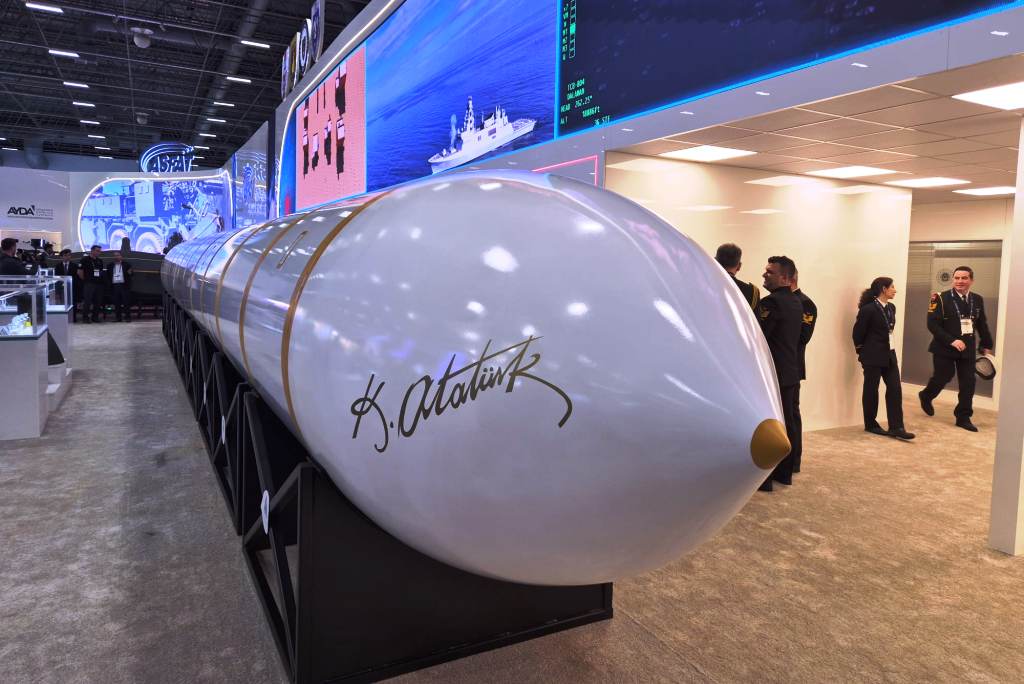
Dominating the Turkish Ministry of Defence stand was the mock-up of the Yıldırımhan, the long-range hypersonic ballistic missile under development. This will considerably increase Ankara strategic capabilities, as it was unveiled that it will have a 6,000 km range carrying a payload of around 3 tonnes. No details were provided on that payload, but it is safe to assume that this will be of the multiple independently targeted re-entry vehicles type. The level of manoeuvrability of the new Turkish missile and that of its re-entry vehicles also remains unknown. The four rocket motors use UDMH (Unsymmetrical DiMethylHydrazine, H2NN(CH3)2) fuel and Dinitrogen tetroxide (N2O4) as oxidiser, ampoules of the two liquids being displayed at the MoD stand beside the missile. In the last years Turkey developed the capacity to produce this type of chemistry, initially at laboratory level, and is now capable to mass produce them. According to the few other information provided. the Yıldırımhan will have a cruise speed of Mach 9, while the peak speed will be Mach 25.
According to information gathered at the Istanbul event, the rocket motors have already been bench-tested, other major subcomponents having successfully completed laboratory tests. No information on the integration process and the flight-testing timeline was revealed. The latter will probably be conducted in a succession of flights aimed at testing the system starting from propulsion to reach full system testing. The capacity to reach out countries from Vietnam to South Africa, to northern Scandinavia, to Asian Russia that the Yıldırımhan will give to Ankara shows well how much the new missile will improve the country strategic capability, in a moment when long range missiles are proving their effectiveness in more than one operational theatre.
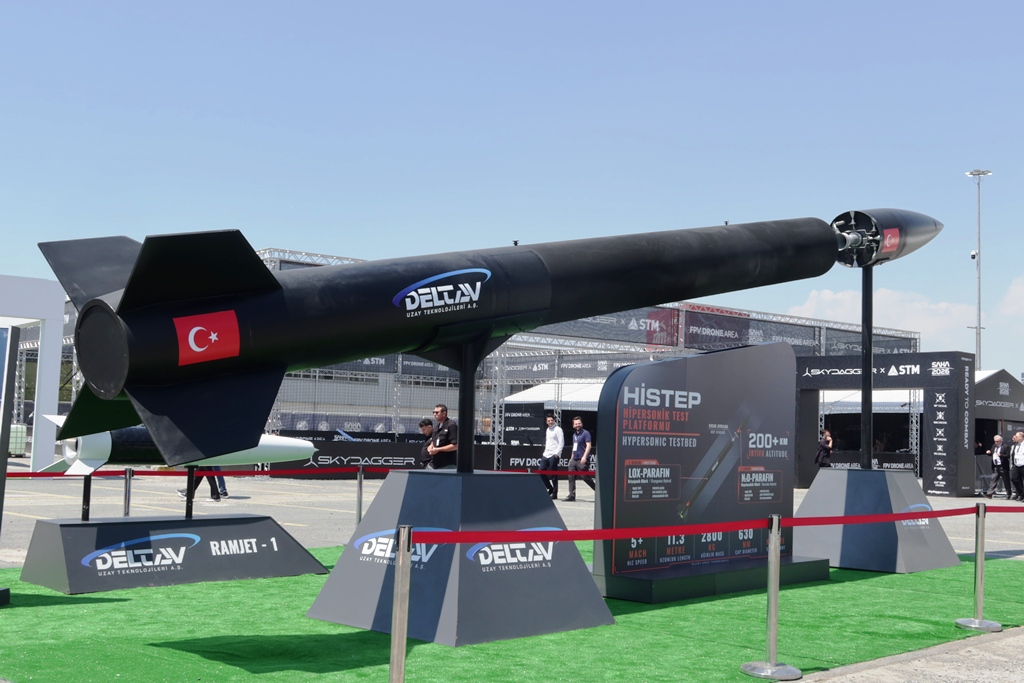
It is to note that the one seen on the Ministry of Defence stand was not the only hypersonic missile present at Saha Expo. On the outdoor area DeltaV, a specialist in space propulsion, was exhibiting its HISTEP (Hipersonick Test Platformu, hypersonic test platform), a two-stage missile capable to fly at over Mach 5, capable to reach an over 200 km altitude. As said, this is not a weapon system but rather a testbed available to those who need to test subsystems at hypersonic speed, and of course to DeltaV to further refine its propulsion system. Both stages use solid paraffin as fuel, however in the first stage liquid oxygen is used as oxidiser while in the second one we find nitrous oxide (N2O). First stage has adjustable thrust while second stage terminates impulse when required. The HISTEP is 11.3 metres long, has a diameter of 630 mm, a mass at take-off of 2,800 kg and can reach an altitude of over 200 km. The company also showcased a land-based solid-fuel ramjet powered missile capable to fly at Mach 2.5-3 at 4,000 metres cruising altitude, reaching a target at 150 km range. DeltaV is also responsible for the propulsion segment of the Turkish space programme.
Photos by P. Valpolini