Enforce Tac 2026 – Diehl Defence relaunches its Garmr counter-drone system
Diehl Defence unveiled some of its C-UAS solutions at Enforce Tac 2025, and one year later the Überlingen-based company brought to the Nurnberg exhibition the Garmr mobile counter-drone system which combines a series of new effectors and a new AI-based detection system
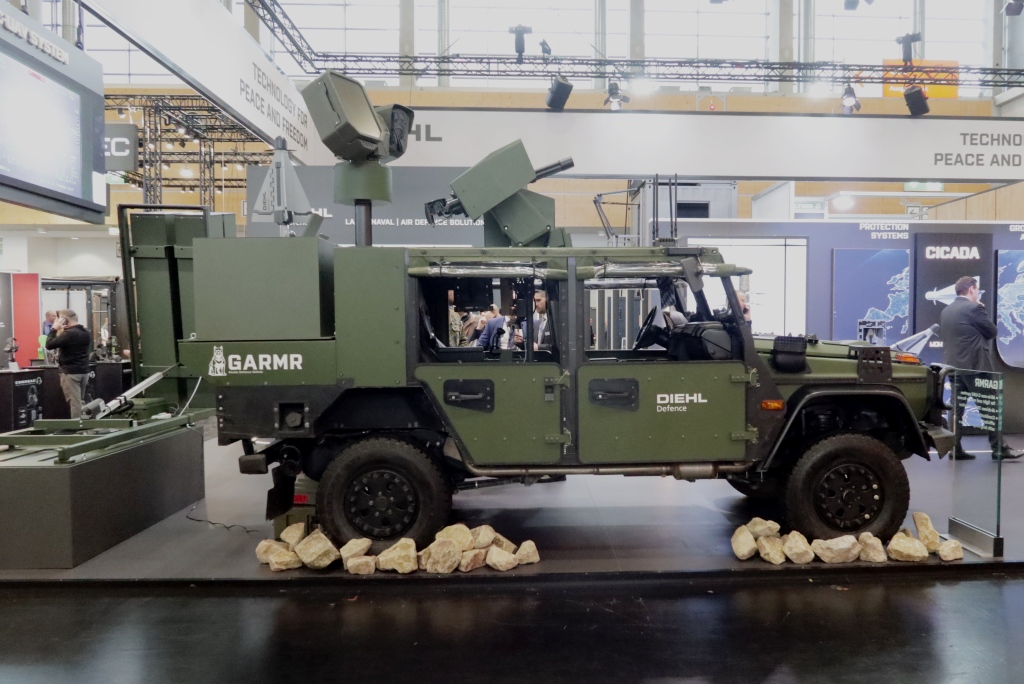
When entering the Enforce Tac 2026 premises one of the first sights was that of an Enok AB/Caracal chassis fitted with a series of sensors and effectors, showcased in the Diehl Defence booth. The mobility platform is the well-known vehicle developed by a team made of Rheinmetall, Mercedes-Benz, and Armored Car Systems (ACS), that has been selected by the German Bundeswehr in the light airmobile role.
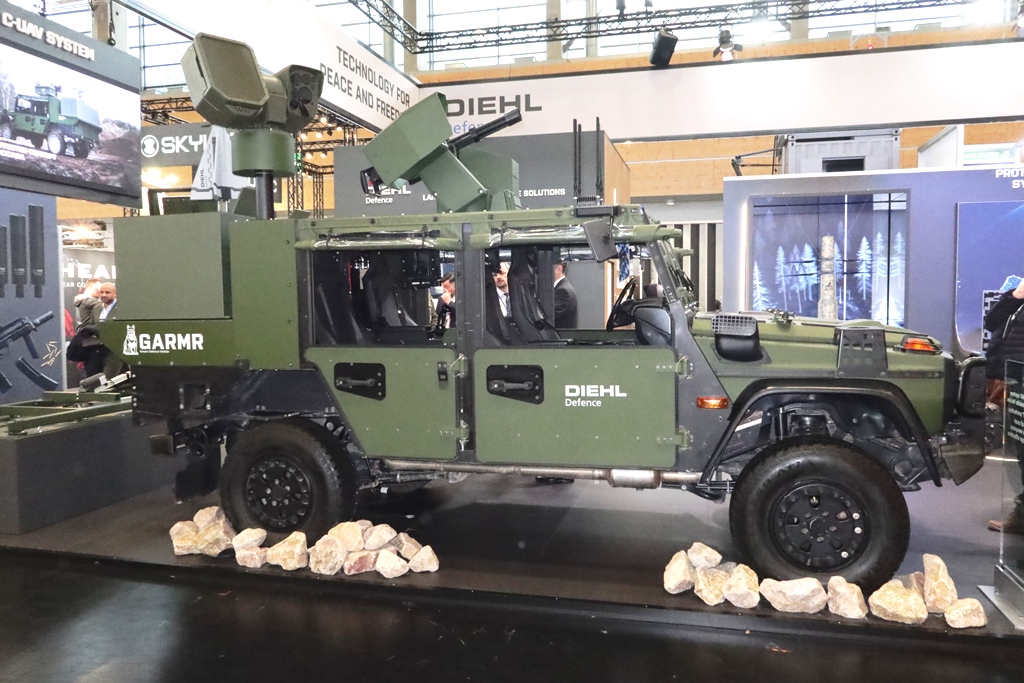
The active sensor is the Echodyne EchoShield Ku-band next-generation, software-defined, medium-range, pulse-Doppler, cognitive 4D AESA radar. It is mounted on the right side of a telescopic mast, its mass is only 17.8 kg, and according to company specs it can detect Group 1 UAVs up to 3-5.3 km ranges and nano-UAVS up to 1.5 km. On the left side of the mast, we find an optronic package with day/night channels and a laser rangefinder. Typically, the radar will pass targets to the AI-based command and control that elaborates the tracks, prioritising them, and passing them to the optronic suite that ensures tracking, images fed into the C2 suite allowing identification.
AI algorithms permit to dramatically reduce identification time thus giving the operator to give the green light for the engagement. Installing the two sensors on the mast, which is fitted behind the rear wall of the cabin, ensures full 360° view, avoiding dead angles generated by the remotely controlled weapon station (RCWS). A jammer is fitted on the roof, forward right, representing the soft kill element.
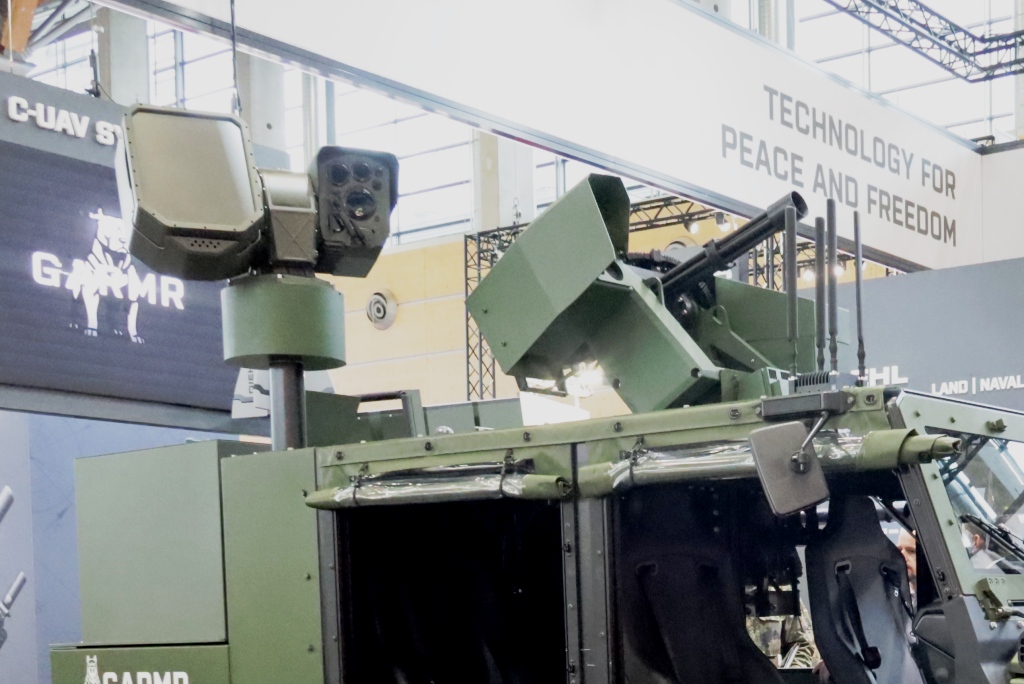
The RCWS is the first kinetic effector of the Garmr. It is armed with a Dillon M134-D Minigun in 7.62×51 mm calibre, which can fire up to 3,000 rounds per minute, generating a cloud of balls in front of the incoming threat at a range of a few hundred metres. It is interesting to see that numerous ammunition companies are developing and are starting to produce dedicated C-UAS rounds. The RCWS is installed on the vehicle roof, and is fitted with its own optronic sensors suite, which means it can engage a target based on data received from the C2 system while the main optronic sensor continues its work, providing a hunter-killer capacity against UAVs.
The Garmr seen at Enforce Tac 2026 was the Garms SRS, for Short Range System, its second hard kill effector being the Cicada C-UAS interceptor drone by Diehl Defence, unveiled last year. The fuselage has a 300 mm diameter and is 700 mm long; four delta wings are folded along the fuselage in the launch canister and deploy at launch giving the Cicada the typical X-wings architecture. An electric motor drives the front five-blade propeller, which is topped by the radome hiding the radar that guides the killer drone close to the target.
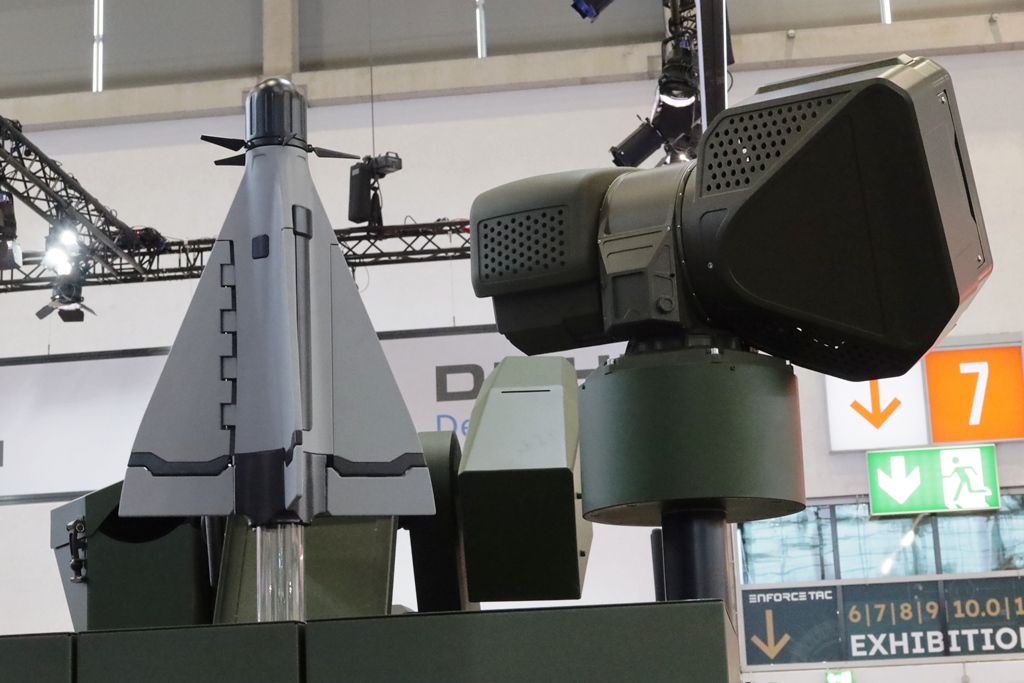
Two payloads can be employed; a soft kill one based on a net, which entangles the enemy drone, and a hard-kill one, based on an explosive warhead. The Cicada has a range of around 5 km and according to company information is able to neutralise drones such as Shaheds and Lancets, to name some of the most widely used by Russia against Ukraine. Fifteen such killer drones are hosted in a parallelepipedal box at the rear of the vehicle.
The Garmr leverages the experience acquired by Diehl Defence with the Kinetic Defence Vehicle (KDV), which in late November 2025 was tested alongside the Cicada interceptor drone at the Grafenwoehr military training area.
Diehl Defence proposes a longer-range version of the Garmr, known as Garms MRS, for Medium Range System. Here the rear container which in the Garmr SRS hosts the Cicada effectors is replaced by a four-canister module hosting Destinus Hornet Block 2 electrically powered interceptors which have a range of over 70 km and carry a 3 kg explosive payload. The container could be seen decoupled from the vehicle at the company stand.
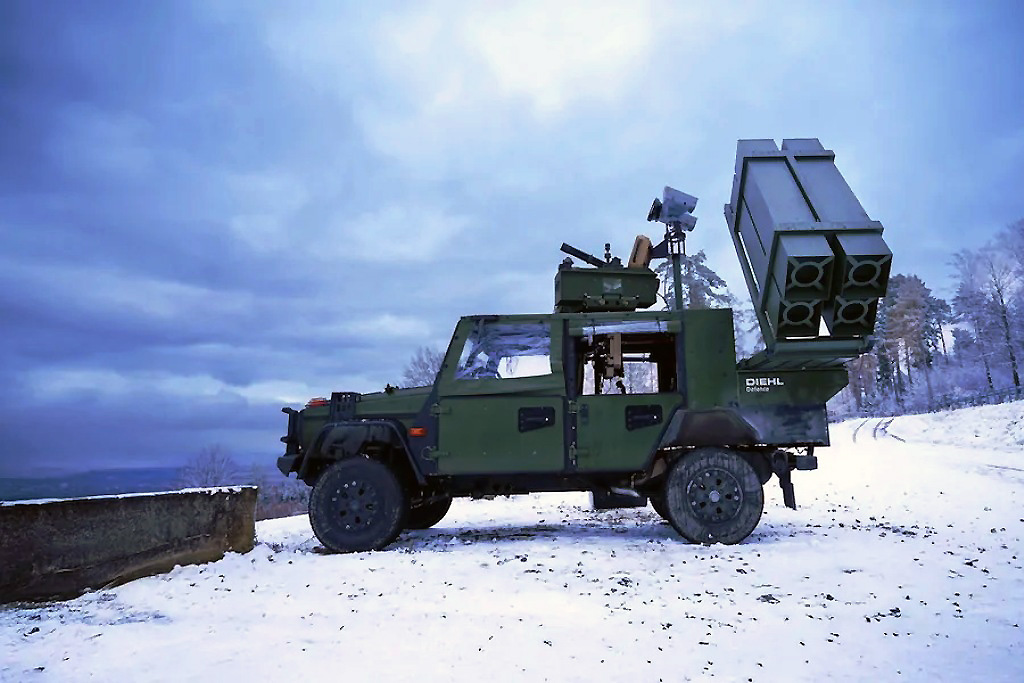
While the smaller Cicada are launched vertically, here at launch the container is raised at an angle of around 30°, the photo provided by the company showing the same turret, while it is quite probable that the sensor suite will be replaced with sensors able to cope with the missiles range. It is to say that one of the improvements of the Garmr over the previous KDV is that the new system is fully networked, hence target cueing can be provided by distributed sensors which provide a common air picture. Equipping antidrone units with both Garms SRS and Garms MRS would provide a two-layer defence system, to which other layers may be added, both at longer and shorter ranges.
Photos courtesy Diehl Defence and P. Valpolini