Enforce Tac 2026 – First public appearance for Rheinmetall RCWS 320C-UAS weapon station
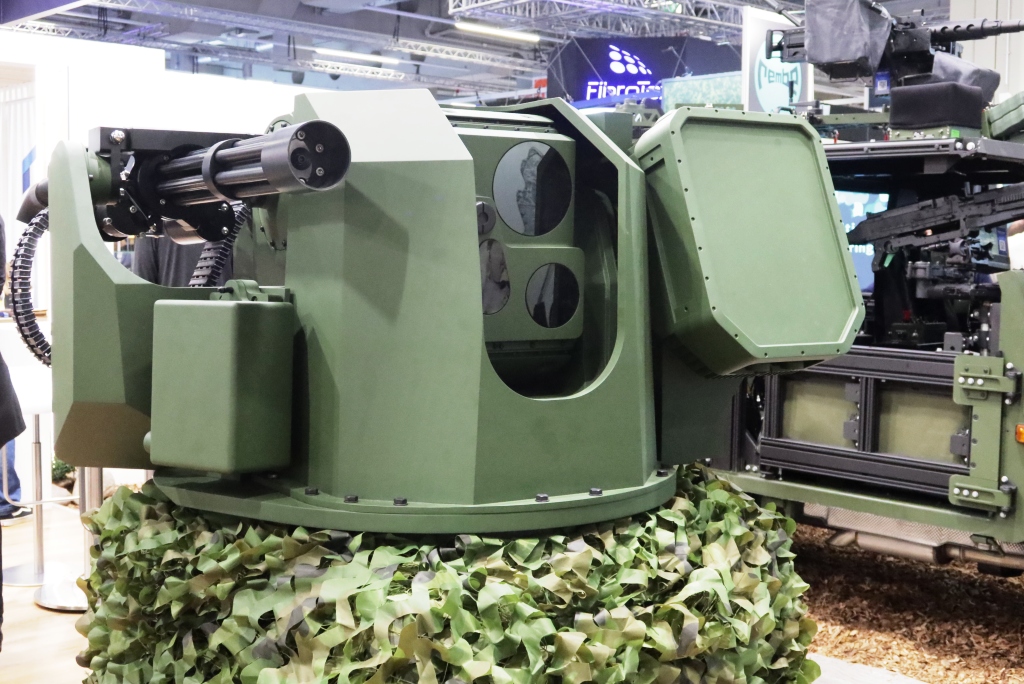
At the Nurnberg exhibition Rheinmetall exhibited for the first time in public its RCWS320 C-UAS remotely controlled weapon station (RCWS), specifically designed for this role
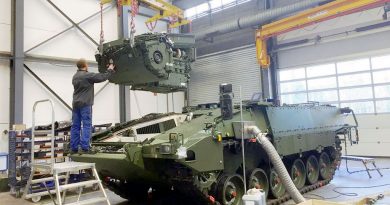
The RCWS 320C-UAS shown at Enforce Tac is already under contract, as it will be one of the effectors of the Boxer NNbs, which stands for Nah- und Nächstbereichsschutz, the short- and very short- range air defence system that will equip the German Bundeswehr, which is being designed and produced by a company temporary consortium made of Rheinmetall Electronics, Diehl Defence and Hensoldt Sensors.
The new RCWS is the top range weapon station among small calibre ones at Rheinmetall, the key feature being its accuracy. EDR On-Line understood that stabilisation is the key issue, which was obtained by design, in mechanical components, as well as by advanced control algorithms, the result being a microradian angular deviation. Beefed up motors are adopted as actuators, to allow a high acceleration which is also part of the game, as well as sensing devices, these being the same used in the CT-025 25 mm turret unveiled by Rheinmetall at DSEI 2025.
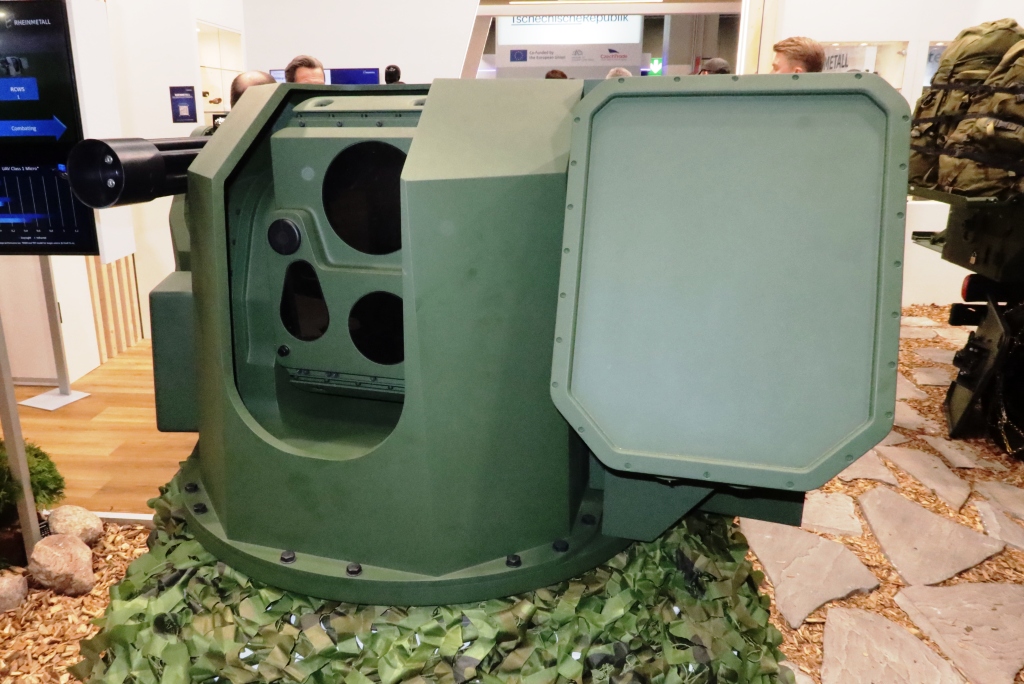
Compared to other RCWS developed by the Bremen based division of Rheinmetall the RCWS 320C-UAS also has better tracking capabilities, optimised to follow aerial vehicles. The long-range sensor is the Echodyne EchoShield Ku-band next-generation, software-defined, medium-range, pulse-Doppler, cognitive 4D AESA radar, capable to detect Group 1 UAVs up to 3-5.3 km ranges (1.5 km for nano-UAVs), all this adding only 17.8 kg to the mount.
Once the drone is detected its position is passed to the tracking system, which is based on Rheinmetall’s SEOSS 320 optronic sensor suite, which number we find in the RCWS name, showing how much this is one of the key elements of the new weapon station. The tracking system exploits images provided by both day and thermal channels image fusion being also used, EDR On-Line understood, and employs AI-based algorithms that were trained using several real videos. It is to note that a SEOSS 300 series sensor suite is used on the medium-calibre Lance turret, which effector obviously has a much longer range that the 7.62×51 mm machine gun used on the RCWS 320C-UAS. The laser rangefinder hosted in the SEOSS 320 has also been optimised as its higher pulse repetition allows acquiring not only the distance but also the speed of the incoming drone. Tracking it every few milliseconds allow obtaining the velocity vector, which is then passed to the fire control system to establish the future point where rounds and target will meet.
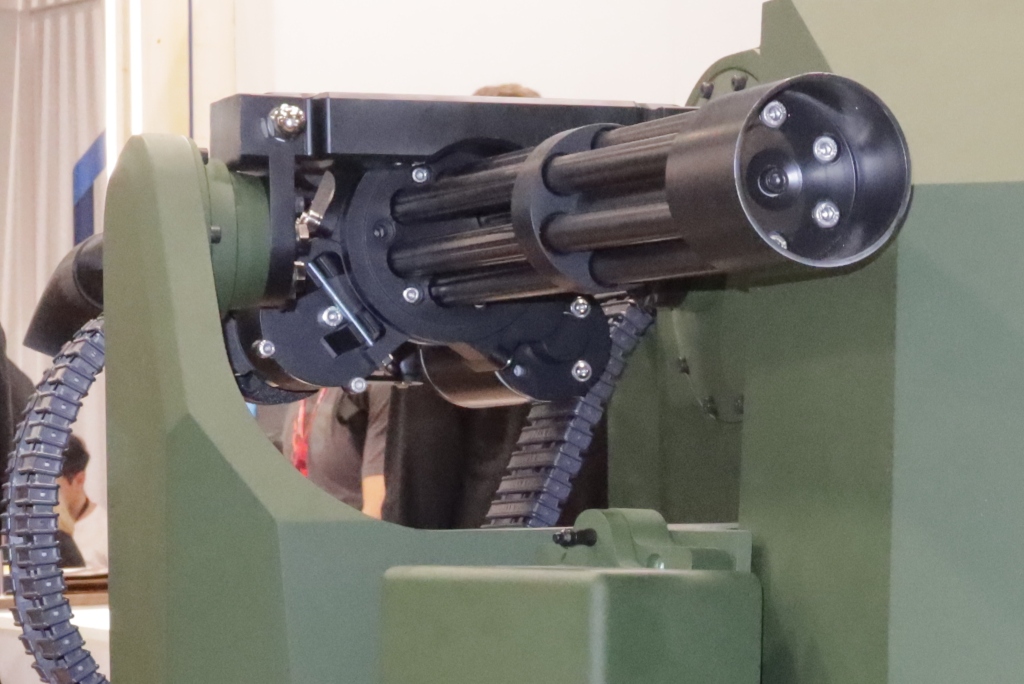
The RCWS 320C-UAS went through a series of evolution steps to come to the final configuration, which sees the SEOSS 320 in the centre, protected by an armoured hood, with the EchoShield radar on the left and the machine gun on the right. The latter is the Dillon M134D-H Minigun, capable to fire 3,000 rounds per minute, although other hard-kill effectors can be installed. The M134D was considered the best option for the C-UAS role as it is capable to generate a real barrier in front of the incoming threat, with an effective range of around 600 metres. The magazine can host up to 3,500 rounds; EDR On-Line understood that Rheinmetall is looking at the Urban Drone Defence (UDD) rounds recently developed by RWS, a BDT company, which polymer bullet ensures reduced background risk, the danger zone being roughly 80% less than that of conventional 7.62 mm rounds, a key factor in reducing collateral damages, especially in urban areas.
Without ammunition the RCWS 320C-UAS has a mass of 430 kg, 100 kg of rounds being added to obtain the operating mass. In the current configuration the new Rheinmetall RCWS is 655 mm long, 1,140 mm wide and 940 mm high; in the future soft-kill effectors might be added. Its electronic architecture is NGVA-compliant, which ensures easy integration on vehicles as well as on heavy- or medium-calibre turrets.
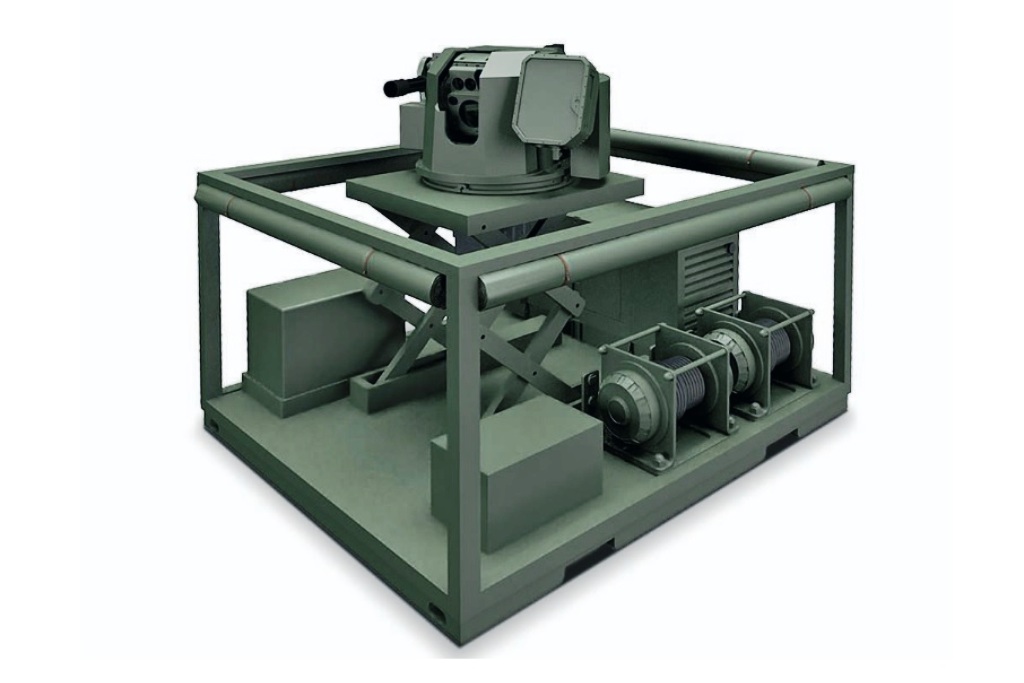
Beside the specific use on the Boxer NNbs, the RCWS 320C-UAS can be installed on other wheeled and tracked platforms, manned or unmanned. A new role is however emerging, which might see the new weapon station employed in a static role. The UAV threat is becoming more and more an issue also on the national territory, therefore a demand is arising to protect sensible installations, among them military barracks, against this danger. Rheinmetall is thus proposing the RCWS 320C-UAS also in a static configuration, capable to operate stand alone thanks to an on-board power supply.
Graphics courtesy Rheinmetall, photos by P. Valpolini