IAV 2026 – Oshkosh looks at British Army HET and LPM programmes
The need to transport a heavier tank, the Challenger 3 combat mass being considerably higher than that of the Challenger 2, and to replace a series of light armoured vehicles, most of them acquired under UOR programmes mostly during the mission in Afghanistan, triggered the interest of several companies, obviously including Oshkosh Defence
With the Challenger 3 programme advancing, not without some problems, the British Army needs to adapt its transport capabilities to the new MBT. While in the (first) Cold War era British Challengers were deployed close to the frontline, its formations being part of the British Army of the Rhine, BAOR in short, and more precisely of the 1st British Corps, in case of need they should now be deployed from the UK to the new border, which has since moved eastwards, an around 2,000 km travel that must necessarily be made on wheels.
Combat mass increase has been a constant in the last decades; While baseline Challenger 2 was slightly over 62 tonnes, when fitted with add-on armour, typically used in peace support operations to cover the 360° threat, combat mass could get close to 75 tonnes. The new Challenger 3 which starts at around 66 tonnes can, with all add on protection suites, including systems defending from top-attack effectors, get close to the 80 tonnes mark.
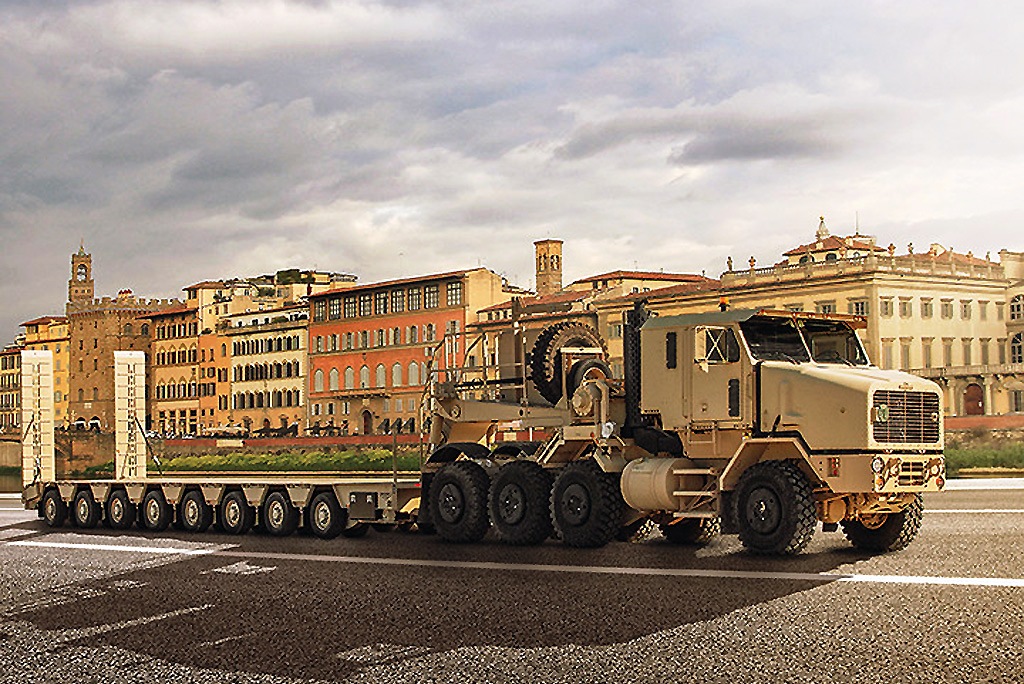
According to the “UK armed forces equipment and formations 2025” published on 30 October 2025 by the MoD, the British Army has currently in service 165 Heavy Equipment Transporters; these are Oshkosh 1070 HET which are coupled to a King Trailer GTS 100 seven-axle semi-trailer. Fitted with a 700 bhp Caterpillar C18 turbocharged diesel engine, their maximum load capacity is 72,000 kg, insufficient to cope with the new version of the UK MBT.
Oshkosh has now completed tests on the EHETS (Enhanced Heavy Equipment Transporter System), a programme aiming at upgrading the US Army tank transporter fleet bringing the load capacity from around 70 tonnes up to 90 tonnes. EDR On-Line understood that a new transfer case is being installed, increasing the torque, advanced suspensions being also used. Many components have been reengineered using aluminium rather than steel as well as composite material, which allowed weight saving, which was reinvested in adopting a fully armoured cabin capable to defeat small arms fire as well as blast. According to information gathered, the EHETS standard can be med adopting an upgrade kit from currently in-service HETs.
Oshkosh is awaiting the order from the US MoW and is lining up for the British bid. EDR On-Line understood this could be for 90 to 180 tractors (the Challenger 3 programme will include upgrades for only 148 tanks over a total of 288) that will be coupled to a UK-made trailer. The selection should be announced in mid- late-2026, the British Army looking for a Full Operational Capability in June 2028.
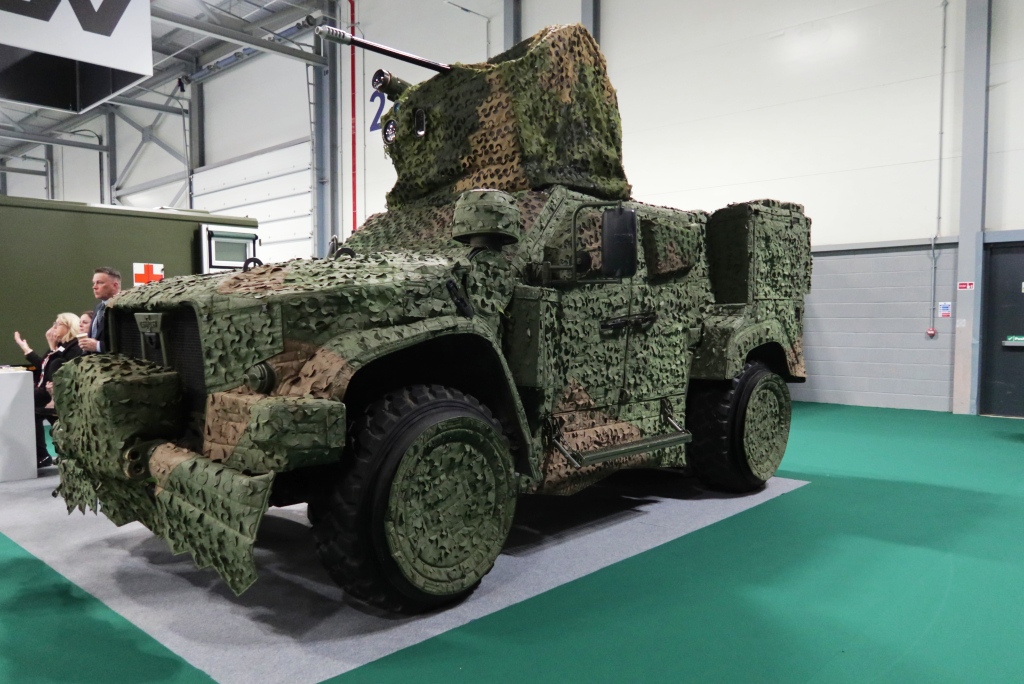
While space issues did not allow exhibiting the tank transporter, this was not true for the JLTV, aimed at the Light Protected Mobility (LPM) segment of the Land Mobility Programme, which also includes heavier and lighter platforms. The JLTV showcased at the Farnborough event under a Saab Barracuda camouflage was fitted with a Kongsberg RCWS armed with a 30×113 mm gun with airburst capability, hence C-UAS capable, a 7.62 mm machine gun, and a Javelin antitank missile; it was the first time Oshkosh Defense was exhibiting the JLTV with a C-UAS effector in Europe, although the Saab Barracuda net was hiding much of the details. Competitors for the LPM are numerous, Otokar, Nurol UK, Urovesa, IDV, Supacat to name some of them. Oshkosh counting on the proven capabilities of its JLTV, of which over 20,000 vehicles have already been produced, an on the involvement of the UK industrial base. A further article dedicated to the JLTV production will be published soon on EDR On-Line. According to available information the IOC or the overall programme, as well as for the LPM, is planned for 2029.
Photos courtesy Oshkosh Defense and P. Valpolini