
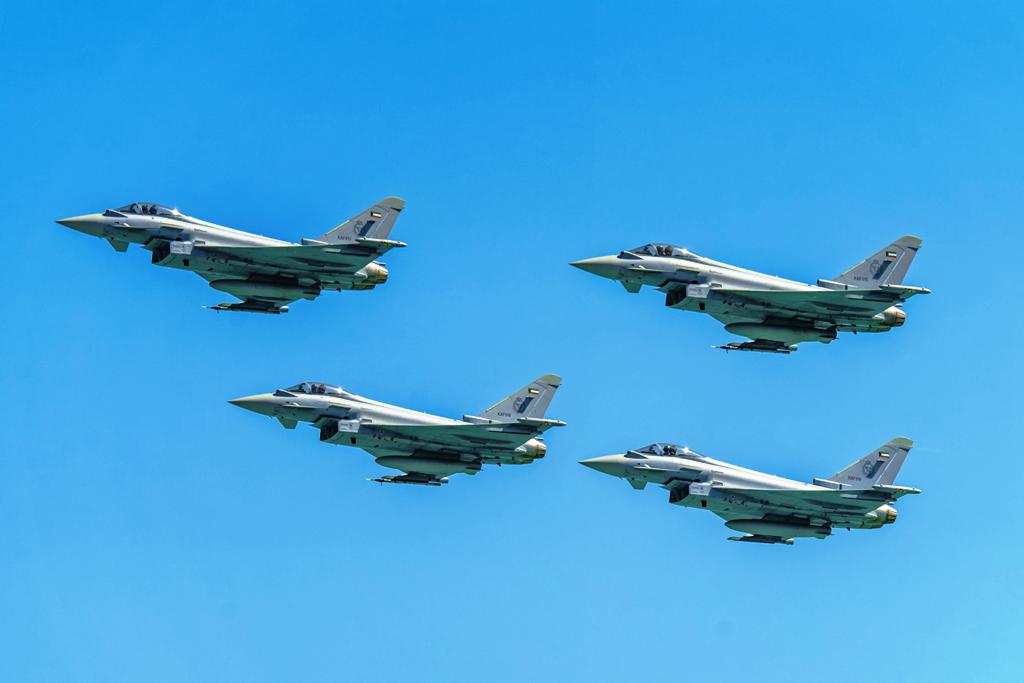
Leonardo Aviation Services, managing Kuwait Eurofighter programme
Eurofighter promotion on the export market is ensured by the stakeholder who is best placed in the nation interest in adopting the Typhoon. In the case of Kuwait it was the turn of Leonardo to represent the consortium in the successful bid. To manage the programme the company set up Leonardo Aviation Services, a dedicates structure which is now up and running
The deal between Kuwait and Eurofighter was signed 10 years ago, and included the delivery of 28 Tranche 3/3a aircraft as well as extensive support and training from Italy. The first two Typhoons, both single-seaters, were delivered to the al-Quwwat al-Jawwiya al-Kuwaitiya, the Kuwait Air Force, in mid-December 2021. With the landing at the Ali Al Salem Air Base of the last two two-seaters on 6 November 2025, the Air Force has now in service all 22 single-seaters and six two-seaters art f the contract. Kuwaiti aircraft are fitted with the Captor-E active electronically scanned array radar, with Leonardo’s Praetorian defensive aid suite and with the PIRATE infrared search and track system. To ensure full support to the Kuwaiti Typhoon fleet, in 2022 Leonardo established a dedicated company, Leonardo Aviation Services, which is now running at full steam, as all aircraft reached their home base.
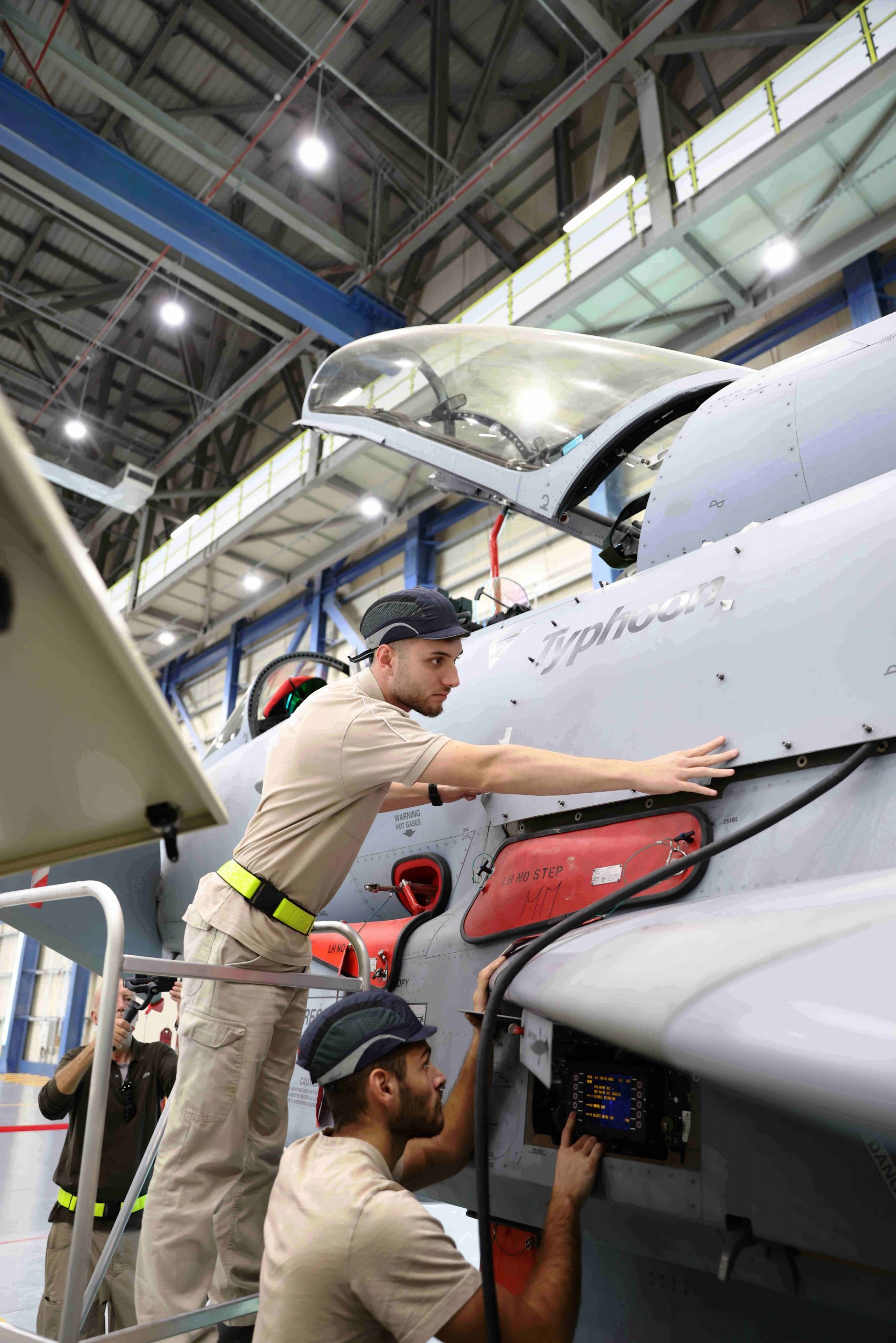
In its latest reorganisation, Leonardo Aeronautics Division is made of four business units, Aircraft, Uncrewed Systems, Aerostructures, and Service, the latter providing support and training activities and services to customers. Leonardo Aviation Services refers to the latter BU, which also includes Customer Support, Training, activities and manages the International Flight Training School, the JV between Leonardo and the Italian Air Force, based in Decimomannu, Sardinia, which provided 4th level fighter training to pilots from several countries, including Kuwait.
“The contract, for both production and logistics support, was signed by the Kuwaiti Ministry of Defence and Leonardo, formerly the Aircraft Division, now the Aeronautics Division, which remains the main contractor. Leonardo Aviation Services was created specifically to deliver on site all logistics support activities to the Eurofighter Kuwait programme,” Corrado Crotti, Leonardo Aviation Services CEO, tells EDR On-Line.
Leonardo Aviation Services, LAS in short, is one of the first foreign investor-owned companies operating under Kuwait Direct Investment Promotion Authority (KDIPA). “LAS is therefore a fully-fledged Kuwaiti company that works seamlessly with Leonardo’s Aeronautic Division, providing the integrated logistics product support, which includes engineering, maintenance and all supply chain management, for the fleet of 28 aircraft. Furthermore, it is also responsible for all the training solutions aimed both at pilots and maintenance personnel, which obviously include simulators, both procedural and pilot simulators,” Mr. Crotti adds.
The contract between the Kuwait MoD and Leonardo is performance-based, the company being required to ensure a certain level of fleet availability service, numbers remaining classified. “In these first three years of activity, fleet availability service has been guaranteed beyond the contractual requirements for the entire fleet, and this was our first achievement. When we were created in 2022 we were a start-up, we started from a blank sheet, and in three years we have gone from nothing to the current structure that employs over 220 people, with the goal of reaching 300 next year, and with a growth profile consistent with the activities to be carried out,” the LAS CEO explains.
At the moment the majority of LAS personnel come from Italy. “However we’ve been making progress with a plan to hire local personnel. Of course the percent of Kuwait personnel will increase in due time,” Corrado Crotti states.
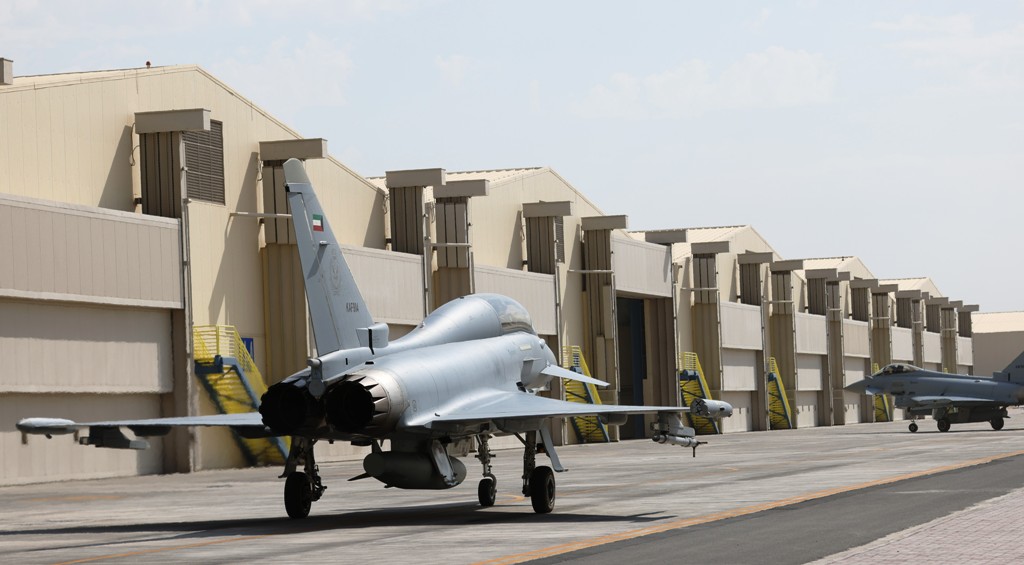
“We are located at the Salem al-Sabah air base, where the Typhoons are deployed: the infrastructure was supplied by Leonardo as part of the main programme and was handed over to the Kuwait Air Force, and is now operated by LAS personnel, the interesting thing about this framework being that our personnel works daily side with Kuwaiti military personnel to achieve the same goal, and all our procedures and processes are integrated with the procedures and processes of the Kuwait Air Force,” the CEO adds, underlining that this structural partnership model means providing availability service rather than only a product.
The LAS CEO underlines how much this is a paradigm shift for Leonardo, stepping up from providing a product with service support to providing a capability because, “because in this partnership model, we guarantee our customer the ability to carry out his mission, in fact, our mission is to execute his mission, as we must guarantee a certain number of missions and a certain level of training.”
LAS and the Kuwait Air Force personnel share objectives and work every single day, which results in a full and comprehensive support where the daily result is the availability of aircraft, simulators, and instructor pilots. “For the entire OCU transition phase we also provide instructor pilots, who are managed by Leonardo and LAS. Simulators were provided as part of the training package, and we are responsible for the entire syllabus, for the entire transition on the Typhoon, based on the needs of the objectives set by the customer.”
Operating the Typhoon in a new scenario means adapting to local conditions, which may influence maintenance and wear and tear. “As with many programmes, the contract included an initial provision of spare parts, which now needs to be replenished and recalibrated based on specific programme needs. The current statistical base is still low, but obviously we are highlighting some phenomena that were not part of our experience with the Italian Air Force. In summer we operate aircraft in temperatures approaching 50°C, so it’s clear we are required to face challenging conditions,” Mr. Crotti underlines.
This was partly anticipated; within the main contract framework Leonardo provided all the infrastructure, including the hangars, which are state-of-the-art infrastructures that LAS continues to support from a management perspective. “All hangars are air-conditioned, and this obviously allows us to perform pre- and post-flight operations in an air-conditioned environment, which is certainly effective in the summer and reduces the impact of the temperature.”
The Leonardo Aviation Services model is in line with the group Industrial Plan 2024-2028, which among the streams to be boosted included that of “servitization and customer proximity”, moving from a product-centric view to the provision of an integrated service. “This is exactly what we do with LAS, giving an integrated end-to-end service working together with our end user, thus providing a one-stop shop service. A company like LAS could also become an antenna, a sensor that captures any future needs of the local customer,” the LAS CEO explains.
Leonardo is actively pursuing other opportunities leading other Eurofighter campaigns, such as the one to meet the Philippine Air Force’s new fighter requirement. A scheme similar to what was developed in Kuwait is somehow being proposed to that country, offering 32 Eurofighter Typhoon Tranche 5 fighters to meet the multirole combat aircraft (MRCA) requirement. The company believes the Kuwaiti model is a winning model to demonstrate that tit is able to localize 360° capacity even in difficult environmental conditions and at a certain distance from Europe.
Photos courtesy LAS

