MSPO 2026 – CBWP, the HSW heavy infantry fighting vehicle technology demonstrator
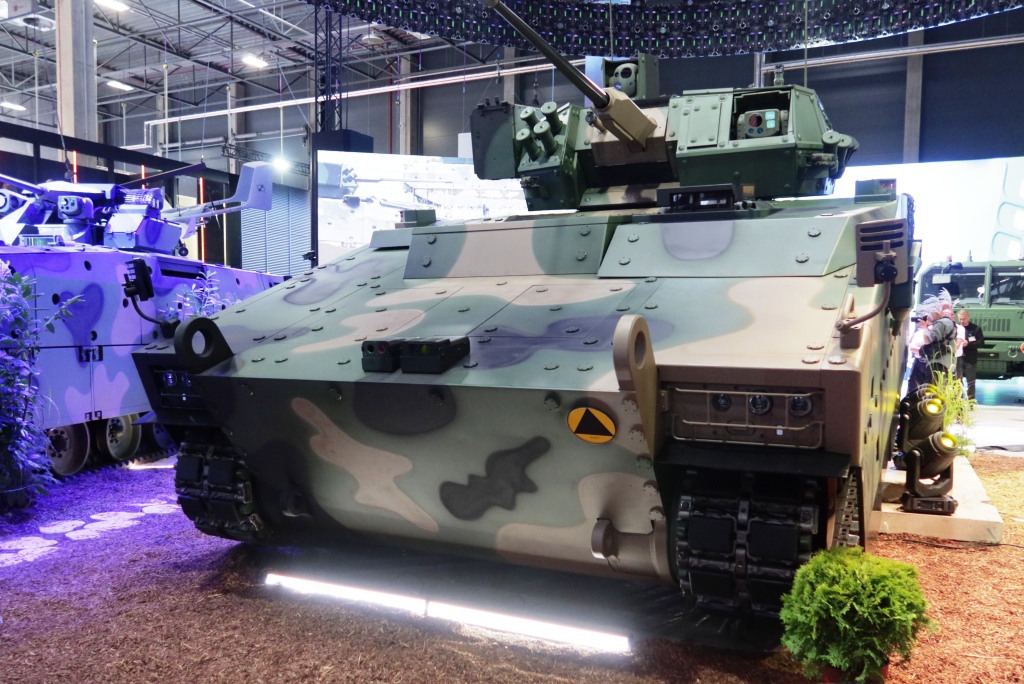
At the 2026 edition of the Kielce exhibition Huta Stalowa Wola (HSW), part of PGZ (Polska Grupa Zbrojeniowa, the Polish Armaments Group) unveiled the CBWP, the acronym standing for Ciężki Bojowy Wóz Piechoty, Heavy Infantry Fighting Vehicle in Polish language. The new vehicle ensures a much higher protection compared to the Borsuk infantry fighting vehicle, with a mass increase of over 40% compared to the new Polish Land Forces IFV

Increasing crew and infantry squad protection, this is the main objective of the new heavy infantry fighting vehicle, CBWP in Polish acronym, which advanced technology demonstrator was unveiled at MSPO 2026. No precise data were provided, as the vehicle is not yet a product, the project being currently entering a critical development phase which will involve advanced analysis and computational work, which will lead to a full prototype.
Compared to the Borsuk, which deliveries started in early December 2025, the combat mass of the CBWP is 12 tonnes more, around 40 compared to 28. Its protected volume is bigger, as it hosts a crew of three and six-eight dismounts, the IFV under delivery hosting six infantrymen in the rear compartment. Most of the add-on mass is dedicated to increasing protection, EDR On-Line understanding this being around two levels more than the Borsuk, according to STANAG 4259, in line with the higher protection required on the modern battlefield; no details were provided about mine protection, although also this should be higher than that of the current IFV, all occupants being equipped with energy absorbing seats to reduce under-belly blast effects.

Of course, the higher mass impacts the powerpack and the automotive components; the engine is provided by MTU and has an 800 kW (1,073 hp) output, probably the 8V199 TE23, and it is integrated with a generator and with an Allison X-series automatic transmission, while the new final drives are produced by HSW itself. Considering the combat mass and engine output the CBWP has a 26.8 hp/t power-to-mass ratio versus the 25.7 hp/t of the Borsuk, which ensures high manoeuvrability, however no data were provided on acceleration; maximum speed on road is 65 km/h while operational range is 500 km on smooth surfaces and 350 km on difficult terrain. Considering the higher protection level, the CBWP is capable to ford shallow water obstacles, but is not amphibious. The powerpack is located front-right, with the driver at the left; the increased length compared to the Borsuk is evident as the CBWP drivetrain features seven roadwheels compared to the six of the lighter IFV.
An auxiliary power unit (APU) is installed, which allows to operate all on-board systems even when the main engine is stopped; among these we find the heating and air conditioning system, the NBC protection system, warning sensors such as the laser warning system and sensors part of an Active Protection System, for which the vehicle is fitted, and of course the turret with its optronics, actuators and weapons.

The CBWP is equipped with the ZSSW-30 (Zdalnie Sterowany System Wieżowy 30 mm, meaning 30 mm Remote Control Turret System) designed by HSW and WB Electronics, the same which is installed on the Rosomak 8×8 armoured personnel carrier as well as on the Borsuk this commonality, together with the reuse of many subsystems present on the Borsuk, allowing reducing both the logistic and training footprints. The ZSSW-30 is armed with a Northrop Grumman Mk44S Bushmaster II automatic cannon chambered for 30×173 mm rounds, which can employ airburst munitions, effective against aerial targets, such as drones, as well as against soft land targets. The “S” in the cannon name stands for Stretch, indicating that should Poland decide to move to a bigger calibre, the weapon can be easily converted into a 40 mm gun shooting 40×180 mm ammunition. Beside the cannon, the turret is also equipped with a twin missile launcher, armed with Rafael Spike LR (Long Range) missiles, with a 4 km range. The CBWP commander and gunner are located within the hull, which increase their safety, the unmanned turret architecture also allowing a lower profile.
The next steps will see HDW fully integrating the powertrain and carrying out a series of demanding mobility trials. EDR On-Line understood that the company will also carry out a series of ballistic and blast tests to verify the effectiveness of the armour solutions adopted. All this will lead to the CBWP prototype, no timeframe having been announced for its delivery.
Photos courtesy HDW and P. Valpolini