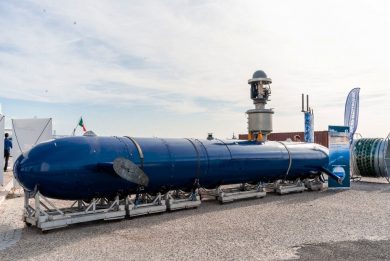
MSPO 2026 – STM NETA: from a lightweight mine-hunting AUV to a node in a networked underwater system
STM is continuing to mature its NETA family of autonomous underwater vehicles (AUVs), designed for mine detection, seabed surveillance and the protection of underwater infrastructures. Following tank and sea trials of the NETA 300, the programme has entered a new industrial and capability phase, marked by the start series production and by its planned integration into a broader autonomous underwater architecture
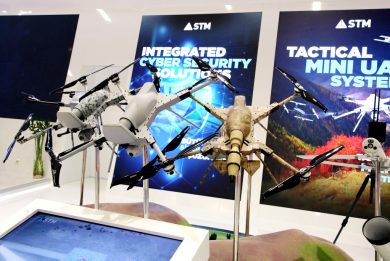
The NETA system is displayed at the International Defence Industry Exhibition MSPO, held in Kielce, Poland, alongside other unmanned and naval programmes, providing the Turkish company with an important European platform for its growing portfolio of autonomous systems.
A family of AUVs for underwater operations
Unveiled at SAHA Expo 2024, the NETA range reflects STM’s ambition to develop a complete family of AUVs. These are intended to support reconnaissance, inspection and mine-countermeasures missions while reducing the exposure of crewed ships and personnel to risk.
STM presents NETA as a family of vehicles covering several operational depth bands, ranging from 100 to 1,000 metres, depending on the variant. Its envisaged mission set extends beyond mine warfare to include underwater surveillance, protection of pipelines and cables, seabed mapping, search-and-rescue support, infrastructure inspection and the collection of data in sensitive or difficult-to-access areas.
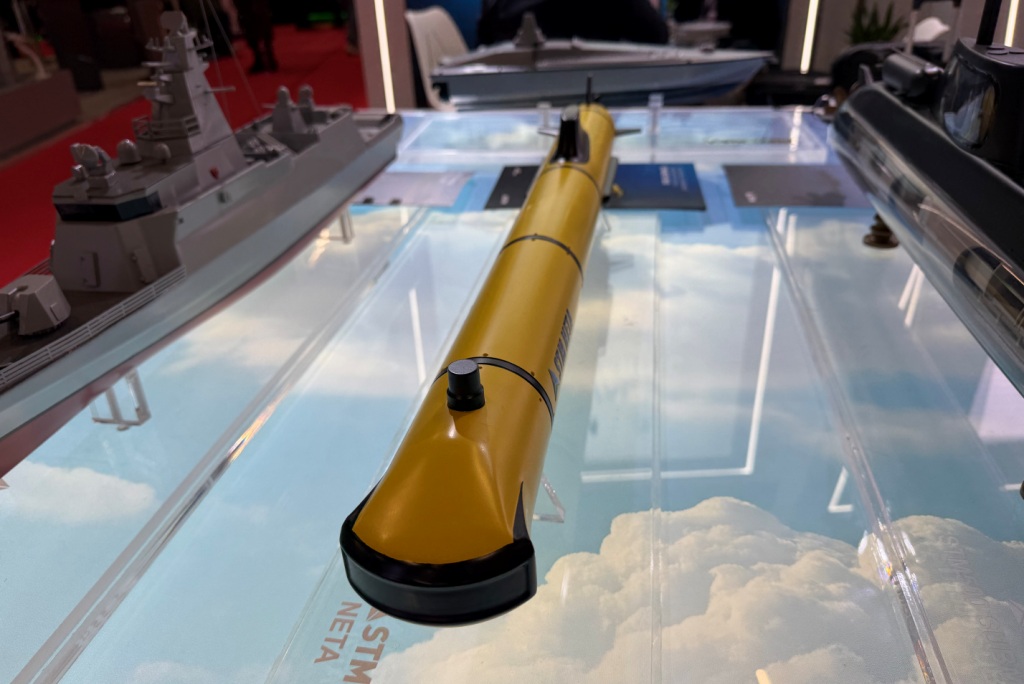
The NETA 300 is the first operationally advanced member of the family. Its initial role is principally linked to mine-countermeasures operations. In this capacity, the AUV can be sent into a suspected area to detect, locate and document mines or mine-like objects before dedicated identification or neutralisation assets are employed.
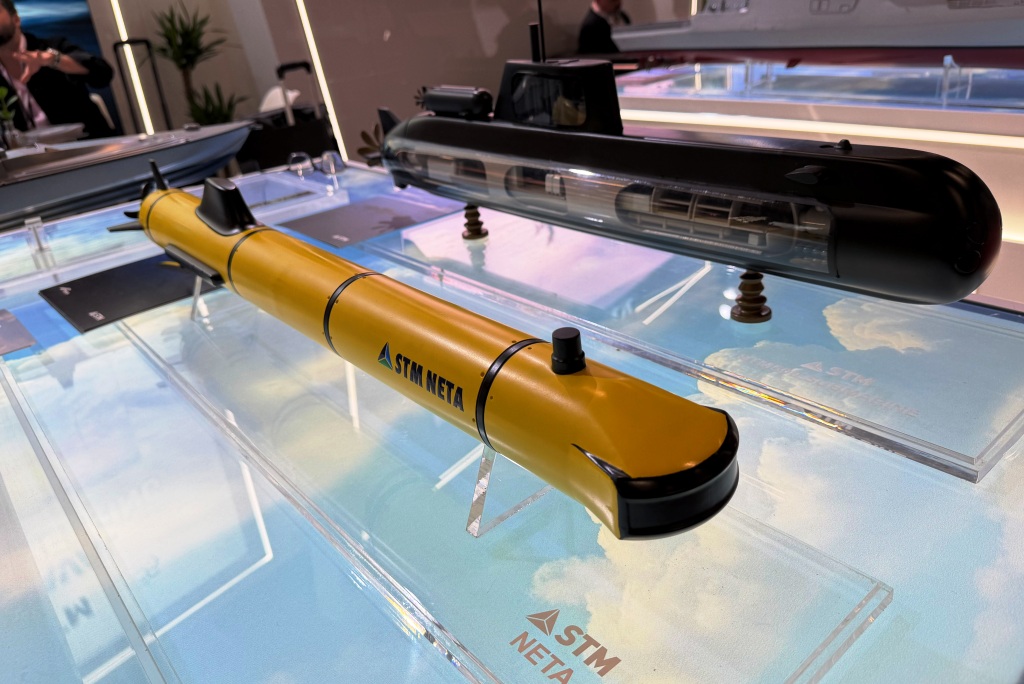
In August 2026, STM announced that NETA 300 had entered series production after a test programme described as close to completion. This is a significant step: the system is moving beyond the development and demonstration stages towards a level of maturity compatible with sustained manufacture and broader operational deployment.
A compact and deployable platform
The STM NETA 300 measures approximately 2.7 metres in length and has a diameter of 205 mm. Its weight mass is around 70 kg in the standard configuration, rising to 85 kg when fitted with a second battery module for extended-endurance missions. Its relatively low mass enables it to be transported, launched and recovered by a team of two operators from a range of surface vessels.
The NETA 300 can operate at depths of up to 300 metres. It has a cruising speed of approximately 3 knots and a maximum speed of 5 knots. Electric propulsion is provided by a direct-drive brushless motor coupled to a three-blade propeller, while the hull is made from marine-grade aluminium.
Endurance is one of the vehicle’s principal strengths. With a 2.1 kWh battery, the NETA 300 can conduct missions lasting around 12 hours. An enhanced configuration, fitted with two batteries with a combined capacity of 4.2 kWh, extends endurance to up to 24 hours. This modular approach allows the vehicle to be tailored either for short reconnaissance tasks or for prolonged sonar-survey and seabed-mapping operations.
For navigation, the NETA 300 combines an inertial system, a Doppler Velocity Log – used to measure its speed relative to the seabed or water mass, an altimeter, and a GPS receiver used whenever satellite signals are available, notably when surfaced. This sensor suite is complemented by communications equipment including an acoustic modem and Wi-Fi; Iridium satellite, radio-frequency and LTE links may also be offered according to user requirements.
In its mine-countermeasures configuration, the NETA 300 can be equipped with a side-scan sonar, a gap-filling sonar and, depending on the stated configuration, a synthetic aperture sonar. These sensors enable it to generate detailed imagery of the seabed, detect anomalies and support the identification of objects that may be mines, wreckage or underwater debris.
Technological improvements
The evolution of the NETA programme is not limited to the transition into series production. Since it’s unveiling, developments have focused on the functions that determine an AUV’s operational effectiveness: autonomous navigation, sonar performance, endurance, payload modularity and integration within a wider ecosystem of unmanned systems.
The first major advance lies in the progressive validation of autonomous navigation in a real maritime environment. Following pool trials, in 2025 STM began sea trials of the NETA 300 in the Mediterranean. These covered sensors, cameras, autonomous navigation, course-keeping and the platform’s overall performance. The transition to open-water operations is a critical milestone for any AUV: currents, reduced visibility, seabed relief, depth variations and limited communications create operational constraints that cannot be fully replicated in static test facilities.
A major improvement concerns the detection chain. For mine-countermeasures operations, the NETA 300 employs a side-scan sonar together with a gap-filling sonar. The side-scan sonar produces detailed seabed imagery and facilitates the detection of anomalies. The gap-filling sonar is intended to reduce areas that may be insufficiently covered by the main sonar sweep, improving continuity of search within a suspected minefield or survey area.
STM has also highlighted the integration of a synthetic aperture sonar, or SAS. This technology uses the AUV’s movement to reconstruct a virtual sonar array with a much larger effective aperture. It can therefore deliver high-resolution imagery across a wider search area. In mine-hunting operations, this improved resolution is especially valuable for distinguishing a real mine from debris, rocks, wreckage or other objects resting on the seabed.
Another improvement concerns operational flexibility. The NETA 300’s modular architecture makes it possible to adapt both energy storage and payloads to the assigned mission. This flexibility is important for a system intended for military as well as civil tasks, including hydrographic mapping, pipeline inspection, wreck searches, search-and-rescue support, pre-mission reconnaissance and mine-countermeasures operations.
Its communications architecture follows the same mission-oriented approach. The NETA 300 is equipped with an acoustic modem and Wi-Fi, while Iridium satellite, radio-frequency and LTE communication options have also been identified. These systems do not provide a continuous radio link at significant underwater depth — which is generally not technically feasible — but support mission planning, status exchanges during selected phases, surface communications and the exploitation of collected data after recovery.
Towards a mothership architecture
The most significant longer-term development is the planned relationship between the NETA 300 and STM’s TENGİZ, an extra-large unmanned underwater vehicle, or XLUUV. Introduced by STM in May 2026, TENGİZ is expected to measure 11.2 metres in length, with a mass of 17.8 tonnes, operate at depths exceeding 400 metres and remain at sea for more than 20 days.
STM describes TENGİZ as a “mothership” platform capable of carrying, transporting and deploying the NETA 300 while submerged. This concept could substantially alter the employment of the smaller AUV. Rather than being launched solely from a surface vessel operating close to the target area, the NETA 300 could be carried discreetly by a much larger and more enduring underwater platform before being released to conduct a localised reconnaissance, mine-search or inspection mission.
Such an architecture could extend the operational reach of the NETA 300, reduce the need to position crewed vessels in threatened areas and distribute tasks among several unmanned platforms. TENGİZ would provide persistence, transit capability and transport, while the NETA 300 would perform a specialist tactical mission using its sonar payloads and ability to survey a defined section of seabed in detail.
The concept also fits within a wider networked naval-operational approach. STM plans to integrate TENGİZ with the ADVENT command-and-control environment, potentially enabling closer co-ordination among crewed platforms, uncrewed surface vessels, aerial drones and autonomous underwater systems.
A maturing underwater capability
The NETA 300 is emerging as a lightweight tactical AUV intended primarily for autonomous reconnaissance and the initial assessment of suspected objects on the seabed. Its value lies in the combination of a readily deployable format, endurance of up to 24 hours, autonomous-navigation functions progressively validated at sea and a sonar suite tailored to mine-countermeasures tasks.
Since its unveiling in 2024, the programme’s progress has been clearly visible: it has moved through open-water trials, strengthened its autonomous-navigation functions, incorporated complementary sonar sensors, developed modular energy and communications options, and entered series production in 2026.
Its display at MSPO in Kielce will provide STM a valuable showcase in Central Europe. More broadly, NETA illustrates the company’s ambition to establish a national family of autonomous underwater systems, ranging from the lightweight NETA 300 AUV to the much larger TENGİZ XLUUV, in support of mine countermeasures, surveillance, critical-infrastructure protection and underwater intelligence missions.
Photos by J. Roukoz