Saha Expo 2026 – Turkish Aerospace Industries unveils Gölge, a piston-engine “baby-Anka III”
Being showcased at a short distance one from the other, it was impossible avoiding noticing a striking resemblance between the Anka-III 7 tonnes class unmanned combat aerial vehicle, dimensions being of course completely different as well as propulsion
Not much was said by Turkish Aerospace Industries (TAI) Turkish Aerospace Industries on the new UAV. According to information gathered at Saha, EDR On-Line understood that a jet-powered airframe of intermediate size was used as technology demonstrator to validate the Anka III concept and more precisely the flight control system. Once all hurdles were positively overcome, the Anka III being now in production, TAI planning to deliver the first aircraft in 2028. According to figures provided by the company the Anka III has a maximum take-off mass of 6.5 tonnes, can carry a payload of 1,200 kg and can fly at altitudes up to 40,000 feet, with a maximum speed of Mach 0.7 and a 10 hours endurance.
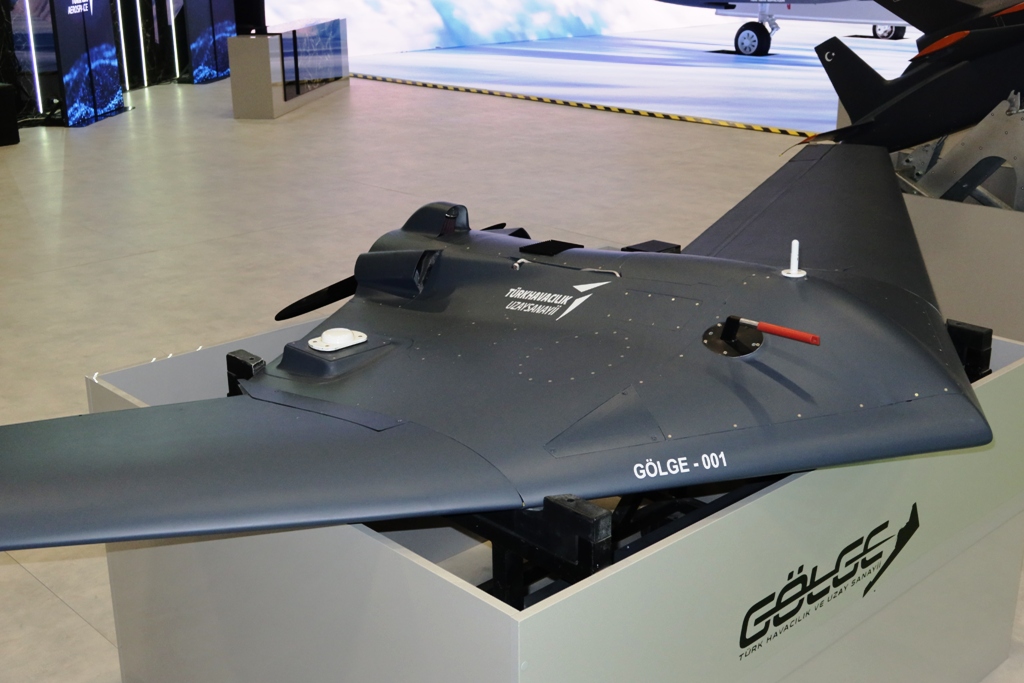
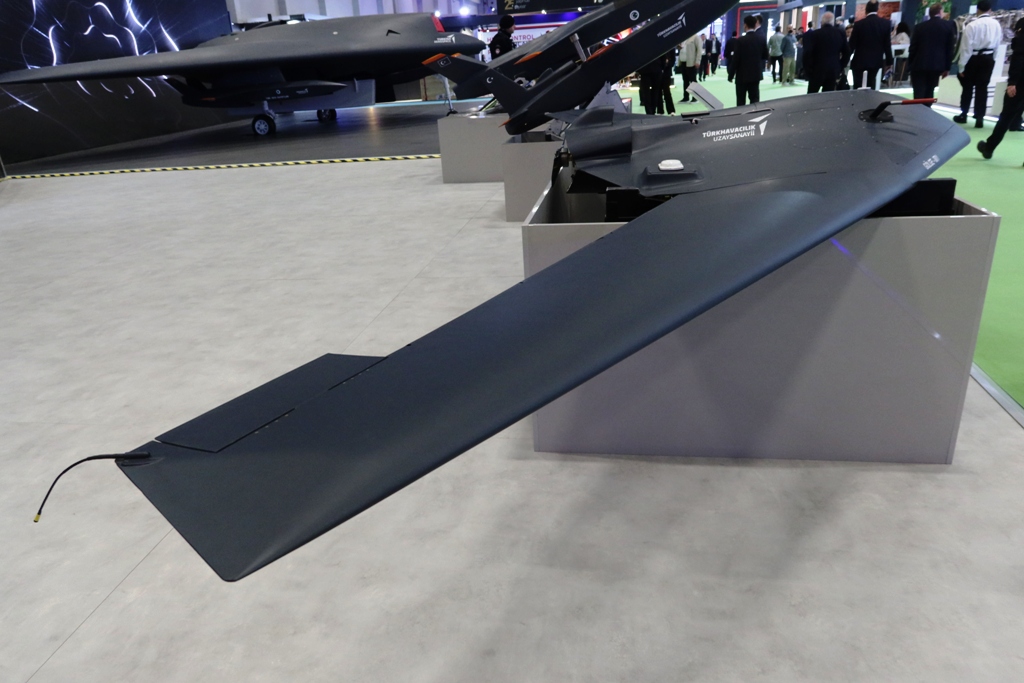
Then company engineers looked at a downsized version of the technology demonstrator, giving birth to the Gölge, a 5 metres wingspan delta wing airframe very similar to the Anka III except for dimensions, the big brother having a 12.5 metres wingspan. EDR On-Line understood that the smaller airframe has a maximum take-off mass of around 100 kg, the payload being 15 kg. Although at a first look the big and the small brothers appear pretty similar, commonalities are evaluated at 30%.
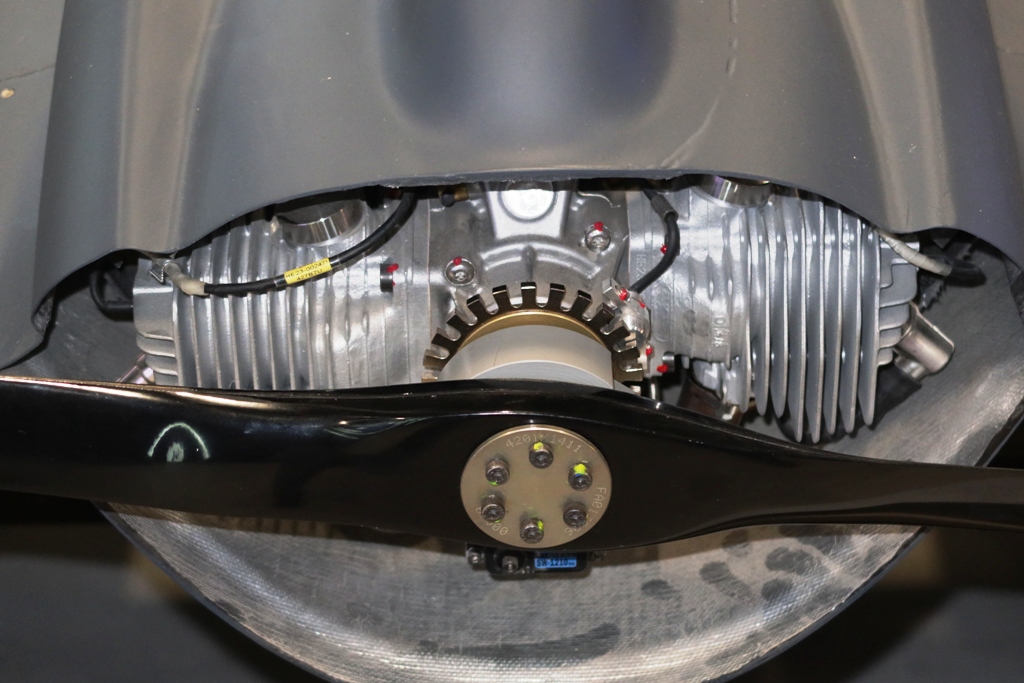
The Gölge takes off from a catapult, which allows it to overcome the stall speed, the 14 hp two-cylinder engine propelling a two-blade pushing propeller ensuring then the needed thrust, available information mentioning a maximum speed of around 165 km/h (90 knots). Three air intakes, two lateral and one on top ensure engine cooling. Born as a stealth platform, it is clear that the presence of a propeller does not favour discretion to radar sensors; the micro-doppler effect created by spinning blades spoils the work done on the airframe shape. It is therefore probable that materials used for building the Gölge will be way less exotic (and expensive) than those used on the Anka III. Endurance is 10 hours, operating ceiling 12,000 feet, the range being 1,300 km.
On the right wing we could see the standard GNSS antenna, while the left wing hosted the CRPA (Controlled Reception Pattern Antenna) antenna, which increases resistance to jamming and spoofing. At the front, on top of the fuselage, an RF antenna could be seen, the one used by the on-board data link which allows the Gölge to exchange information with the ground control station at distances up to 100 km in line of sight being located underneath the fuselage. EDR On-Line understood that the payload will be mostly of the visual optical and infrared type. This is located under the fuselage and is retracted inside it at landing, as the Gölge uses a parachute for landing.
According to information obtained at Saha, TAI should already have attract the interest of three different users in Turkey, no more details being provided on their identity as well as on the status of the deal. Industry testing have been completed and TAI is thus ready to start production.
Photos by P. Valpolini