Singapore Airshow 2026 – ST Engineering presents the AME‑A514 Assault Rifle, next-generation firepower
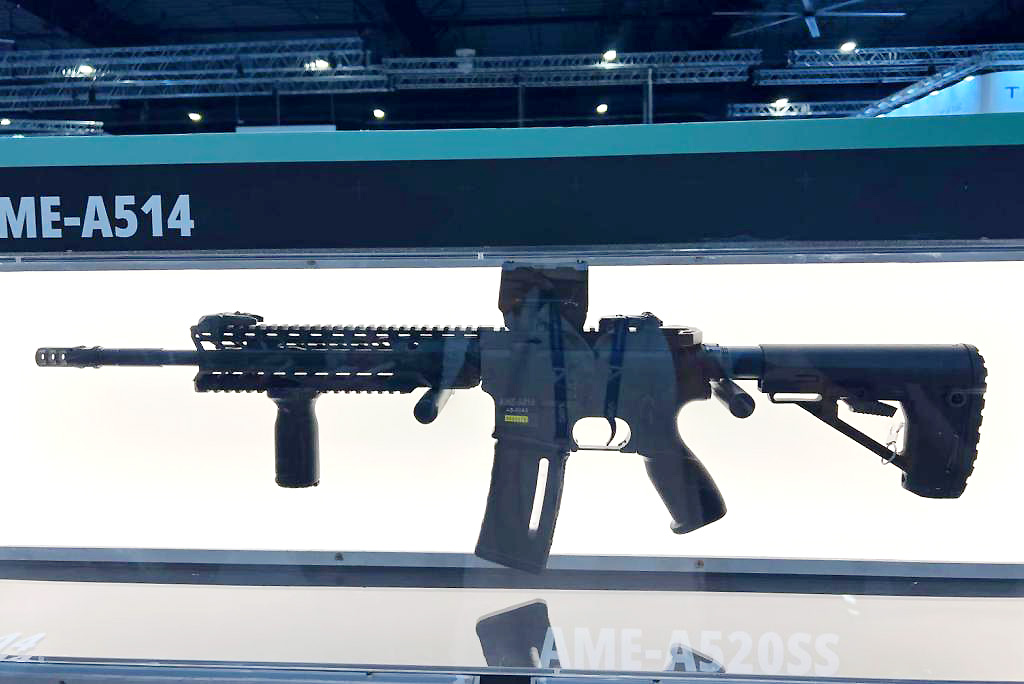
ST Engineering’s AME‑A514 represents the heart of Singapore’s new generation of infantry weapons, designed to replace legacy rifles with a modular platform tailored to tropical and urban battlefields. The AME‑A514, unveiled at Singapore Airshow 2026, brings together improved ergonomics, modern materials, and an architecture ready to host advanced optics and fire‑control systems
At its core, the AME‑A514 is a 5.56 × 45 mm NATO assault rifle intended as the standard weapon for line infantry. It feeds from conventional 30‑round STANAG 4179 magazines, ensuring full compatibility with widely available ammunition and existing logistic chains. Operating by means of a direct gas impingement system provides a lighter, more accurate and smoother recoiling system. With additional titanium nitride coated rotating bolt, it offers the reliability expected in hot, humid, and dusty conditions, while reducing fouling in the receiver and easing maintenance for conscript soldiers. Controls are largely ambidextrous and follow the general layout familiar from AR‑15 family weapons, shortening training time for users already accustomed to this pattern.
The barrel length of the AME‑A514 sits in the mid‑range typically associated with general‑purpose assault rifles, 14 to 15 inches. This configuration strikes a balance between compactness in confined spaces and sufficient muzzle velocity for effective engagement at normal infantry distances. Overall length varies according to stock position, but the weapon remains short enough for vehicle crews and urban combat while retaining the reach needed for open‑terrain engagements. The barrel is free‑floating within a rigid fore‑end, improving practical accuracy, particularly when accessories such as bipods or under‑barrel grenade launchers are fitted.
In terms of construction, the AME‑A514 makes extensive use of high‑strength aluminium alloys and polymer composites to manage mass without sacrificing robustness. The upper receiver features a full‑length Picatinny rail for day sights, image intensification, and thermal optics, while shorter accessory interfaces on the handguard allow the mounting of illumination systems, laser pointers and foregrips. The stock is adjustable to suit different body sizes and load‑bearing equipment, and the pistol grip has been reshaped to provide more positive control in wet conditions. All major user controls — safety/selector, magazine release and bolt catch — are either duplicated or designed for easy operation by right‑ and left‑handed shooters alike.
Autonomy on the battlefield, in the small‑arms sense, is governed primarily by the number of rounds a soldier can carry rather than the weapon’s internal mechanisms. Here, the AME‑A514 leverages lightweight polymer magazines and an efficient 5.56 mm cartridge to maximise the ammunition load without overburdening the infantryman. The robustdirect gas impingement, corrosion‑resistant coatings and sealed design reduce the frequency of stoppages and cleaning, translating into higher operational endurance between armoury‑level maintenance sessions. In practice, a soldier equipped with several 30‑round magazines can sustain prolonged engagements with a weapon that remains reliable and controllable over extended firing sequences.
Within the AME family, the AME‑A514 sits alongside the AME‑A510, which appears to occupy the role of a more compact carbine. While official, fully detailed specifications remain scarce, the A510 is generally understood to feature a shorter barrel and slightly reduced overall length. This makes it well suited to vehicle crews, special units operating in tight urban environments or personnel for whom a full‑length assault rifle would be cumbersome. By contrast, the AME‑A514 is optimised as the primary service rifle, offering a longer barrel for improved ballistic performance and effective range while still remaining manoeuvrable.
The difference in barrel length between the A510 and A514 has several practical consequences. The shorter tube of the A510 favours close‑quarters handling and rapid target transitions but typically yields lower muzzle velocity and a reduced effective range, especially when using standard 5.56 mm ammunition. The AME‑A514’s longer barrel allows the propellant to burn more completely, improving velocity, terminal effect, and penetration at medium ranges. For the end user, this translates into a carbine better tailored to close‑in fighting on the A510 side, and a more versatile, general‑purpose rifle in the case of the A514.
Both rifles share the same core operating mechanism, magazine compatibility and general ergonomics, which simplifies training, armoury support and spare‑parts management. Units can therefore mix A510 and A514 within the same formation as mission profiles demand, while maintaining common procedures and maintenance routines. In many armies, such a family approach replaces the previous practice of fielding entirely different weapons for compact and standard roles, and ST Engineering clearly follows this logic with the AME series.
The AME‑A514 also fits into a broader ecosystem that includes the longer‑barrelled AME‑A520 for marksman duties and the AME‑B514 bullpup, aimed at users who prefer a very compact weapon without sacrificing barrel length. The architecture has been conceived from the outset to accept advanced day/night sights and, eventually, integrated fire‑control units capable of range finding and ballistic computation. In this sense, the A514 is not just a replacement for older rifles but a digital‑age platform ready to evolve as sensors and soldier‑system technologies mature.
By exhibiting the AME‑A514 at the Singapore Airshow, ST Engineering signalled its intention to market the weapon for customers seeking a modern yet familiar 5.56 mm solution. The rifle’s blend of proven mechanical principles, contemporary ergonomics, and growth potential positions it as a credible contender in a crowded global small‑arms market. For operators, the key attraction lies in a weapon that feels immediately intuitive but is engineered to meet the demands of tomorrow’s connected battlefield.
Photo by J. Roukoz