Launch of the Vigilansea Project: toward autonomous maritime persistence between surface and aerial systems
Toulouse, March 02, 2026
A new milestone in USV & UAV interoperability for surveillance and inspection missions at sea.
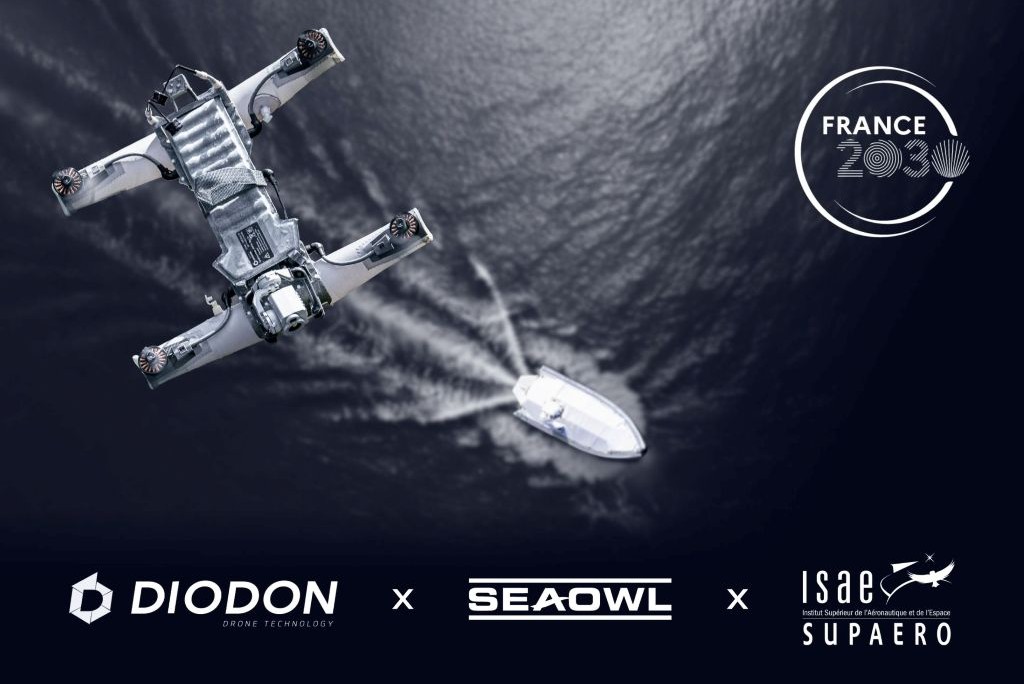
DIODON announces the launch of Vigilansea, the most ambitious project in its history, aimed at enabling persistent USV & UAV operations at sea for surveillance and inspection missions. This three-year program, funded by the French government under France 2030, will be led by DIODON in partnership with SeaOwl Technology Solutions and ISAE-SUPAERO.
Building on DIODON’s ongoing work in aerial-surface interoperability, the project focuses on the development of two key technological building blocks:
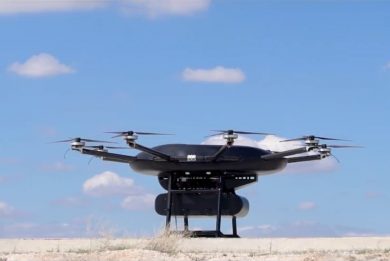
— A new-generation maritime UAV designed for long-endurance operations in open seas;
— An onboard UAV station for USVs, DIODON REEF, enabling deployment, recovery, recharging, and operational readiness of the aerial platform, allowing repeated high-sea missions without human intervention.
These developments will be complemented by the design of a dedicated SeaOwl USV for autonomous UAV deployment at sea, supported by ISAE-SUPAERO’s expertise in aerodynamic optimization and advanced flight control systems.
A roadmap built on concrete operational experimentation
For several years, DIODON has structured its expertise around the hardware and software integration of maritime UAVs within existing naval architectures, with a strong focus on UAV × USV cooperation.
Its software integration capabilities were notably demonstrated during Dronathlon 2024 (see video), with successful C2 interfacing achieved through the use of onboard communication systems, including satellite connectivity integrated on the USV.
In 2025, participation in NATO’s Task Force X Baltic (see video) confirmed DIODON’s hardware integration expertise through the development of a deployment module enabling the deployment of the DIODON HP30 maritime UAV from USVs: the DIODON LAUNCHER.
At the same time, DIODON’s expertise in designing natively maritime UAVs has addressed one of the primary barriers to interoperability: the UAV’s ability to withstand the harsh marine environment of USV operations (watertightness, positive buoyancy, structural robustness, resistance to corrosion, sea spray, wind, and waves).
Toward autonomous persistence in open seas
The operational objective is clear: to enable sustained maritime presence by combining the endurance of a surface drone with the aerial observation capabilities of a UAV. This approach significantly extends maritime coverage, automates mission execution, and reduces human exposure in complex environments.
By integrating autonomous deployment, recovery, onboard recharging, and real- time coordination through resilient communication architectures, VIGILANSEA aims to achieve a decisive step toward repeated mission execution without human intervention.
The UAV thus becomes a true remote sensor for the surface platform, extending surveillance from open seas to coastal areas, accelerating detection and identification of suspicious activities, and strengthening overall maritime situational awareness.
This architecture enables a broad range of missions:
— Maritime surveillance and counter-trafficking operations;
— Protection of critical coastal and offshore infrastructure and sensitive areas;
— Environmental inspection and pollution detection;
— Maritime safety and security missions across wide maritime zones.
“The control of maritime spaces has always been a central strategic challenge. Today, however, the scale of the areas to be monitored and the intensity of maritime activities make it a challenge of an entirely different magnitude. Ensuring extended and sustained coverage requires complementing human assets with collaborative, integrated robotic solutions.”
— Antoine TOURNET, CEO & Co-founder of DIODON Drone Technology.
photo courtesy DIODON Drone Technology