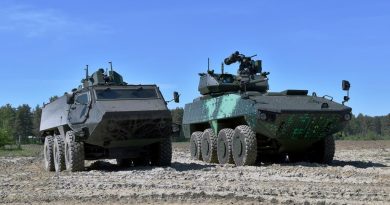
► Patria and Latvia sign comprehensive life-cycle support agreement for CAVS 6×6 armoured vehicle fleet
March 12, 2026 – Patria and Latvia have concluded Life Cycle Support (LCS) agreement for the Common Armoured Vehicle System (CAVS) 6×6 armoured vehicle fleet operated by Latvian National Armed Forces (LNAF). The agreement supplements the 2024 Life Cycle Management (LCM) contract for the 6×6 CAVS signed by Latvia, Finland and Patria, which Sweden and Denmark later joined. The contract defines Latvia-specific sustainment processes, responsibilities, services and products ensuring long-term operational readiness of the fleet.
The arrangements of the contract fully support Latvian security of supply requirements and is aligned with the overarching CAVS programme’s Life Cycle Management framework. The agreement brings all local and Original Equipment Manufacturer (OEM) level sustainment activities under one contract.
“This agreement strengthens Latvia’s long-term readiness by combining capabilities of the national defence industry with Patria’s OEM expertise. The LCS framework ensures reliable, efficient and future-proof sustainment for the Latvian CAVS fleet for years to come,” says Pekka Ruutu, Executive Vice President of Patria’s Sustainment Solutions business area.
“Through the CAVS programme, Latvia’s security of supply in armoured 6×6 vehicles will be exceptionally strong, supported by ongoing local vehicle assembly since 2022, a completed maintenance, repair and overhaul (MRO) technology-transfer programme in 2025, and the establishment of a dedicated spare parts stock capable of supporting both peacetime and crisis conditions,” says Ugis Romanovs, Patria’s Country Manager for Latvia.
The Finnish-led CAVS programme currently consists of seven member nations: Finland, Latvia, Sweden, Germany, Denmark, The United Kingdom and Norway with the vehicles being also operational in Ukraine. Within the CAVS programme, the 6×6 armoured vehicle system development is led by Patria, that has more than four decades of experience in developing and delivering state-of-the-art protected troop transportation and system integration. Vast majority of supply of the vehicles is conducted by utilising the member nations’ local industry capabilities and every new nation is inherently reinforcing the security of supply for the whole collaboration system.