Enforce Tac 2026 – Guardiaris widens its portfolio with the Vortex radar and solid oxide fuel cell solutions
At the Nurnberg exhibition Guardiaris, the Slovenian company which core business is simulation, unveiled two new branches of products developed by two spinoff companies, Carboteh and CeraSynth, the former working in the radar field presenting its Vortex radar while the latter was showcasing its solid oxide fuel cell solutions, both dual technologies that can find applications in the military and civilian environment
While the Guardiaris stand was dominated by the Mobile Training Center, a truck-mounted version of the company well known Small-Arms Mobile Trainer (SAMT), another simulation tool, the DOTT, for Drone Operator Tactical Trainer underlining the house specialty, two spin-off companies were showing for the first time their solutions in the radar and power domains.
Carboteh is currently producing the BANS™, for Battlefield Anti-aircraft Non-kinetic vshorad System, and the MAAT, for MANPADS And Aircrew Trainer; the former is a system that digitally stimulates the aircraft’s missile launch warning and detection system leading the self-protection suite to dispense countermeasures, leaving the fix- or rotary wing aircraft vulnerable to air defence missiles, while the latter is an all-in-one trainer that allows simultaneous training of gunners, aircrews, MAWS operators and electronic warfare officers. The company being the group element involved in air defence, the next step was developing a sensor capable to detect UAVs and FPVs.
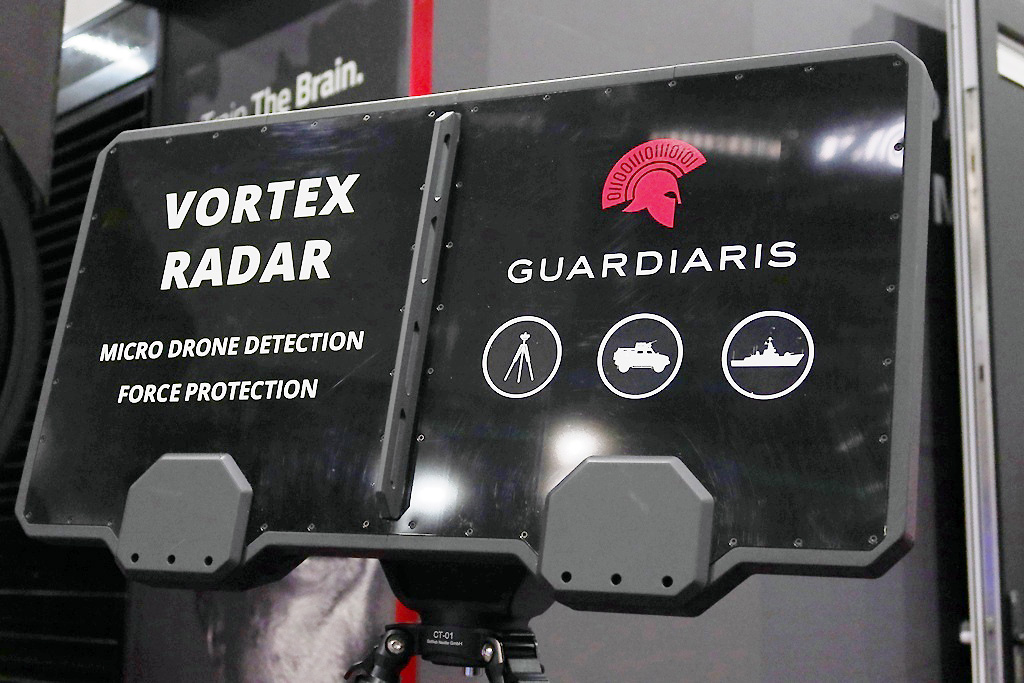
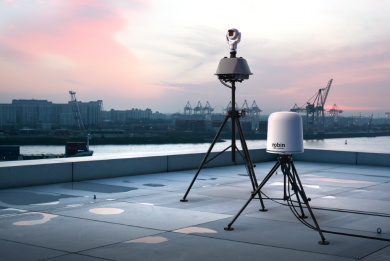
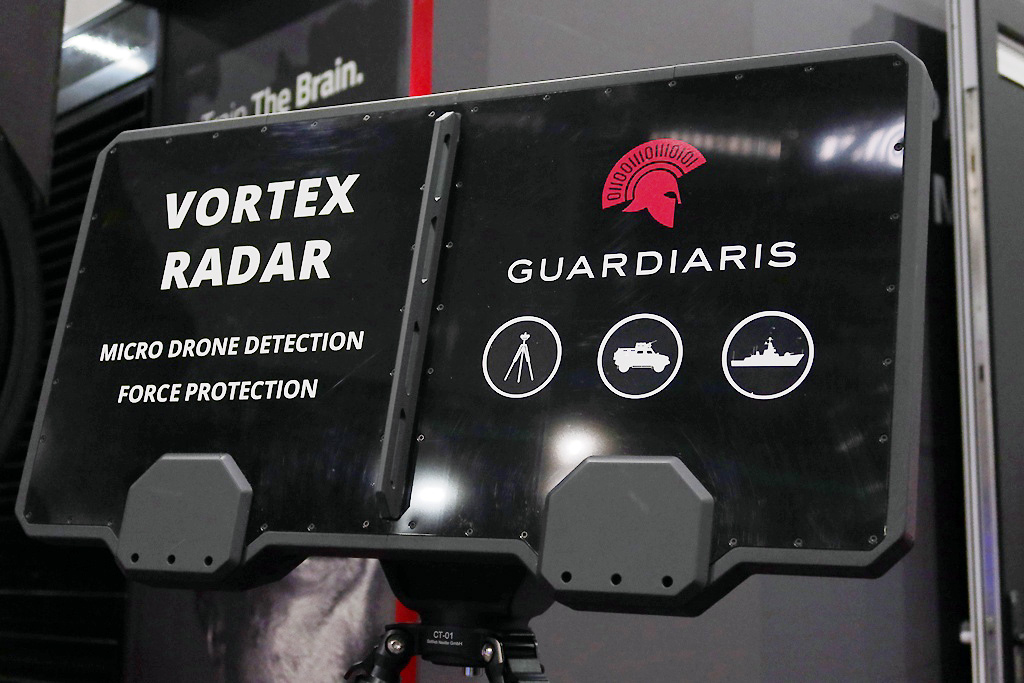
The Vortex is a lightweight, under 25 kg, AESA X-band radar that provides a 100° coverage in azimuth and 60° in elevation, thus four such radars allow full 360° coverage. It can be installed in a static configuration, on a tripod as seen at Enforce Tec, over a building, etc, or on board a light vehicle or a small naval vessel. Designed for force protection duties, it can detect a micro quadcopter drone at over 2 km, while bigger targets such as helicopters can be seen at over 5 km. The Vortex tracks the rotation of rotors and propellers, exploiting the doppler effect, which helps in detecting very small targets with very low radar cross sections. Target classification is based on doppler analysis and AI algorithms, the radar being able to acquire over 20 targets per scan, scan frequency being over 2 Hz, which allows it to detect swarms of drones approaching. Data interface is 1 GE (Gigabit Ethernet) or 10 GE, the Vortex supporting Asterix (All-purpose STructured EuRocontrol surveillance Information eXchange), battle management systems, C2/C4I systems and API Application Programming Interface) protocols. Power supply is provided with a 28 VDC source, power consumption for a 360° solution being 350 W.
The Vortex radar is being developed as part of a Ministry of Defence research, development and innovation initiative. The project is carried out with the support of the Slovenian Armed Forces and in cooperation with a consortium of Slovenian defence and research partners, including KEKO Equipment, Impol, the University of Ljubljana and the University of Maribor, led by Guardiaris. The Vortex radar is fully tested and is ready for production.
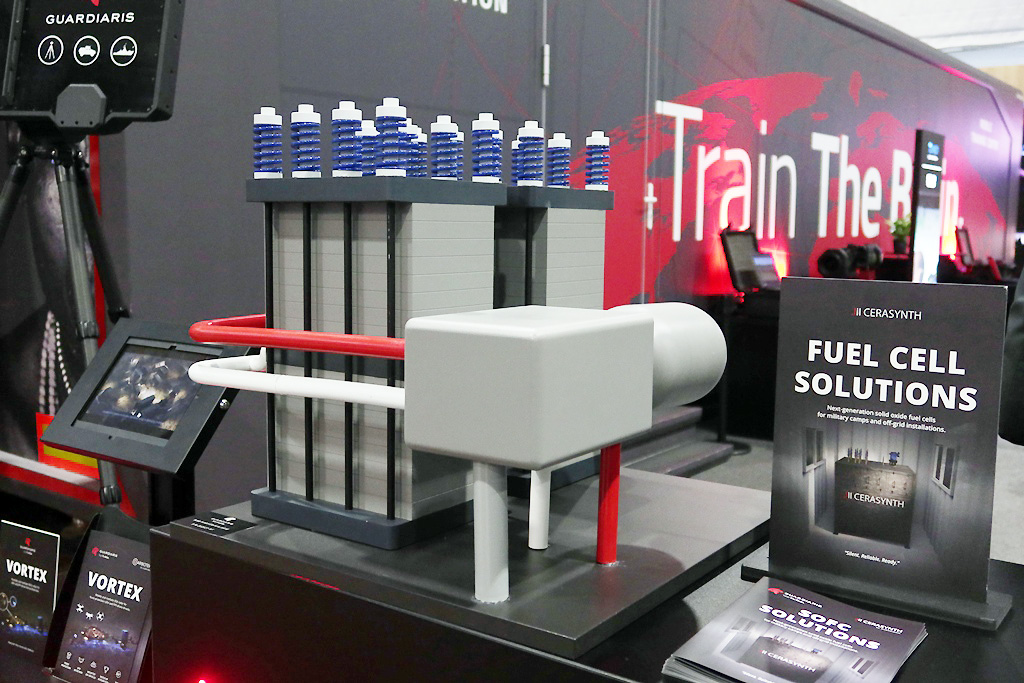
As seen, protecting a forward base means also powering it. Here another Guardiaris spin-off comes into play, CeraSynth being focused on Solid Oxide Fuel Cells (SOFC) and Solid Oxide Electrolysis Cells (SOEC). Based on SOFCs the company is proposing solutions for powering off-grid installations, military forward operating bases (FOBs) being an obvious example. Among the advantages mentioned by the company we find an efficiency of over 60%, silent operations, low thermal footprint, no CO2 emissions, and fuel flexibility, as cells can be fuelled with hydrogen, methanol, methane, ammonia, or CO. Not only, in emergency situations other fuels such as diesel, jet fuel or gasoline can be used. When powering a FOB, a SOFC solution such as that proposed by CeraSynth is not limited to electric power, heat exhausts allowing to obtain hot water, heating, and cooking energy, in that case efficiency can get closer to 90% although thermal signature must be considered. The company proposes 2 kW and 8 kW units; however. the system is scalable, containerised solutions being also available. CeraSynth is ready to produce tailored solutions according to customers’ needs.
Photos by P. Valpolini