Dubai Airshow 2025 – EDGE unveils its latest radars widening its C-UAS sensors portfolio
While some radars developed by EDGE were already unveiled at IDEX 2025, at the Dubai event the UAE defence group showcased for the first time some other radar sensors, while detailing the progresses made with the already known ones
One of the busiest entities within EDGE must be the Radar Centre of Excellence, which task is to develop solution to fit customers’ requirements, some of these to become part of integrated systems provided by other e group companies. The radars are mostly operating in the X and S bands, and artificial intelligence (AI) insertions are becoming more and more common.
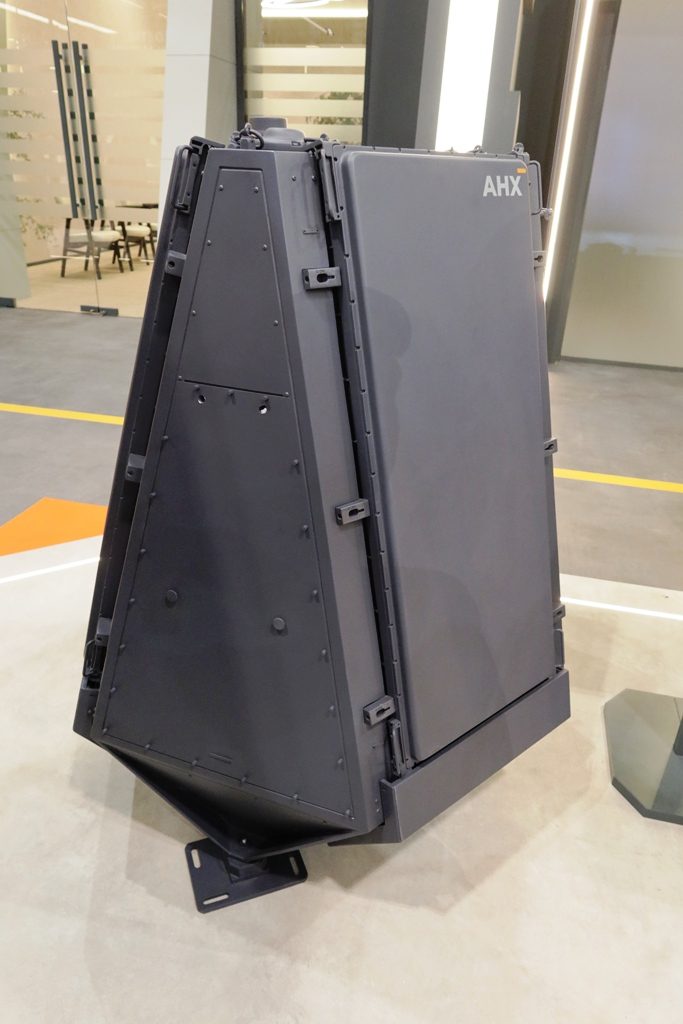
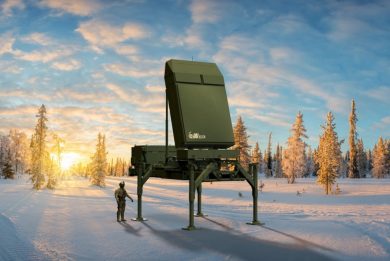
Among new systems we could find the Al Haris-X, a next generation long range drone detection and multi-mission surveillance 3D multi-function X-band digital AESA radar. Software driven, highly scalable, the Al Haris-X, the last letter showing the operating band, will become the core of EDGE counter-UAS systems, but can also be employed for key targets protection, border protection and SHORAD applications. Its flat AESA antenna is 1,465 mm long, 665 mm wide and 153 mm thick (at Dubai a 60% scaled down model was exhibited) and covers +/- 60° in azimuth and +/- 40˚ in elevation, therefore at least three antennas must be used to cover the full 360°. According to data provided it has a 250 km instrumented range, maximum detection range for a target with a 0.1 m2 radar cross section (RCS) being 50 km, which become 15 km for a 0.01 m2 RCS target. Declared accuracy is 0.3° in azimuth, 0.2° in elevation, 1 meter in range and 0.1 m/s in velocity, minimum detectable velocity being 1 m/s. The Al Haris-X can follow up to 10,000 tracks simultaneously, a plus when looking at swarming threats, with a refreshing rate of 0.5 to 2.5 seconds, however targets selected as high priority are dealt with a 10 Hz update rate. It is capable of automatically classify targets thanks to AI-based algorithms. Beside static applications, considering its dimensions it can be integrated on land and naval platforms. The system is currently in the development phase, EDR On-Line understanding it is around halfway.
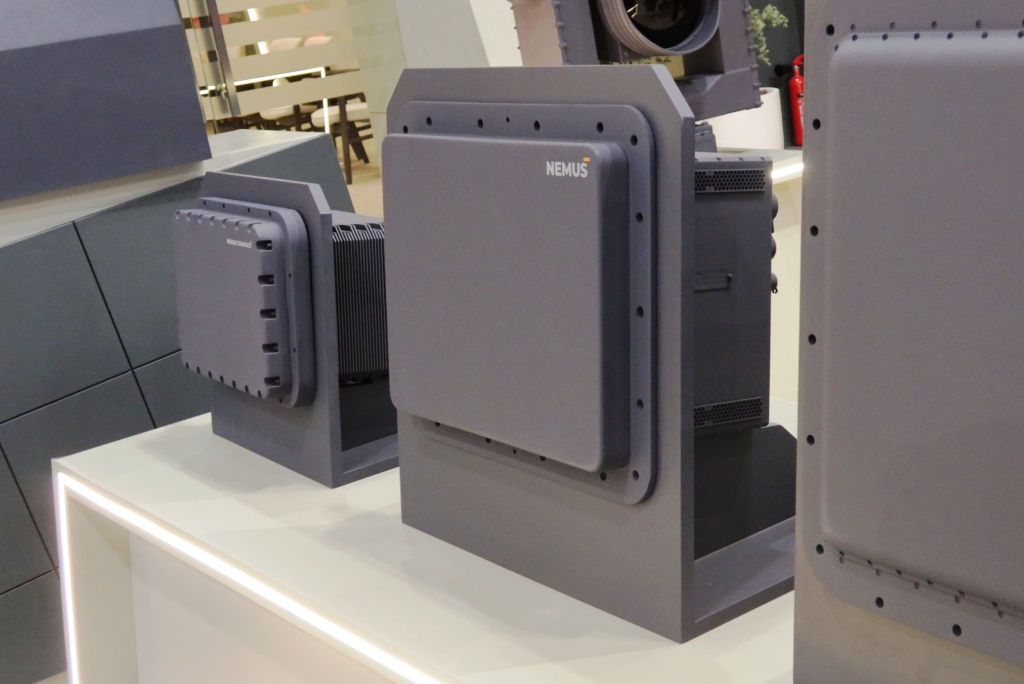
Another sensor seen in Dubai that has counter-UAS applications, and not only, is the Nemus Compact, the little brother of the Nemus, both operating in the S-band, EDGE proposing two versions to cope with different types of platforms. Comparing it with the bigger solution, each AESA antenna, which also contains the whole electronics, is 295 mm high (versus 435 mm), 405 mm wide (555 mm) and maintains the same depth, 305 mm. Each module has a +/- 45° in azimuth and -10°/+70˚ in elevation. Four elements are therefore needed to cover the 360°, the addition of a fifth element looking upwards providing detection against top-attack threats. Being designed to be used as part as active protection systems, it can detect incoming threats at a range of up to 405 metres; Fully digitised, it is capable to detect nano-, micro- and mini-UAVs, as well as incoming projectiles such as antitank missiles, rocket-propelled grenades and kinetic energy rounds of the APFSDS type fired from main battle tanks, at speeds ranging from 90 m/s of the slowest targets up to 2,000 m/s of kinetic energy penetrators. Range accuracy declared is 1.15 metres, while azimuth and elevation accuracy are respectively 1.5° and 2°, with a velocity accuracy of 5 m/s against fastest targets and 0.1 m/s against slowest ones. The Nemus Compact can track simultaneously over 20 incoming targets per element. The radar is powered in 28 VDC, which makes it compatible with vehicle applications. All this makes the radar the perfect sensor for an active protection system (APS), capable to defend armoured vehicles against multiple threats, basically all those listed above. Although EDGE never announced the development of an APS system, it would not be a surprise to find one announced at next IDEX, in February 2027, as it would perfectly fit the group development logic. Its dimensions also allow it to be fitted to small naval platforms, providing them with a C-UAS sensor capable to detect incoming threats and direct effectors available on board.
Compared to the Compact version the full-size Nemus has the same spatial coverage pattern. Here EDGE declared detection ranges, which are 3.4 km against a 0.005 m2 RCS nano-UAV, 4 km against a micro-UAV (0.01 m2 RCS), 7 km for a mini-UAV (0.1 m2 RCS) and 12.5 km when dealing with a small-size UAV (1.0 m2 RCS). It can also detect a vehicle at 13 km distance, an incoming APFSDS round at 1,100 metres and an RPG or antitank missile at 1,900 metres. Declared accuracy is 1 metre in range, 1° in azimuth, 1.5° in elevation and from 0.1 to 10 m/s in velocity, depending on operating in low- or high-speed mode, speed detection range being between 0.1 and 2000 m/s. Each radar element can track simultaneously over 100 targets.
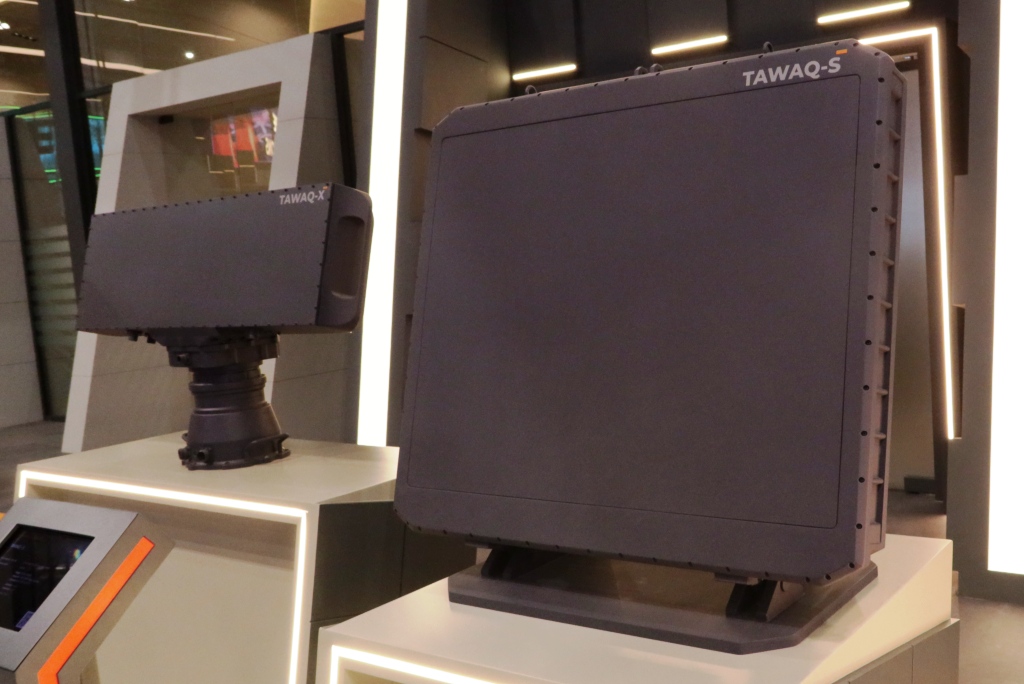
To counter the drone threat EDGE also developed the Tawaq family of radars. The Tawaq-X short-range, low-altitude 3D X-band air-surveillance radar that provides detection, tracking and automatic classification of flying objects, including mini-UAVs. Tripod-mounted, it features mechanical rotation electronic elevation scanning, up to 20°, with respective accuracy of 0.25° and 0.5°. Update rate can vary from 20 to 10 to 5 seconds, in the latter mode maximum detection ranges being 4.5 km against 0.005 m2 RCS nano-UAVs, 5 km against 0.01 m2 RCS micro-UAVs, and 9 km against 0.1 m2 RCS fixed-wing UAVs.
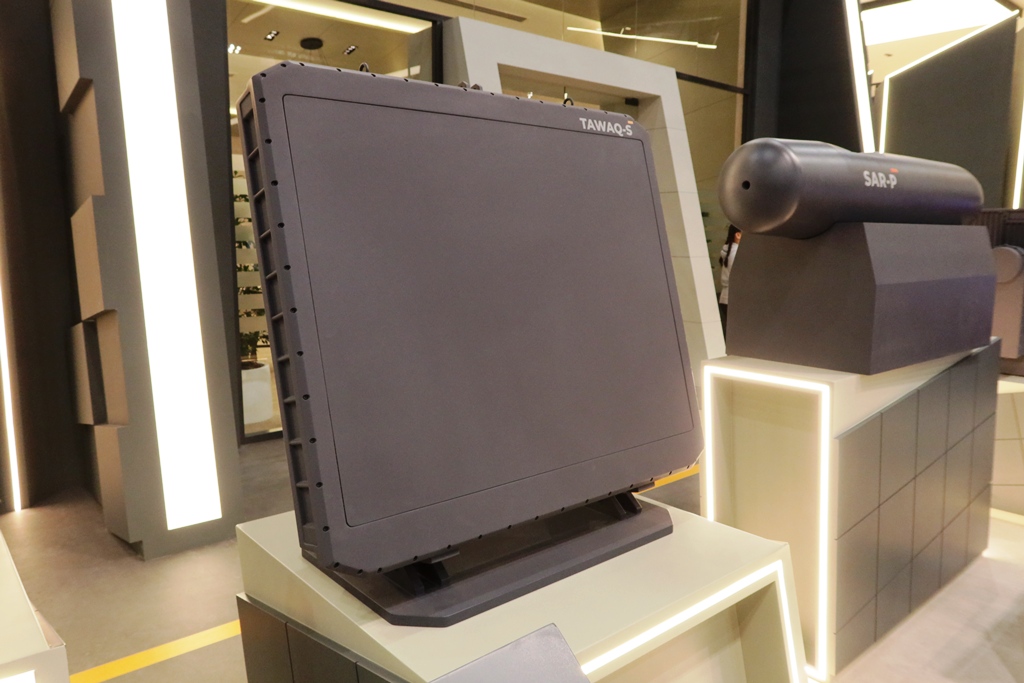
Operating in the S-band, the Tawaq-S is a 3D surveillance radar with AESA antennas based on GaN technology, which has a much wider set of missions, including not only C-UAS but also border protection, coastal surveillance, and counter rocket, artillery, and mortar (C-RAM). Each antenna covers over 90° in azimuth, four being needed to cover the 360° arc, elevation being -15°/+75°. Maximum detection range is 45 km against 0.5 m2 RCS fixed wing UAVs and 60 km against a 2 m2 RCS fighter aircraft.
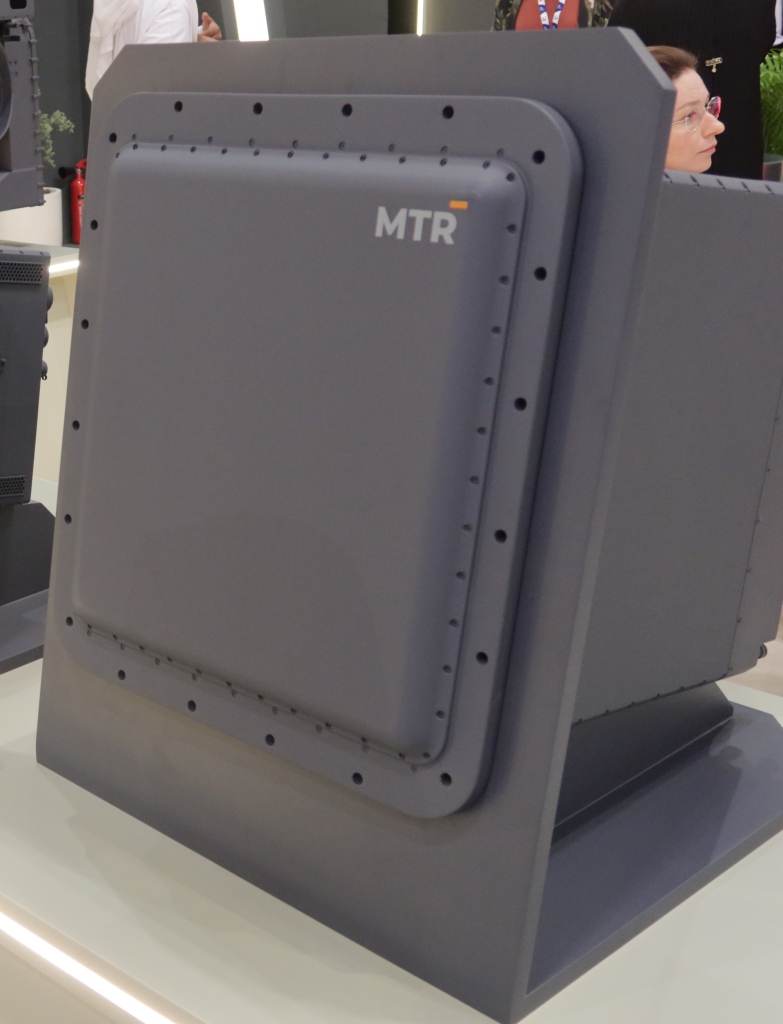
Another AESA S-band system is the MTR-1, a multi-functional radar designed for air defence purposes, which beside targets detection, tracking and classification is also capable of tracking its own missiles. Hosted in a 10-foot container, with the four flat-panel antennas on the top, it has a 360° surveillance capability with a range up to 50 km.
All those radars being software-based, are subject to a spiral improvement process, AI-based algorithms being added to increase autonomous functions, especially in the target identification and classification process. The company declined to provide information about the development status of the various radars mentioned in this article.
Photos by P. Valpolini