
MBDA and Safran Electronics & Defense announce successful testing of the surface-to-surface Thundart missile
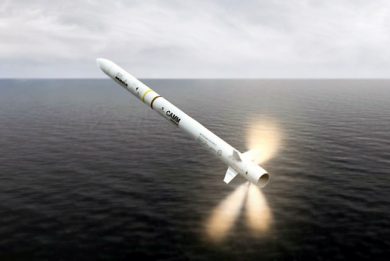
As anticipated by EDR On-Line, mid-April saw the first live firing test of the Thundart, the missile proposed to the French DGA by the MBDA-Safran team to answer the FLP-T (Frappe Longue Portée Terrestre, Long-Range Land Strike) requirement aiming to replace MLRS systems in service with the 1st Artillery Regiment of the French Army
“MBDA and Safran are proud to announce that Thundart deep strike system has successfully completed a demonstration firing. This took place on April 14th at the DGA Missile Test site on the Île du Levant [in the Mediterranean Sea, south-west of Touon] and was a complete and total success. It has not only demonstrated but also exceeded all expectations, both ours at MBDA and Safran as well as those of the DGA Missile Tests teams, not only in terms of flight dynamics but also in terms of demonstrated performance,” Hugo Coqueret, the MBDA France business development for land combat activities explained during the presentation, carried out together with Michel Soulard, the director of the Air-Land Combat Systems department at Safran Electronics and Defence.
Only 18 months elapsed since the launch of the programme. “This development has been very rapid within the framework of our partnership because both MBDA and Safran are building on mature and thoroughly tested technological building blocks. In particular, the AASM guidance kit, the AASM being the main air-to-ground weapon currently equipping aircraft like the Rafale and is used very regularly in current theatres of operation. Another key to this rapid development was the 100% integration of Roxel as an MBDA final,” Michel Soulard underlined.
In January 2025 MBDA finalised the acquisition of Safran’s 50% share of Roxel and integrated the company as a wholly owned subsidiary. The development of a fully new propulsion system for the Thundart was one of the very first programmes since the company is under MBDA and was carried out in only 10 months. The launch allowed to demonstrate the capability of the propulsion system, however the rocket was also fitted with the guidance kit derived from that of the AASM and with a telemetry system that allowed to gather a huge amount of real data, which will be of importance in the further development phase. According to the speakers the guidance kit performed flawlessly during the entire flight, EDR On-Line understanding that currently the guidance kit use does not contain the LIR that might be added at a later date.
Around 100 employees from MBDA and Safran are already working on the Thundart programme. MBDA and Safran already cooperated on several programmes, the two companies controlling together 63% of CILAS, the French specialist in laser systems, involved in the SYDERAL C-UAS system.
According to the companies the Thundart is the first fully sovereign European system of its class to be tested in real. Six different sites in France are involved in the programme, three per each company. “This allows France to have full freedom of use and complete control over the standard system, both over its evolution and over the various interfaces that can be implemented. Similarly, having this sovereign solution allows for freedom of decision regarding exports. Therefore, France will indeed be able to decide on its export clients independently, without being subject to external constraints from other nations,” the speakers underlined. They also highlighted the importance of the full control of the supply chain, especially in the context of a war economy, and that of the increasing production capacity of both companies, which considerably increased their potential in the last few years.
The Thundart is a high supersonic weapon, no precise figures being provided, declared speed being between Mach 1 and Mach 5, which means targets at maximum range can be hit in a few minutes, with a maximum range of 150 km and carries a 100 kg warhead, Eurenco and Aresia being the main subcontractors. MBDA And Safran representatives underlined its higher accuracy compared to currently available competitors, not to mention its capacity to operate in GNSS denied scenarios. This and the heavy warhead will ensure a powerful terminal effect, capable to neutralise enemy artillery systems, in an artillery duel, as well as other key targets such as ground-based air defence artillery, command posts as well as logistic centres or lines of communication, slowing down the enemy manoeuvre hitting their capabilities before they can even get in contact with friendly troops. Elaborating on the accuracy and lethality issues, the speakers underlined that delivering a warhead and maintain terminal guidance at the high speeds involved in the last phase of a ballistic trajectory is not easy task. “Since we also produce other air-to-ground and surface-to-surface missiles, this allowed us to work from the outset on how to manage this terminal velocity and avoid simply entering freefall, which is what would happen with a rocket making a conventional re-entry and not controlling its final trajectory,” implying that in the final phase the trajectory is not entirely ballistic to optimize the effects.
The Thundart will be launched from a Scania France 8×8 truck which will carry eight munitions; this will be fitted with an armoured cabin provided by Essonne, CMAR being responsible for the azimuth and elevation system, while the reloading crane is supplied by Palfinger, which makes the launcher a fully French element. The launcher will be capable to travel cross-country, to reach a maximum off-road speed of 90 km/h, allowing quick redeployment, and will have a range of 600 km, mobility being a key element when operating in shoot-and-scoot mode to avoid enemy retaliatory fire.
Should the MBDA-Safran team obtain the contract, it is competing against the ArianeGroup-Thales team, the two companies are planning to create a joint venture that will ensure the full development and production of the Thundart, the aim being to deliver a sovereign operational capability to replace French Army MLRS rocket launchers by 2030, although some options might move this date to the left.
The Thundart team obviously does not limit the market to that of the Frenc Army, and looks at the international market,
Image courtesy MBDA/Safran