Oreshnik, Russia’s new hypersonic theatre strike hammer
The Russian Oreshnik/Orechnik missile is a ground‑launched, intermediate‑range hypersonic ballistic missile derived from the RS‑26 Rubezh programme, designed to deliver multiple warheads over long distances against strategic targets, with or without nuclear payloads
In terms of role and concept of employment, Oreshnik is primarily a regional strategic strike asset, capable of engaging targets between roughly 3,000 and 5,500 km, which places it in the IRBM (Intermediate Range Ballistic Missile) category, allowing it to cover the entire European theatre from Russian or Belarusian territory and to threaten targets deep in the operational rear.
It functions both as a tool of deterrence (through its potential nuclear capability) and as a very high‑precision conventional strike weapon against critical infrastructure, air bases, logistical hubs, or industrial centres.
Moscow highlights its ability to penetrate modern missile‑defence systems, making it a politico‑military pressure instrument vis‑à‑vis NATO and Russia’s neighbours. Its use against Ukraine illustrates a capability demonstration aimed as much at psychological and strategic effect as at strictly military efficiency.
The Oreshnik is a road‑mobile, solid‑fuel ballistic missile, very likely a two‑stage design and a shortened derivative of the RS‑26 Rubezh, initially developed as an ICBM. The reference RS‑26 is about 12 metres long with a diameter close to 1.8 metres, a launch mass of around 36 tonnes and a total payload of about 800 kg, which gives a plausible order of magnitude for Oreshnik. The structure combines a missile body made of aluminium alloys and composites, solid‑fuel motors, and a terminal section (re‑entry bus) carrying several re‑entry vehicles and potentially decoy systems.
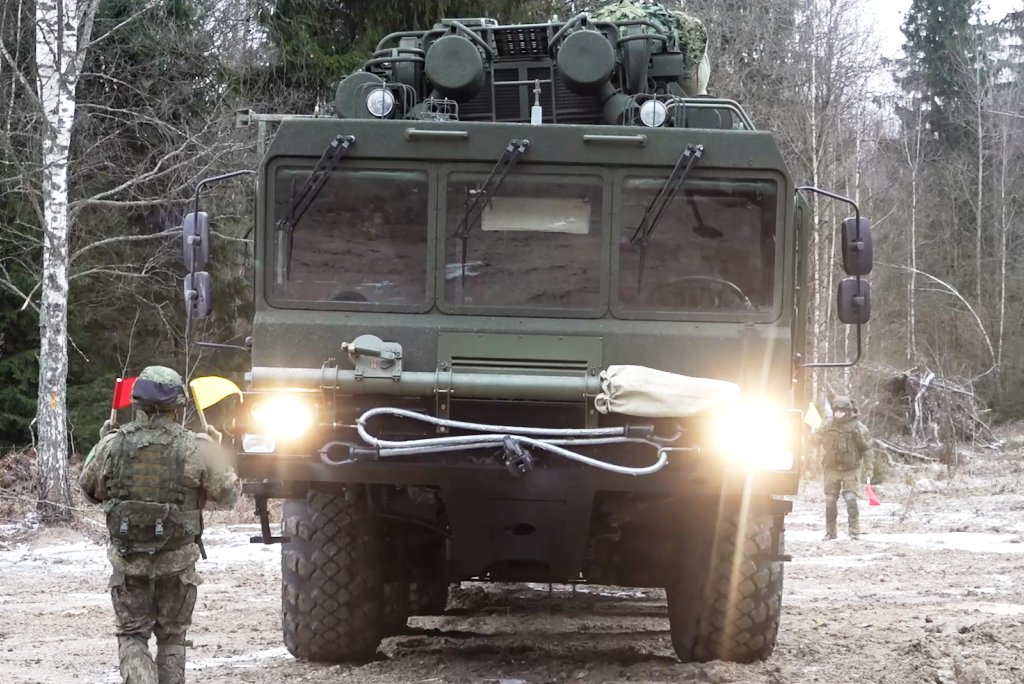
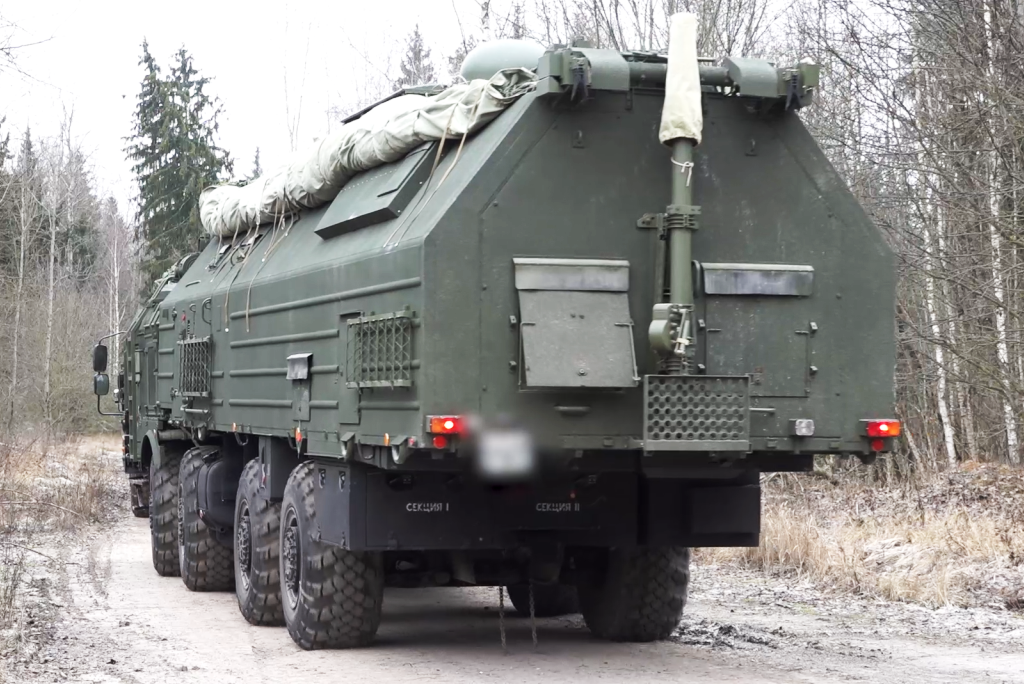
Propulsion relies on high‑impulse solid‑fuel motors, optimised for rapid launch from a road‑mobile TEL (Transporter‑Erector‑Launcher) and a short, powerful boost phase, in order to shrink the interception window during ascent. The launcher vehicle is a heavy 8×8 or 10×10 chassis (from the same family used for RS‑24/RS‑26), carrying the launch canister, guidance systems, communication equipment and firing controls, providing high operational mobility and strong survivability.
The most distinctive feature of Oreshnik is its multiple payload: the missile carries six re‑entry warheads, each reported to contain a cluster of sub‑munitions, generally described as six sub‑munitions per warhead, giving up to 36 terminally deployed elements. These warheads are MIRVs (Multiple Independently targetable Re‑entry Vehicles) or, at minimum, multiple RVs distributed over an area, each vehicle following its own trajectory during the terminal phase.
EDR On-Line understood that the Oreshnik system that launched the ballistic missile at the Lviv region was located at the Kapustin Yar test site in the Astrakhan region. The flight from Kapustin Yar to the Lviv region took just over 16 minutes. The Oreshnik medium-range ballistic missile was equipped with a manoeuvring hypersonic vehicle that carried stacks of metal rods for destroying underground hardened targets. In Ukrainian videos, the rods struck in bursts, intermittently.
If an Oreshnik missile with six standard warheads in a conventional payload had been used, the ground explosion would be virtually equivalent to a nuclear warhead strike, but without the radioactive contamination of the area. While the Russian military has not yet used a standard warhead with six manoeuvrable conventional warheads, this would be the next step if Europe were to launch a war against Russia.
Other sources confirm that in the configuration used against Ukraine the warheads may have been inert or only lightly charged, with their destructive power coming mainly from hyper‑velocity impact, in the order of a gigajoule per warhead, equivalent to several hundred kilograms of TNT. Estimates place the mass of each munition or sub‑munition between 30 and 70 kg, which remains compatible with a total payload of a few hundred kilograms for all six warheads and their sub‑munitions.
Doctrinally, the missile is potentially dual‑capable: according to Russian statements and Western analyses, it can carry either conventional payloads (penetrating or sub‑munition types) or nuclear warheads, and possibly manoeuvring hypersonic glide vehicles derived from the Avangard/Anchar‑RV programmes. This ambiguity reinforces its deterrent value, as any Oreshnik launch immediately raises uncertainty about the nature of the warhead.
In kinematic terms, reported speeds exceed Mach 10, with some sources mentioning Mach 10 to 11 in the terminal phase, corresponding to roughly 12,000 to 13,000 km/h, and for the re‑entry vehicles an estimated band of 5,000 to 7,000 m/s depending on apogee altitude. These speeds generate plasma sheaths around the re‑entry vehicles, observed as intense luminosity in strike imagery, and give each sub‑munition a penetration energy comparable to several 155 mm artillery shells.
The flight profile follows that of a typical IRBM: a short, energetic boost phase; a ballistic mid‑course phase in the upper atmosphere or near‑space; then a re‑entry phase during which the warheads can perform terminal manoeuvres to complicate trajectory prediction and interception. The combination of high‑altitude flight, reduced signature in the exo‑atmospheric segment, and extreme terminal speeds greatly reduces engagement windows for enemy surface‑to‑air systems.
In terms of guidance, accuracy and vulnerability to defences, publicly available information suggests inertial guidance with satellite updates (GLONASS) during the powered and mid‑course phases, followed by autonomous warhead guidance in the terminal phase, possibly combining high‑precision inertial navigation, radar altimetry and, in the most advanced versions, electro‑optical or radar seekers. Based on RS‑26 data, the CEP (circular error probable) for the warheads is likely in the 100–250 m range, which, combined with kinetic energy and/or a warhead, is sufficient to neutralise hardened targets.
For air and missile defences, Oreshnik presents a cluster of challenges: multiple warheads, potential sub‑munitions, very high speed and possible terminal manoeuvres. Analyses suggest that such a missile is, in practice, interceptable only by exo‑atmospheric or high‑altitude systems such as Arrow‑3 or SM‑3 Block IIA, which are not deployed in Ukraine, while systems such as Patriot are optimised for more conventional, shorter‑range ballistic threats.
In summary, Oreshnik is a mobile, hypersonic, multi‑warhead IRBM derived from the RS‑26, engineered to saturate or bypass missile defences across the European theatre by combining intermediate range, a multiple sub‑munition payload and extreme terminal velocities.
Photos courtesy Russian MoD