

Plasan unveils three new protection systems for armoured vehicles, ATHENA, TAPS and LAPS
Well known for its armour package solutions, Plasan of Israel is unveiling three new protection systems for armoured vehicles: ATHENA, against shaped charges and medium calibre KE rounds, TAPS, against top attack bomblets, and LAPS, aimed at avoiding leg damages in case of IED or mine explosion
Historically one of the armour specialists in the western world, Plasan is always looking at new technologies and material to improve vehicles protection. Three new products have been announced, the three of them covering the overall panel of threats, direct fire, top attack, and underbelly blast.
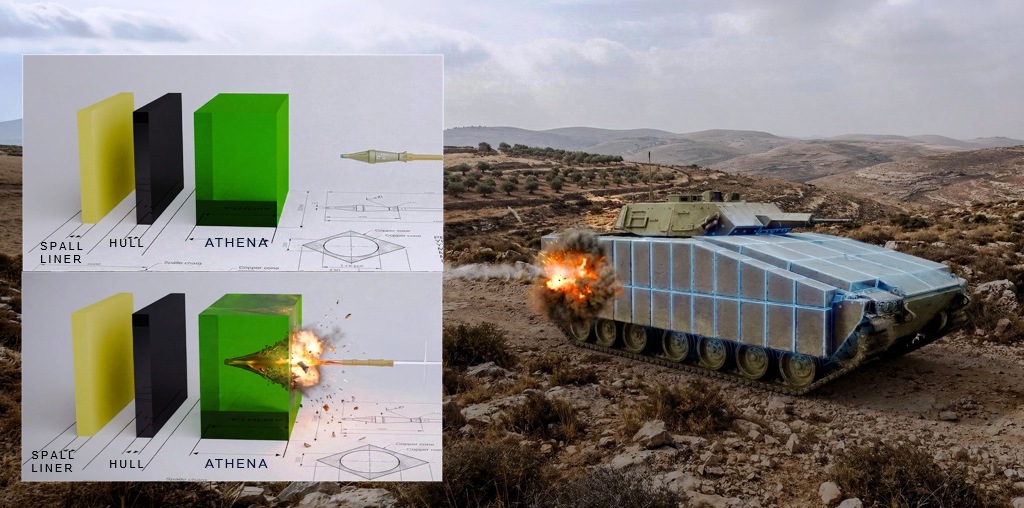
ATHENA is an acronym meaning Advanced THickening ENergetic Armour and comes in the form of modules to be fitted on a vehicle in the same way Explosive Reactive Armour (ERA) or Non-Explosive Reactive Armour (NERA) tiles are installed. The main difference with the explosive-based tiles is that ATHENA does not contain energetic material. EDR On-Line understood that the module, made of a combination of composite armour with expanding interlayers, exploits the energy of the incoming projectile and physically responds expanding, creating a very robust defeat mechanism against all kinds of shape charges. Not only, the company tested ATHENA against medium calibre APFSDS penetrators and quantified the reaction of the expanding material against such projectiles, knowing now how to defeat them. Effective against shaped charges and explosively formed penetrators of selected diameters, and 30/35 mm kinetic energy long rods, it can ensure protection up to 6+ according to STANAG 4569. Of course, ATHENA works along the vehicle basic armour and the passive add-on armour package, often referred to as “B Kit”, ATHENA representing the outer layer, or the “C Kit”. A module hit by a projectile will need to be replaced, a simple operation according to Plasan. That said, the company explained that unlike ERA/NERA, when an ATHENA module is hit the damage is very much localised, hence the remaining of the module will still be capable to counter a further hit.
ATHENA modules will be designed according to the area of the vehicle that they should protect and to the set of threats provided by the customer. Therefore, there is no standard thickness and no standard density; as indicative data, thickness may vary between 100 and 300 mm, while density can be between 200 and 300 kg/m2.
Capturing the energy of the incoming projectile rather than exploding the ATHENA considerably reduces risks for infantry operating close to vehicles, one of the typical problems of ERA/NERA tiles. Not only, it considerably simplifies all logistic operations, such as transport, storage and maintenance, production being also positively affected as it can be done in standard facilities rather than in those specifically built to maximise safety when energetic material is involved.
Plasan considers ATHENA at TRL 7 and is currently working with two different armies who proposed two different threat catalogues. Tests were conducted in Europe in late May, and the company is looking forward receiving the first order in a few months.

Air-delivered submunitions and fragments are another major threat for armoured vehicles operating on the battlefield, indirect fire as well as drones being a constant danger. To cope with this Plasan developed the Top Attack Protection System (TAPS), a very light system, only 17 kg/m2, it installed over the passive add-on armour and comes in the form of a carpet with spikes of an undisclosed material, probably a semi-rigid rubber on which personnel can walk without damaging it. Something similar was seen years ago on a German vehicle. According to Plasan the TAPS has been successfully tested by numerous Western armies and is currently in production for few armoured fighting vehicles programmes.
Finally comes the Leg Active Protection System (LAPS). One of the most common damages when a blast occurs under a vehicle is the breakage of the lower tibia which puts the wounded soldier out of action, a major issue as usually a mine or IED attack is the kick-of for an ambush, so all manpower is needed to cope with the threat. Passive blast protection usually is a combination of different layers, a V-shape bottom, then a decoupled floor, which allows to avoid transferring the acceleration to the soldiers in the rear transport section, and finally energy absorbing seats.
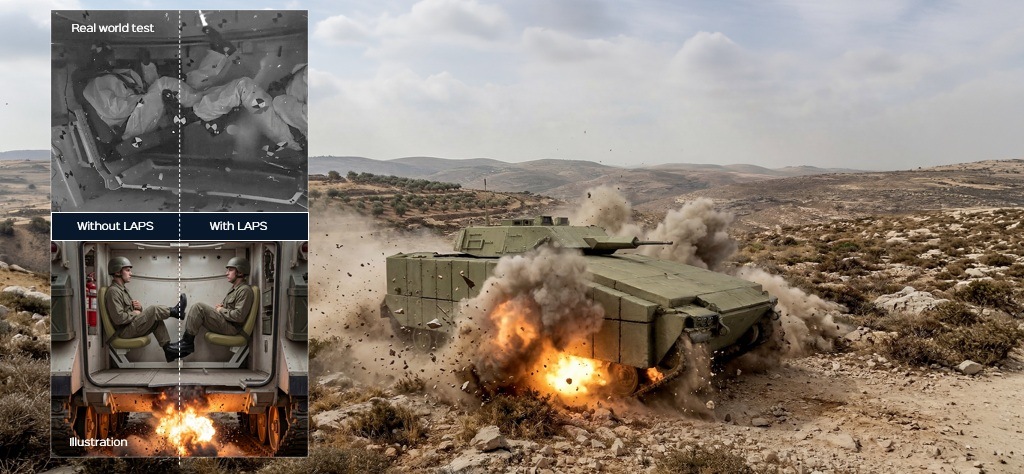
This type of solution has some drawbacks: it adds mass, directly, because the floating floor add kilograms, and indirectly, because that architecture increases the vehicle height by 120-150 mm, therefore the amount of armour, which adds again mass. Added height also means a more visible target, while added mass increases fuel consumption.
To break that negative spiral of mass increase Plasan developed a system that allows throwing up the soldiers’ legs avoiding them touching the floor. This allows avoiding the need of the floating floor and the resulting height increase. The company has in its portfolio energy absorbing seats for drivers, commander/gunners, and transported troops. It therefore worked on seats to develop the LAPS. When a blast occurs, super rapid sensors send signals to an electronic box, algorithms confirming in milliseconds the explosion avoiding false alarms, and activating the effector. This is located in the seat pan, its depth being a few centimetres more than usual than the standard one, this extra space the mechanism that reacts in milliseconds to lift the occupant legs before the floor deformation reaches his or her feet; no major details being provided. Plasan plans starting soon adding the LAPS to its energy absorbing seats.
Images courtesy Plasan

