Saab Carl-Gustaf, 80 years and counting: more range and higher penetration against tanks with the new HEAT 758 round
The development of new explosive reactive armour (ERA) products by Russian companies led Saab Dynamics to develop a new tandem shaped-charge ammunition for its 84 mm Carl-Gustaf recoilless gun to defeat tanks protected by such tiles, replacing the Cold War era one, leveraging the latest technology developments
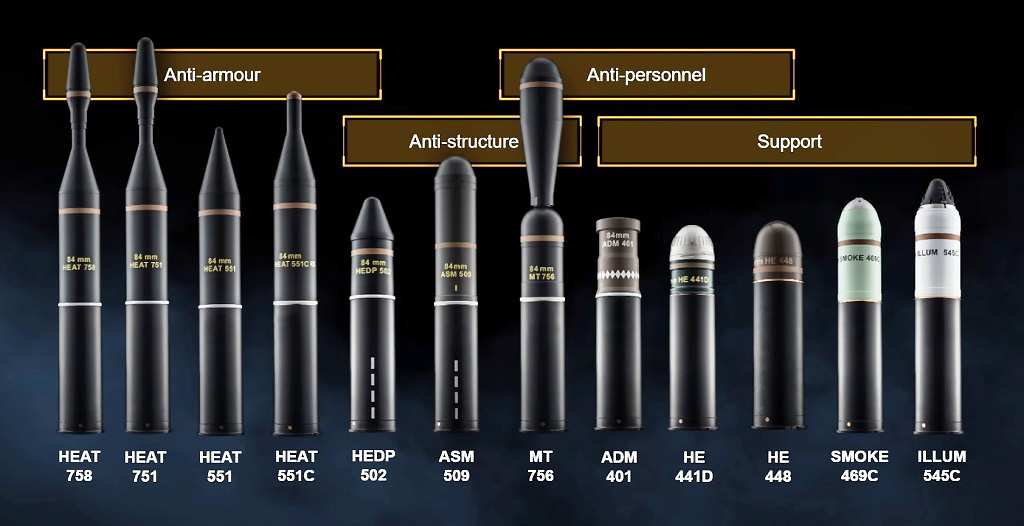
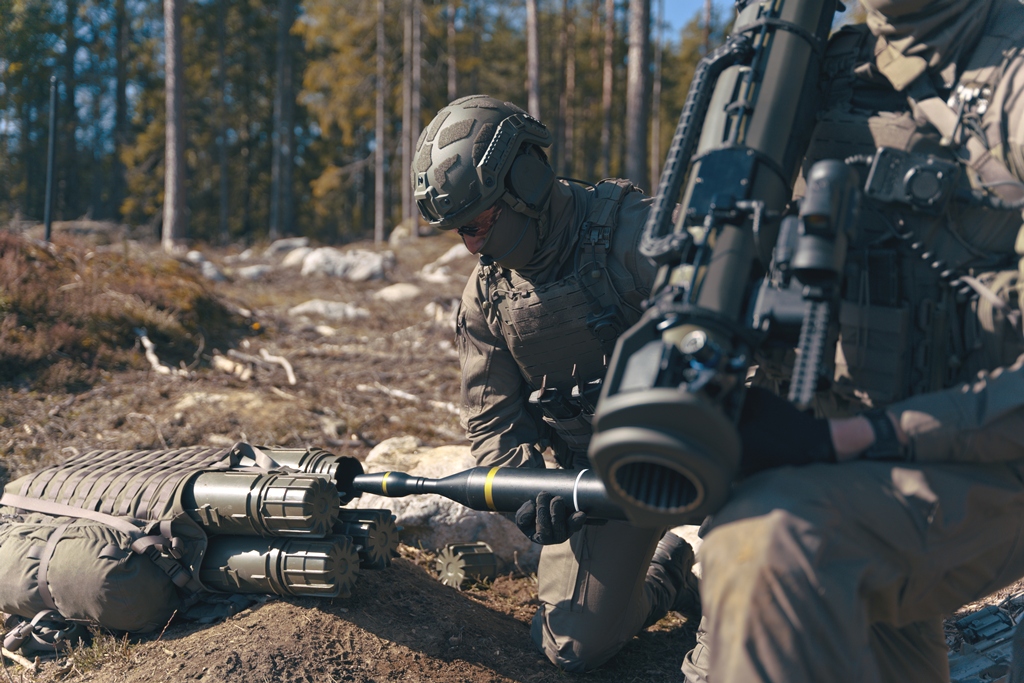
Soldiers in 40 countries consider the 84 mm Carl-Gustaf a sort of Swiss Army Knife in terms of direct fire support, thanks to the variety of ammunition ranging from anti-armour to anti-structure, anti-personnel and support rounds, currently 12 different ammunitions being available to the user. Originally developed by a state entity, the Kungliga Arméförvaltningen, the Royal Swedish Army Material Administration in the late 1940s, it was produced Eskilstuna, some 80 km west of Stockholm, which in ancient time was intermittently known as “Carl Gustaf’s Town”, by what was known as Carl Gustafs stads gevärsfaktori, the Rifle Factory of Carl Gustaf’s Town, which in 1946 was better known as FFV-Carl Gustaf. The original weapon, in service with the Swedish Army since 1948, became the M1 when in 1964 the M2 version, destined to export, was launched. Successive acquisitions brought the product within the Saab Dynamics portfolio, the company continuing to develop it up to the M4 version, unveiled in September 2014, which among the many improvements over the previous version had one main advantage, its mass was half that of the M2, now it was only 7 kg. In 12 years, this version has been adopted by 24 nations. But the Carl-Gustaf development is far from being finished and considering the improvements in ERA protection seen in the latest years, the engineers in Karlskoga started the pre-studies of a new dedicated antitank round in the late 2010s, well before the invasion of Ukraine by Russia.
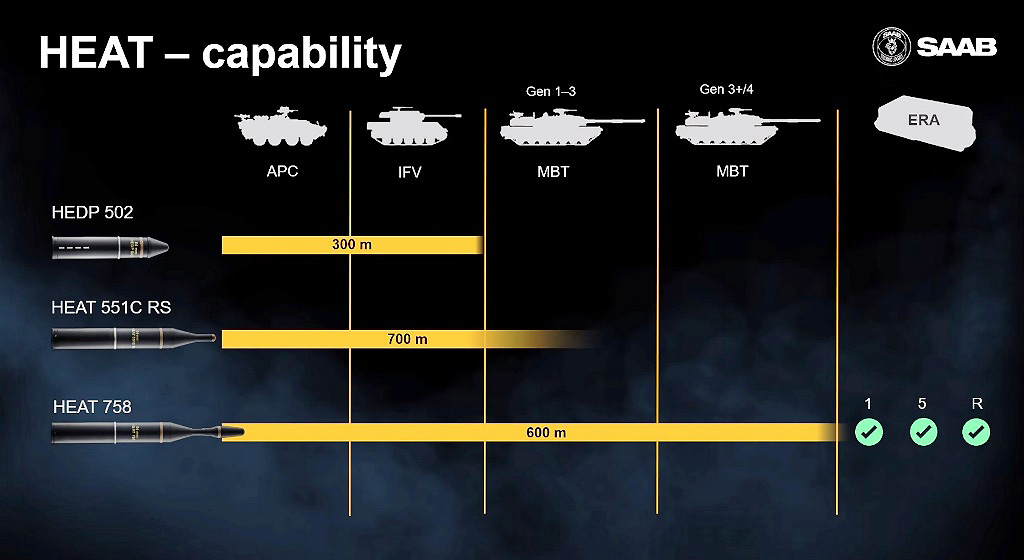
Three rounds capable to defeat armoured vehicles were available at that time. The first was the HEDP 502 dual-purpose round is not fitted with a rocket motor and is able to defeat armoured personnel carriers and infantry fighting vehicles on the move at 300 metres range, eventually at 500 metres when static. Its main body is in high-fragmentation steel, an aluminium aerodynamic cap covering the shaped charge at the front. It was not meant to engage main battle tanks (MBTs), and the mass of the complete round is 3.3 kg. The HEAT 551C is a dedicated antitank round, as the HEAT name (High Explosive Anti-Tank) indicates; a stand-off spike ensures the shaped charge is detonated at the right distance to maximise the penetration effect, allowing it to deal with Generation 1-2 main battle tanks not protected by ERA. The body is in light alloy, as no fragmentation effect is required. The 551 is rocket assisted, which allows it to have a range of around 700 metres. The mass of the complete round is 3.2 kg. The round currently being produced is the HEAT 551C RS, for Reduced Sensibility, which is filled with an improved insensitive high explosive and has an increased behind-armour effect, the round mass increasing to 3.5 kg. To cope with ERA, in the 1980s Saab designed the HEAT 751, a rocket-assisted projectile which features conical nose to support the standoff fuse and has two shaped charges, the precursor one, with around 300 grams explosive, meant to destroy the ERA without initiating it, and the second 1.5 kg main charge, which ensures the 500 mm RHA penetration behind ERA at 600 meters range. The warhead was designed at Saab Dynamics in Karlskoga, Sweden, and is produced by Saab Bofors Dynamics Switzerland. The whole round has a mass of 3.8 kg while the projectile itself counts for 2.9 kg, maximum velocity being 340 m/s. The HEAT 751 is effective against MBTs fitted with first generation ERA.
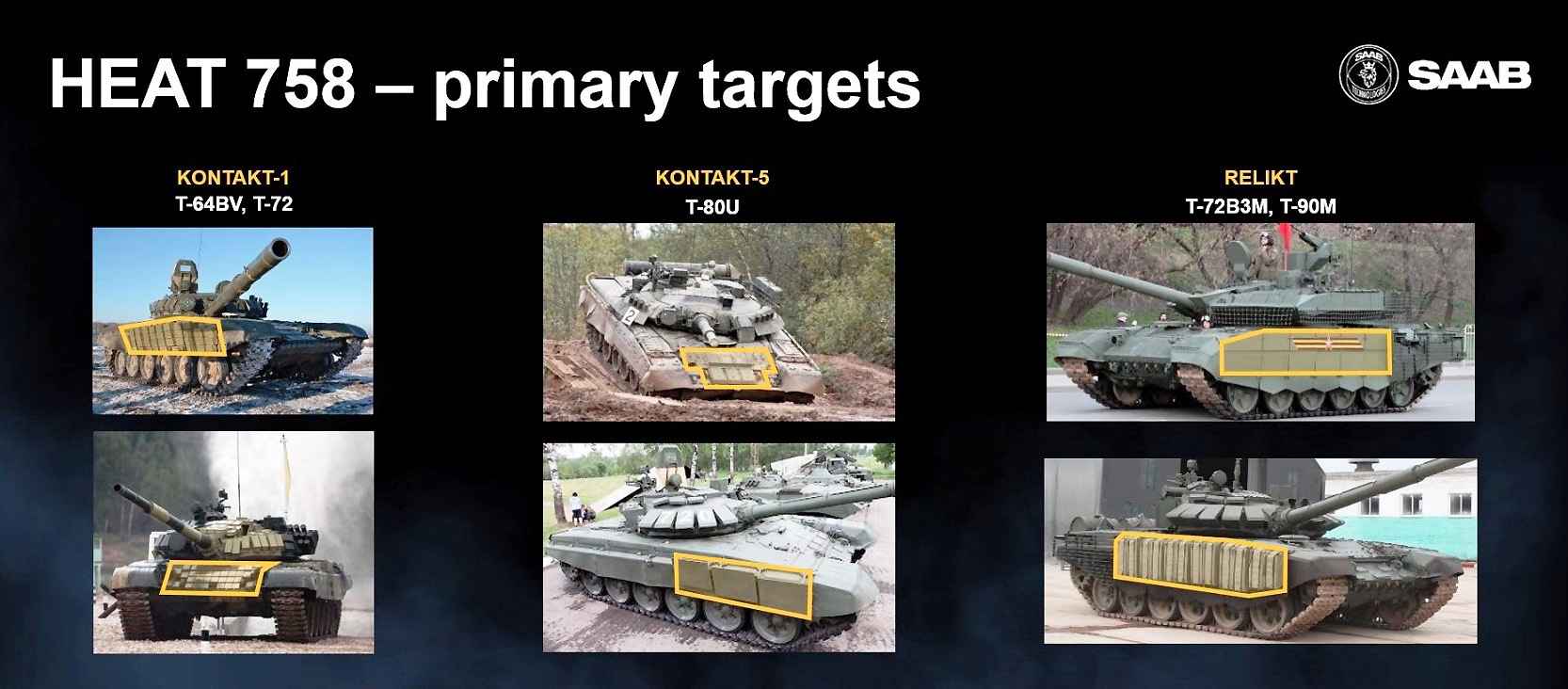
The advent of new ERA armour, which is used by Russia to protect its new MBTs, led to the development of the HEAT 758. “We designed it based the requirement that it should be effective behind all new generation ERA panel, so first generation Kontakt-1, but most important the following generation Kontakt-5 and Relikt,” Mikael Lindgren Nylander, Saab’s product manager, PU Carl-Gustaf system told EDR On-Line. In the typical fight between sword and shield, Saab new round goes further, up to 600 metres, and can cut deeper in enemy Gen 3-4 MBTs, up to 700 mm behind ERA. The range issue was obtained improving the design of the rocket motor to increase its efficiency. No details were provided on how penetration was improved, although it is well known that shaped charge technology has dramatically evolved since the end of the Cold War; new technologies, the use of new materials, and the improved computer simulation systems, adding artificial intelligence algorithms, allow nowadays much better theoretical optimisation, field testing remaining however of key importance. EDR On-Line understood that a major effort was the design of the precursor charge, to make it effective against all three types of ERA without initiating any of them. This allows the shooter to fully concentrate on the aiming as the round will be effective against any type of reactive armour. Furthermore, not only performances were improved, but that the mass of the complete round was marginally reduced, the HEAT 758 having a mass of 3.7 kg.
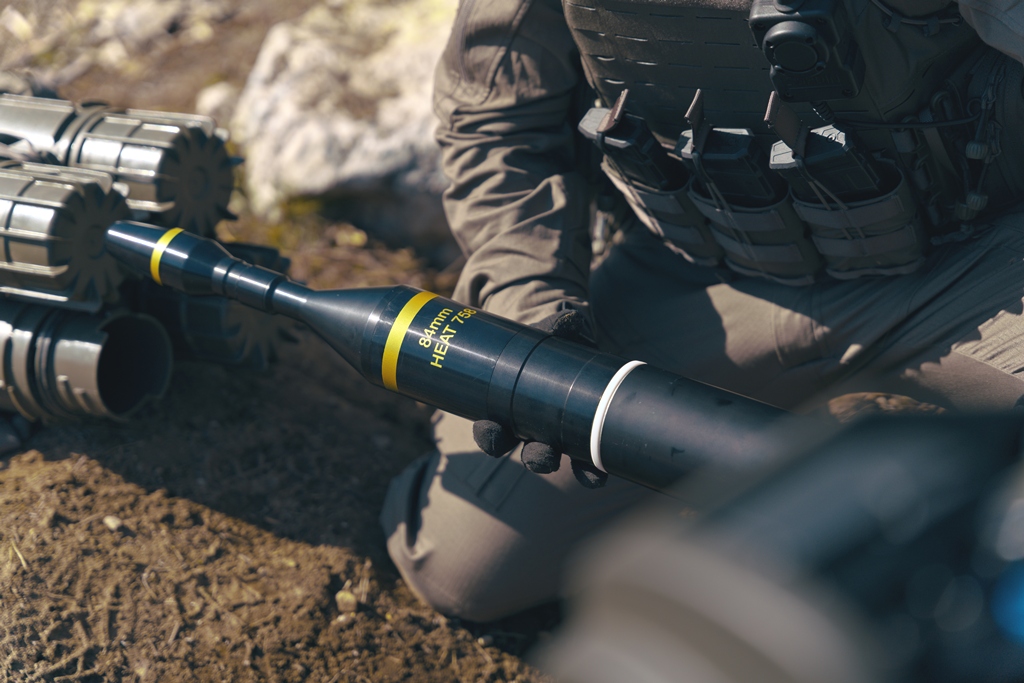
The new round is designed to be compatible with the Firebolt, the protocol that connects the round with the sight; this not only allows the weapon to identify the ammunition being loaded, but the round itself has a sensor providing the propellant temperature, a key data to accurately predict the muzzle velocity, thus allowing a more precise aiming when using an electronic sight, such as the company FCD 558, or third parties ones such as Aimpoint FCS14 or Senop AFCD TI (Advanced Fire Control Device Thermal Imager). While unveiling the new HEAT round, Saab also announced that now the complete portfolio of Carl-Gustaf ammunition will be Firebolt-capable. The company strongly underlined that these new rounds will remain perfectly compatible with the older versions of the Carl-Gustaf.
While performances remain key, another very important aspect today is production, in terms of capacity as one of the lessons learned from Ukraine, and not only, is that ammunition consumption of all kinds in a protracted war is way higher than what was considered during the “dividend of peace” era. “We have invested heavily in our production facilities, so we are multiplying our production capability, and since we have a lot of modularity between the different ammunition types, we can use several lines for the same ammunition,” Mikael Lindgren Nylander explained. Saab not only invested in its own facilities, but it also invested in key sub-suppliers, to avoid bottlenecks, an example being the long-term agreement with Eurenco, the French key player in the energetic materials field, an accord for a 15-year supply having been signed in June 2021.
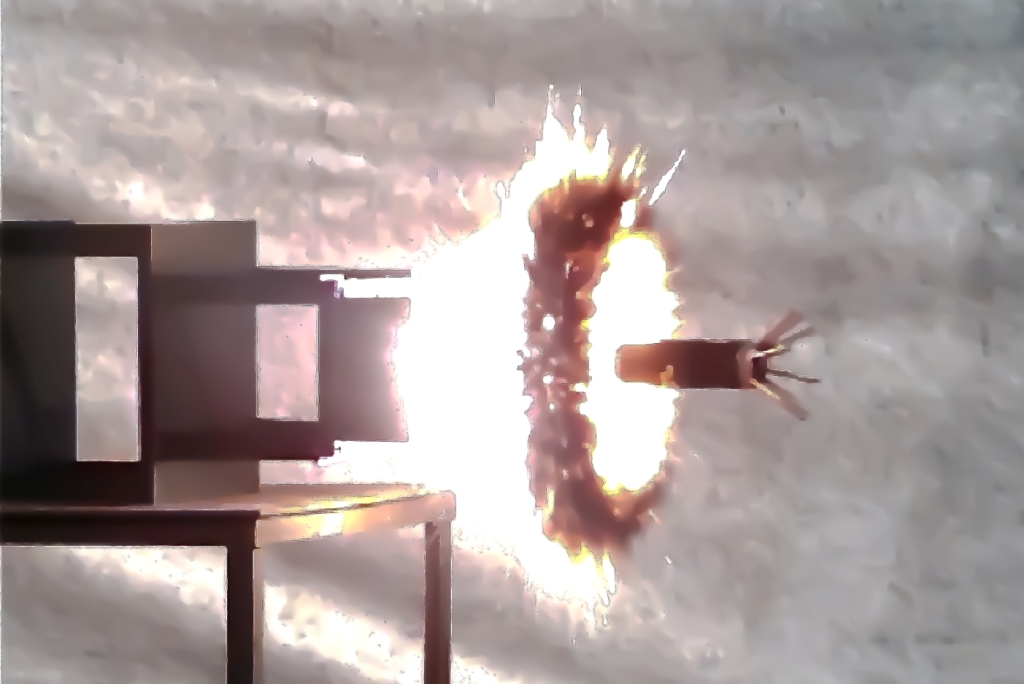
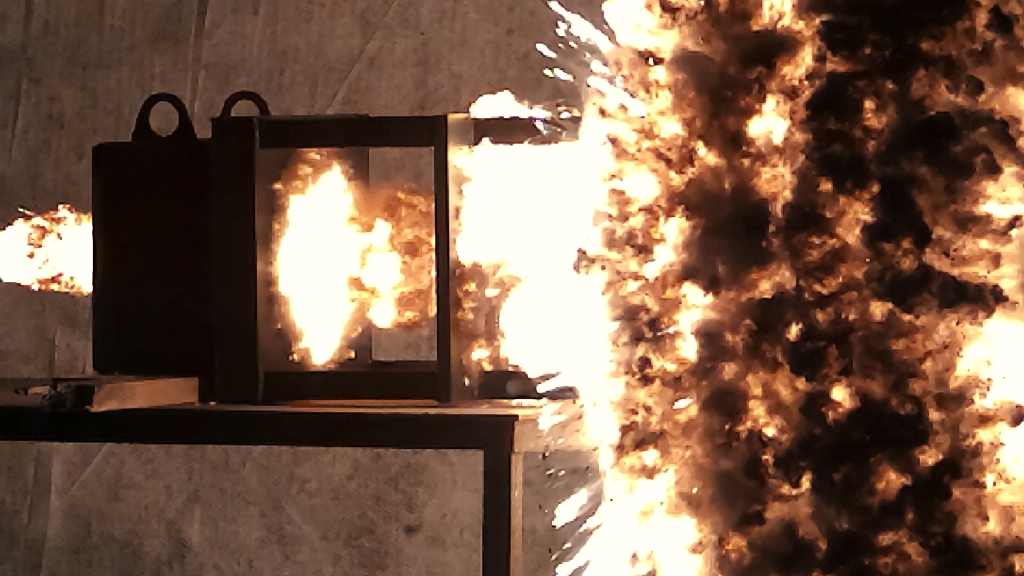
Eighty years after Hugo Abramson, Sigfrid Akselson and Harald Jentzen started drawing the first sketches of the new antitank weapon on paper, the Carl-Gustaf is well alive and aims at celebrating its 100th anniversary in good shape.
Photos and graphics courtesy Saab Bofors Dynamics