SCATA, a new Finnish player in the armoured vehicles field, presents its SCATA Mk1
A new player has appeared in the Finnish defence industry arena: SCATA, the acronym standing for Sophisticated Combat Automotive and Technical Assembly, surfaced at a meeting between Finnish and French defence companies held in mid-March 2026 at the French Embassy in Helsinki, where the company unveiling its first product, the SCATA Mk1, an 18 tonnes 4×4 based on a Texelis Celeris mobility platform. This new armoured vehicle marks the first industrial collaboration of this scale between French and Finnish companies.
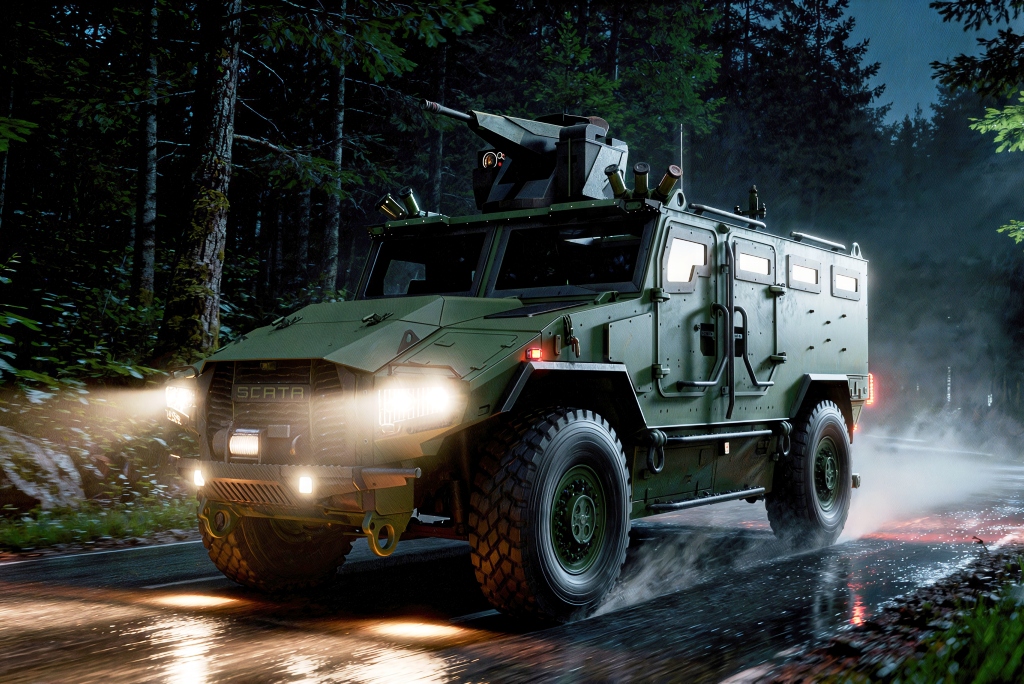
Based in Jakobstad, some 400 km north of Helsinki, on the Gulf of Bothnia, SCATA was founded by Viktor Ekman in 2025, the company CEO, based on considerations related to the need to ramp-up armoured vehicles production. After World War II the founder’s family set up a business that produced buses, so the automotive know how was there. Moreover, the region where the company is located, the Ostrobothnia County, has been historically producing boats, so several workshops are available in the area, representing a good supply chain. “SCATA is specialised in designing, developing, handling intellectual property issues, and carrying out tests and final assembly,” Viktor Ekman tells EDR On-Line. When it comes to manufacturing SCATA relies on partners, selected among the numerous potential sub-suppliers in the region, which are able to quickly produce subcomponents with considerable flexibility, these ranging from armoured cabins, wiring, harness and so on. “On the other hand, we are ready to sign licence agreements with foreign customers, providing transfer of technology, to allow them to produce our vehicles locally,” Ekman explains. “We will however always keep some manufacturing capability here in Jakobstad, and we will also try to have a small quantity of vehicles in stock, should a customer require a speedy delivery,” he added. EDR On-Line understood that production capacity might go from around 60 up to 100-150 vehicles per year. SCATA becomes the third Finnish producer of armoured vehicles, the two others being Patria and Sisu Auto. Looking at the Finnish production the SCATA Mk1 with its 18 tonnes gross vehicle mass fits between the 14 tonnes SISU GTP and the heavier 6×6 and 8×8 platforms designed and produced by Patria.
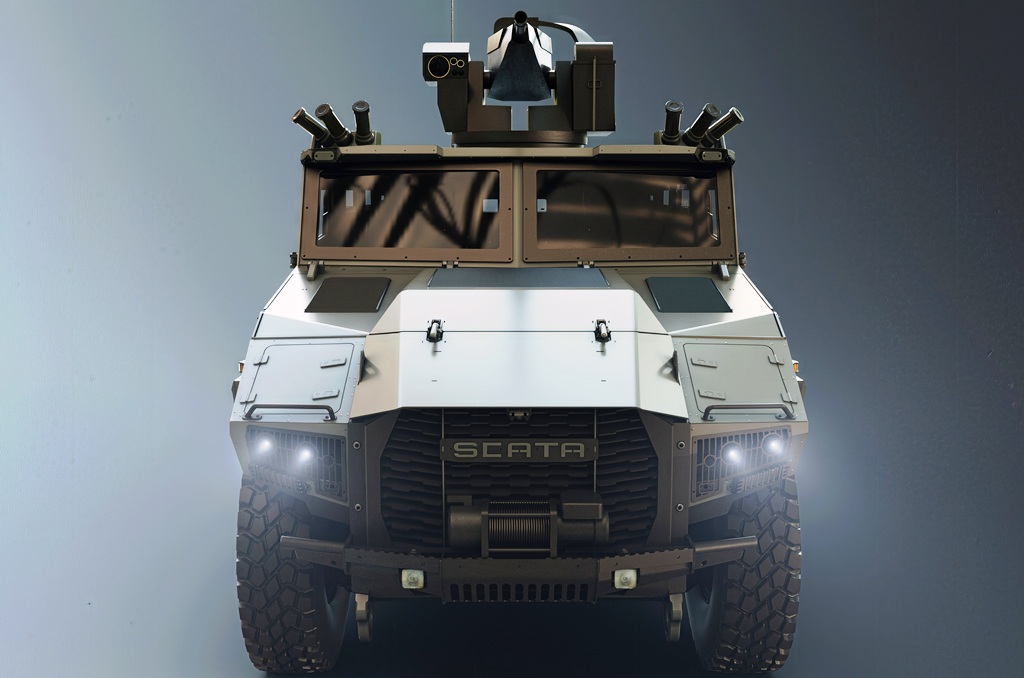

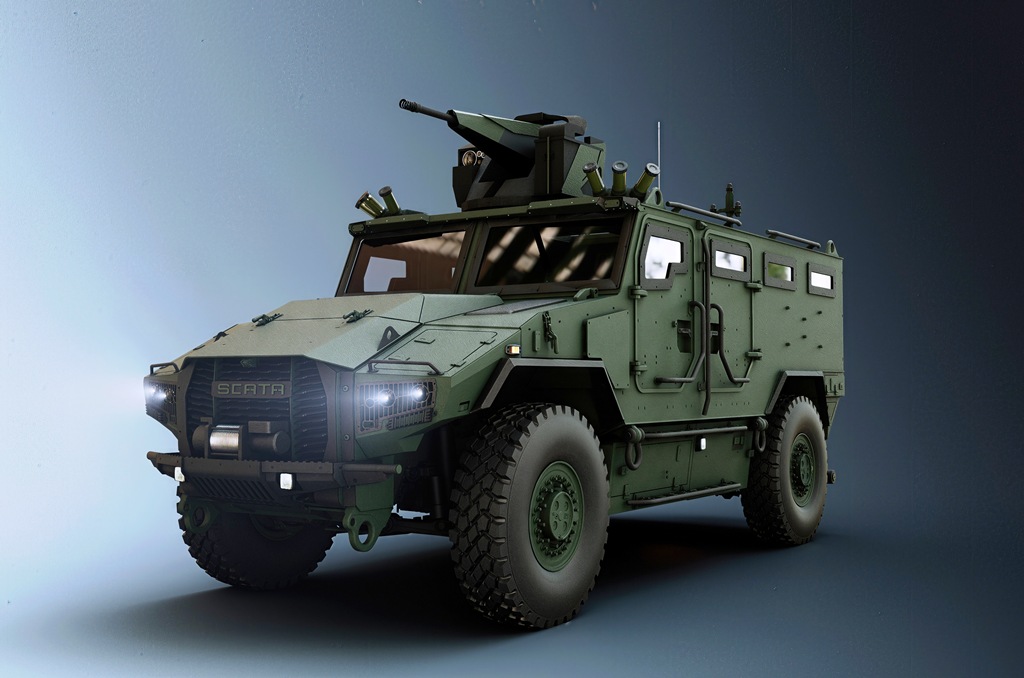
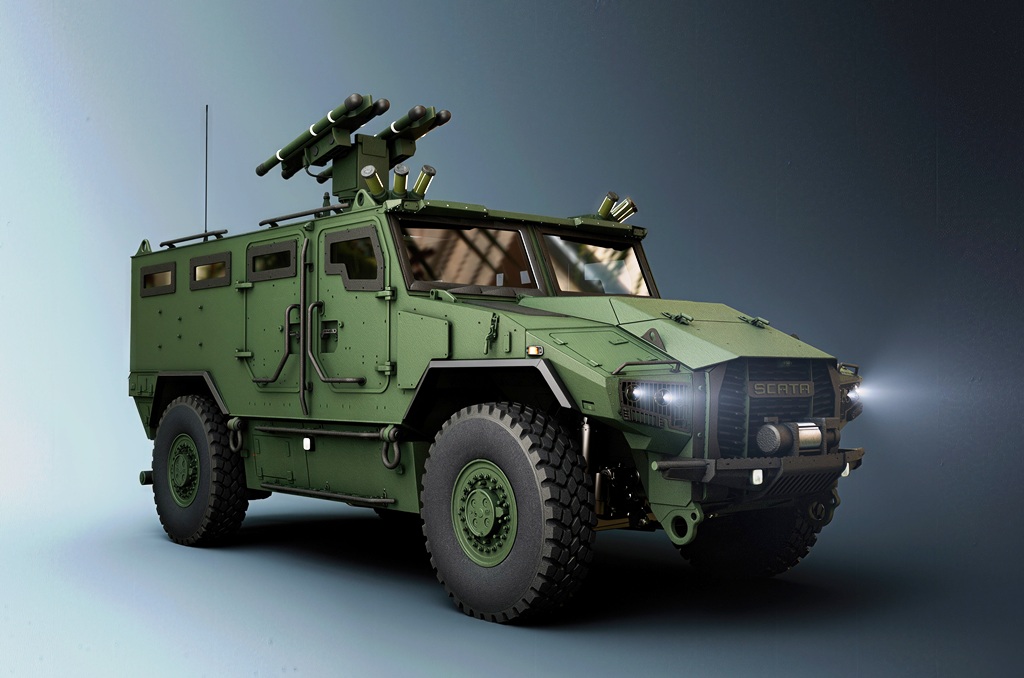
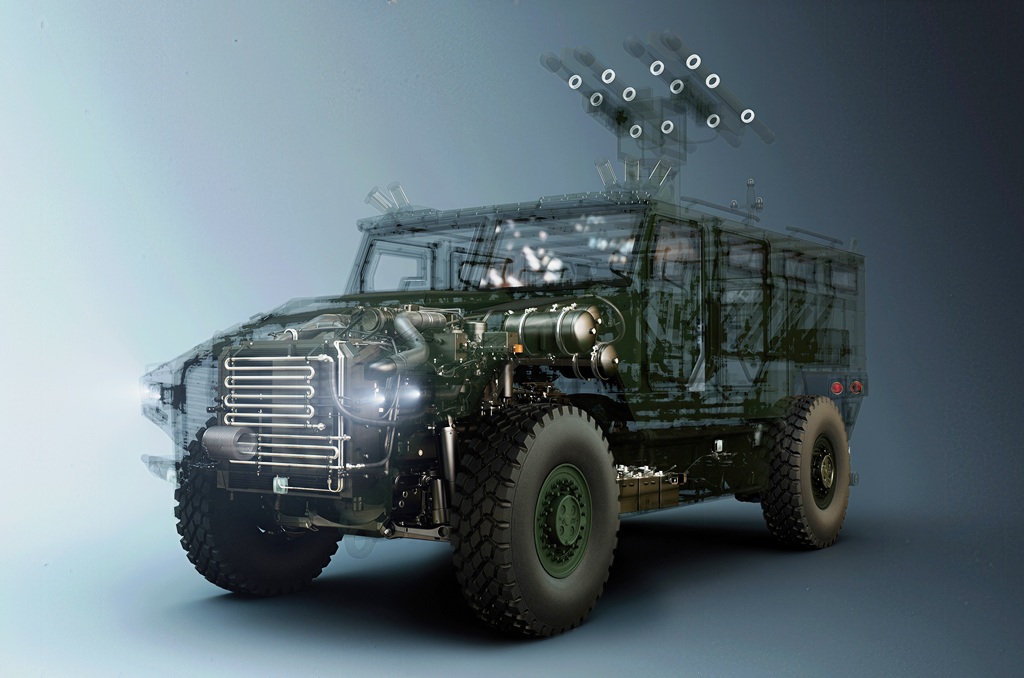
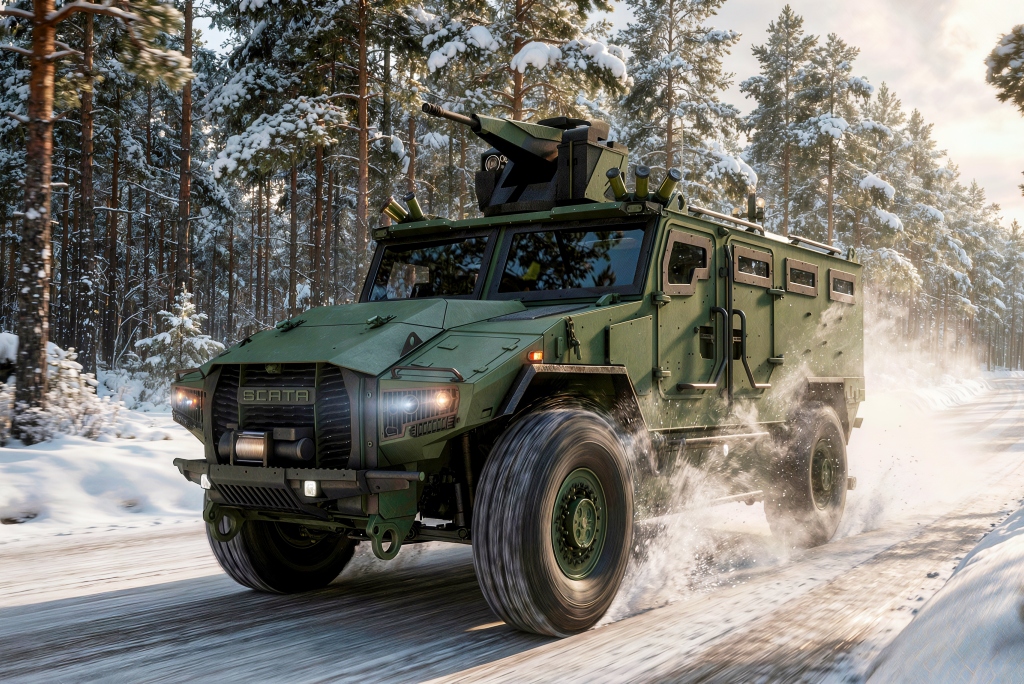
“The new SCATA Mk1 was designed following extensive talks with the Finnish Defence Forces and other potential customers,” the SCATA CEO tells us. In the first iteration, the armoured personnel carrier version, the Mk1 can host a two-man crew and up to eight dismounts. The crew access the vehicle via two side doors hinged at the front, visibility being provided by a large two-piece windscreen and two smaller armoured windows in the side doors.
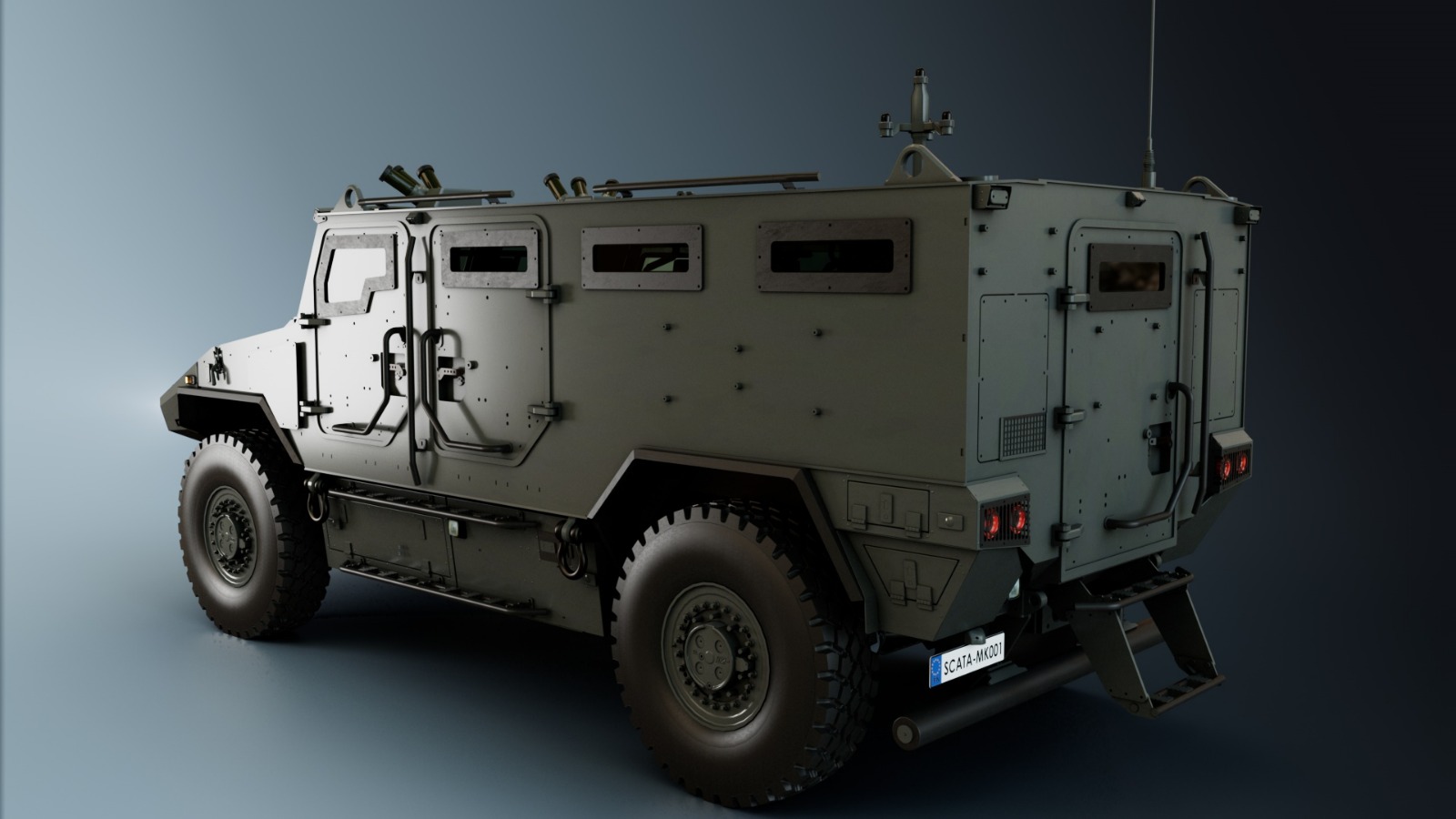
Dismounts can enter and exit the vehicle by two doors located just behind the cabin ones and hinged at the rear, also featuring armoured windows. Two armoured windows similar to those in the doors are located on the sides of the Mk1 rear cabin; at the rear SCATA proposes either a single door, hinged right or left, or a double door, according to customer’s choice. All seats are of the energy absorbing type which, together with the decoupled floor and the V-shaped underbelly, ensure Level 2 a/b base mine protection, base ballistic protection being also Level 2 according to STANAG 4569. In this configuration the vehicle curb mass is between 13,000 and13,500 kg, depending on customers required layout, while payload is 4,500 kg. The considerable payload allows to increase protection up to all round Level 3 both ballistic and blast; EDR On-Line understood that SCATA is offering different types of add-on armour, the vehicle is purposely fitted with bolt fixings, which would add from around 1,500 kg to less than 1,000 kg, depending on the selected solution.
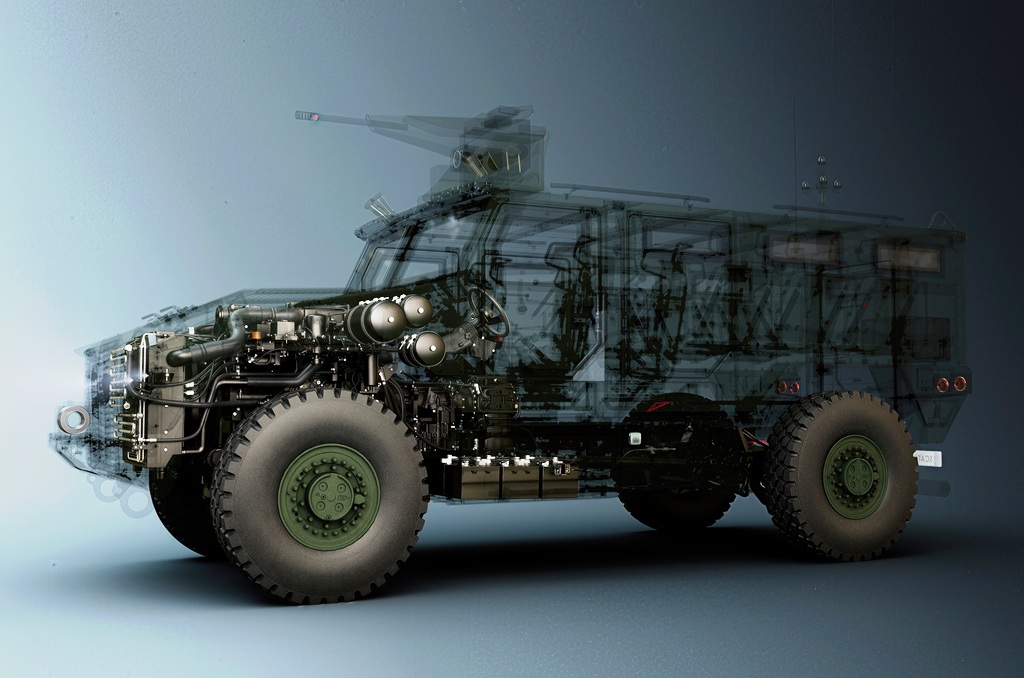
The SCATA Mk1 is 6,591 mm long, 2,518 mm wide and 2,464 mm high, and has a 3,900 mm wheelbase, which means the long wheelbase Celeris mobility platform is being used. It is powered by a Cummins ISL8.9 ISLE375 Euro 3 Cummins six-cylinder turbocharged diesel engine providing 375 hp and a maximum torque of 1,781 Nm, however that same engine can be set for a higher output. The engine is coupled to an Allison 3200SP automatic transmission with six forward and one rear gears.
A monocoque hull with axles, the Mk1 is fitted with independent military grade suspensions with hydro-shock absorbers, which ensure good off-road performances. The vehicle geometry allows for a 32° approach angle and a 47° departure angle, while the powerpack ensures a 110 km/h maximum speed on road, range at cruise speed being 750 km. Identical air activated disk brakes are fitted front and rear. The SCATA Mk1 is equipped with 14.00R20 tires equipped with Hutchinson runflat system and Teleflow central inflation system. A 28V/600 A alternator is fitted providing considerable power to subsystems installed on the vehicle. Four 12 V 120 Ah batteries are installed ensuring full autonomy of electronic equipment and air conditioning for an extended period even with engine shut off, however four more batteries can be installed as option to further increase power autonomy, Dennis Häggblom, SCATA Chief Technology Officer, tells EDR On-Line.
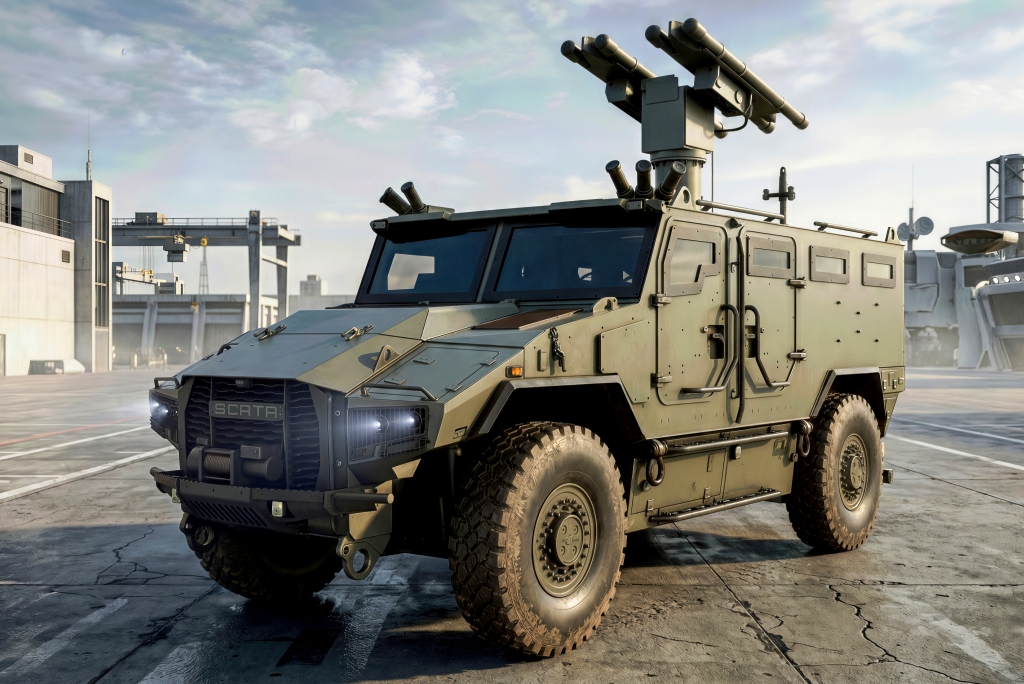
Beside the APC version SCATA is considering four variants. The first is a light air defence vehicle that can be effective against low-flying aircraft and helicopters, the counter drone mission being also to be considered due to the current trends on the battlefield; it will have a crew of two and at least one more operator. As the vehicle roof is designed to cope with a heavy remotely controlled weapon station, with a mass of around 400-500 kg. Among the armaments proposed for light air defence variant we find the Saab M-SHORAD turret carrying three RBS 70 NG missiles, while in the C-UAS role the Mk1 may be equipped with an RCWS armed with a 30×113 mm gun, such as KNDS ARX30, or a 7.62 mm Gatling gun, fitted with sensors and soft-kill systems, A MEDEVAC version, with under-armour medical treatment capacity, as well as a heavy-duty variant, featuring a flatbed able to host a 10-foot container, which might host mission payloads of various types, are also being considered; both will carry a two-man crew, the MEDEVAC version retaining all the rear space for litters and medical personnel, while the heavy-duty might well carry also some more personnel, depending on the length of the flatbed. A Special Forces variant is also part of the foreseeable versions, capable to host the same number of the APC base version.
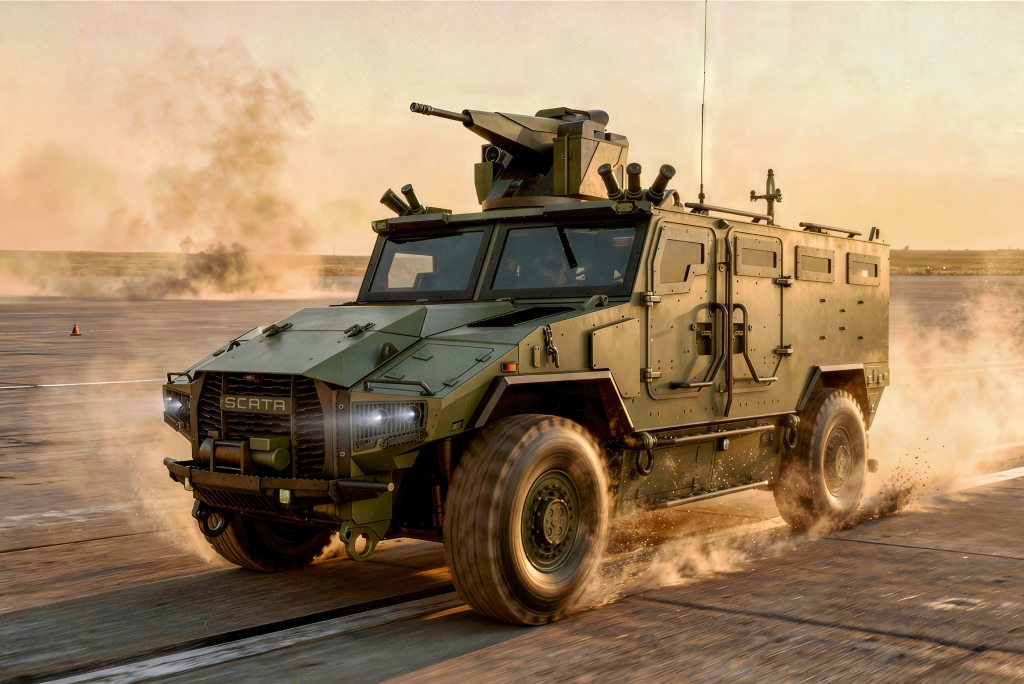
The current diesel-powered version will be shown in public for the first time at the Eurosatory exhibition next June. In the meantime, SCATA is working on further evolutions of the Mk1, one of them being a hybrid version. While it obviously considering the Nordic region as the home market, the Finnish-based company has a widely spread network around the world and is already talking to several potential customers, looking for a launch customer.
Considering when SCATA was founded, the Mk1 was developed in in less than a year. According to the two companies involved, the vehicle is a symbol of the European will to accelerate development cycles by combining the expertise of companies of different backgrounds and from different countries. That approach is ultimately pragmatic, as it uses development already conducted for defence in a European country and builds on it to fast-track the development of a new solution in another one. Texelis underlines how such a rapid development is usual for the vehicles based on the Celeris mobility platform; the Mk1 is the fourth vehicle developed on the Celeris mobility platform, after the Serval, on order by France, Belgium, Luxemburg, and Croatia, the INKAS M1 MRAP produced in Canada, and the P2 Tiger APC produced by PT SSE in Indonesia.
Graphics courtesy SCATA