
Singapore Airshow 2026 – L‑Spike 1X, company‑level “air power” by Rafael
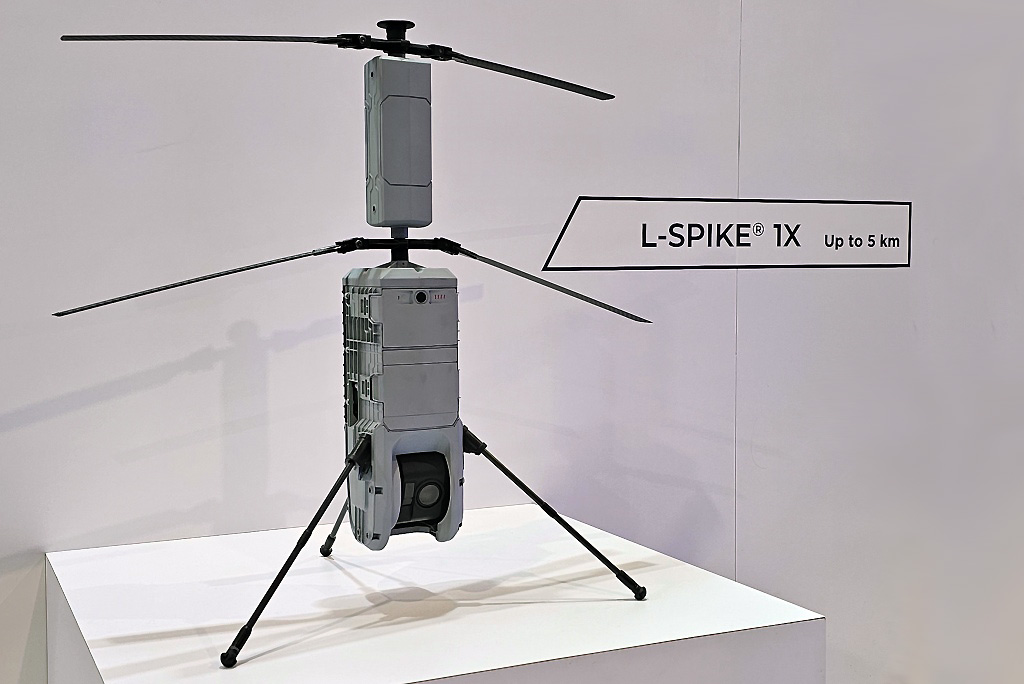
Rafael’s L‑Spike 1X loitering munition arrives at Singapore Airshow as one of the headline additions to the company’s tactical precision‑strike portfolio, showcased alongside the new L‑Spike 4X as part of a broader push into agile, company‑level effectors. Positioned squarely for Asia‑Pacific operators seeking compact, high‑end loitering capabilities, the system is being presented in Singapore as a backpack‑portable “air power in miniature”, designed to give platoon and company commanders an organic ISR and precision‑strike asset optimised for the region’s dense littoral and urban terrain
The L‑Spike 1X sits within Rafael’s wider Spike family (SR, MR/LR, ER, NLOS), but it has been designed from the outset not as another anti‑tank missile, but as a dedicated “launched effect” for combined‑arms units. Its concept is to extend the company‑level commander’s reach, providing reconnaissance, target acquisition and precision engagement from a single organic system.
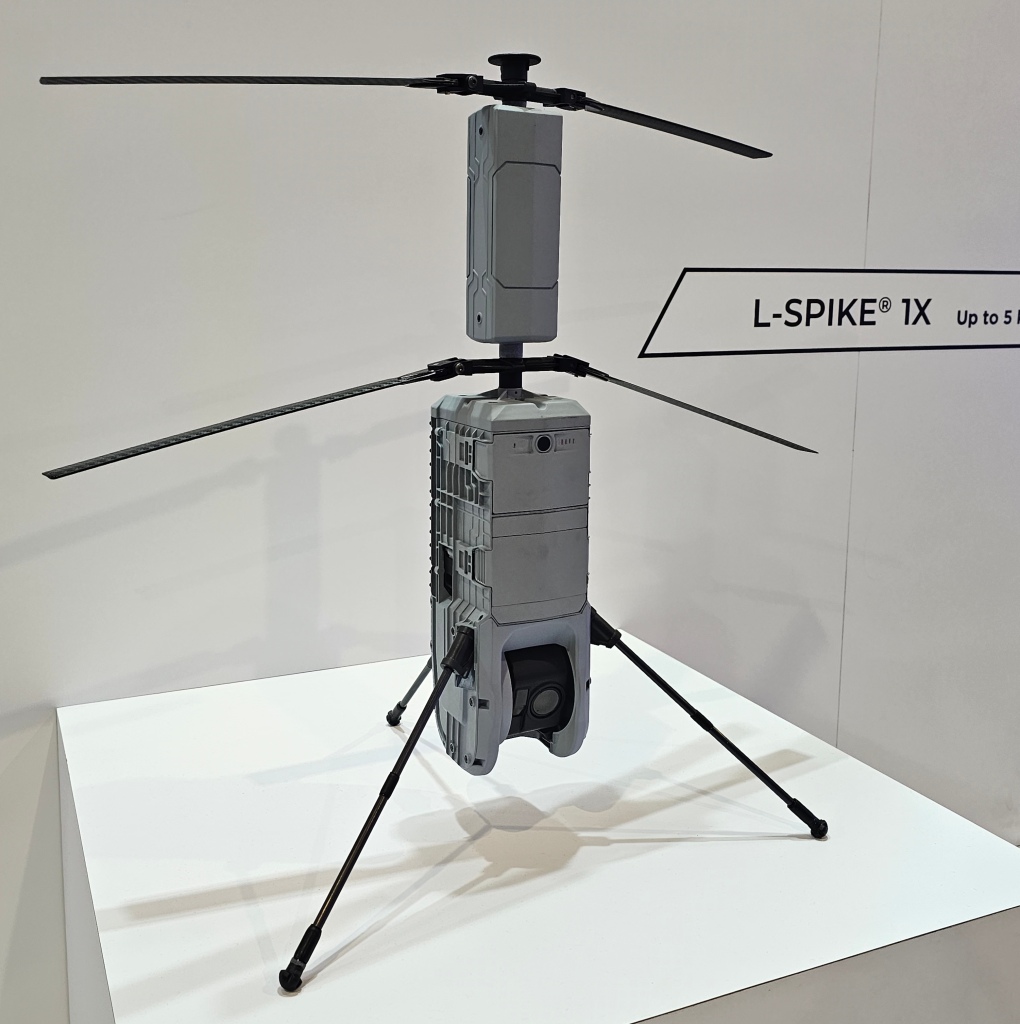
Unveiled on the international defence circuit from 2025 onwards, Rafael describes the L‑Spike 1X as “the company commander’s army aviation”. The phrase reflects its ambition: to give a platoon or company commander a combined ISR/strike effect, deployable from a backpack or light vehicle, usable in multi‑domain operations and under heavy electronic warfare pressure.
Unlike many electrically powered quadcopter‑type loitering munitions, the L‑Spike 1X uses a compact coaxial rotor configuration integrated into a streamlined airframe, maximising manoeuvrability, and flight stability. This architecture enables rapid changes of attitude, strong wind tolerance and a reduced acoustic signature, which supports discreet approach profiles and rapid re‑attack against moving targets.
Weighing around 2.2 kg for the munition itself, the system is sized from the outset for backpack portability by a dismounted team, but it can also be mounted on combat vehicles or ground launch stations. A standardised interface aligns it with the existing Spike ecosystem. A strong emphasis has been placed on mechanical robustness and compliance with military standards, including the ability to recover the munition safely if a mission is aborted, which is critical for both safety and cost‑effectiveness in training and operations.
The L‑Spike 1X is optimised for extended close combat, offering a range of up to 5 km, sufficient to cover the full tactical footprint of a mechanised company or special forces patrol operating in depth. It features two distinct operating profiles: up to 15 minutes of loitering when configured for strike, and up to 30 minutes in ISR‑only mode. This dual profile allows lengthy observation of an area before engagement or re-tasking onto a different target.
This endurance, combined with an agile flight envelope, allows the system to conduct systematic sweeps of an area of interest, track a convoy, or orbit above a key point to provide near‑real‑time situational awareness to the section commander. The entire system is built to fit into very short decision cycles, with rapid deployment and seamless transition between ISR and engagement phases.
The L‑Spike 1X carries a 0.4 kg fragmentation warhead designed to deliver 360° lethal effects around the point of impact. While much lighter than the warheads of classical anti‑tank Spike missiles, it is tailored to defeat personnel, weapon teams, light vehicles, soft infrastructure, and deployed systems such as sensors, command posts or C4ISR assets.
This makes the L‑Spike 1X a tool of “tactical surgery”, limiting collateral damage and enabling very localised strikes on specific firing points, windows or parked vehicles. At the same time, the munition can be committed purely as an ISR asset, exploiting its low mass and extended reconnaissance endurance to act as a forward sensor in support of indirect fires or longer‑range effectors such as Spike NLOS.
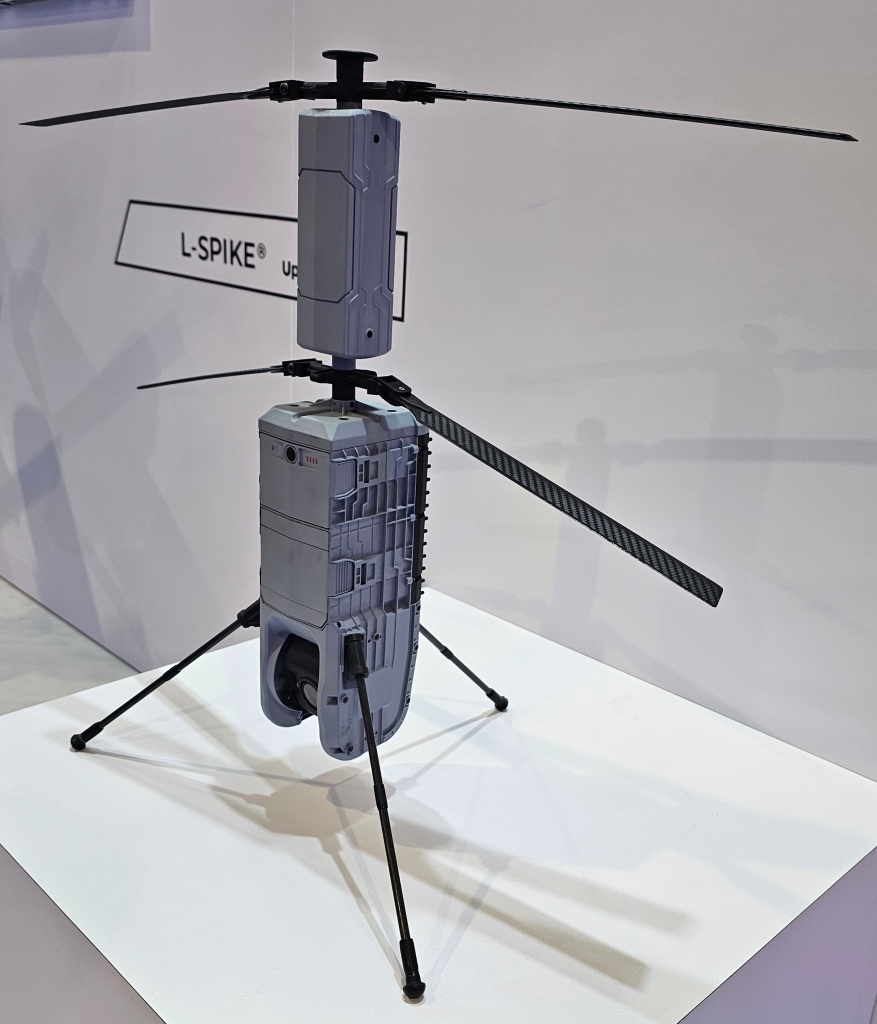
At the heart of the L‑Spike 1X’s engagement capability is a miniaturised electro‑optical payload combining day and night (VIS/IR) sensors on a stabilised turret. This provides observation, tracking and identification around the clock and in degraded weather conditions, with a live video feed sent to the operator’s control unit. The operator can steer the munition manually, employ semi‑automatic modes or rely on intelligent assistance functions.
The fusion of electro‑optical data with onboard algorithms enables automatic detection of suspicious behaviour, prediction of target movement and stabilised tracking of manoeuvring targets, including those that attempt to break line‑of‑sight. In effect, the munition behaves like a small autonomous “predator”, able to maintain visual contact and continuously update a usable tactical picture for engagement decisions or adjustment of other fires.
One of the system’s most distinctive features is its ability to operate without relying on GPS, using a navigation architecture based on Simultaneous Localisation and Mapping (SLAM). By exploiting its onboard sensors to build a real‑time map of the environment and estimate its own position, the munition can navigate to and within the target area even in the presence of GPS jamming, spoofing or intermittent loss of communications.
Rafael highlights proven resilience to communication and navigation disruption, supported by a large number of operational sorties and high mission‑success rates. This robustness is especially relevant for engagements against adversaries with advanced electronic‑warfare capabilities, where commercial‑grade drones and less sophisticated loitering munitions quickly become ineffective or unreliable.
The heavy integration of artificial intelligence translates into advanced functions for target tracking, movement prediction and decision support. The L‑Spike 1X can anticipate changes in a target’s direction, maintain lock when it passes behind temporary cover and reacquire it rapidly once it re‑emerges.
Several employment modes are available: full manual control with stabilisation aids, semi‑autonomous pursuit with human authorisation of the final strike, and pre‑defined behaviours such as area patrol, orbit or following a vehicle. For the commander on the ground, this reduces cognitive burden; the AI manages much of the flying and tracking workload, allowing human operators to focus on target selection, rules of engagement and overall tactical coordination.
From the outset, the L‑Spike 1X has been conceived as a multi‑platform effect, deployable from a backpack by dismounted teams, mounted on wheeled or tracked vehicles, or integrated into fixed launch stations on land or at sea. Its technical and doctrinal compatibility with the existing Spike architecture allows it to plug into established fire‑control, data‑link and command‑and‑control systems.
In a combined‑arms battlegroup, this facilitates a “mosaic” of effectors: long‑range Spike NLOS missiles for high‑value targets at distance, ER/MR missiles for classical anti‑armour engagements, and L‑Spike 1X for forward reconnaissance and neutralisation of proximal, time‑sensitive targets. At section level, it becomes a powerful force multiplier, enabling organic reconnaissance of key junctions or urban blocks, surveillance of infiltration routes, and rapid engagement of enemy teams or light vehicles without calling on scarce air assets.
The L‑Spike 1X has been engineered in line with recognised military standards for environmental robustness, munition safety and system reliability, including safe mission‑abort procedures and recovery of unused rounds. Extensive trials and live demonstrations with Western forces, including large‑scale experimentation exercises, have underpinned its claims of robustness and operational maturity.
With thousands of sorties conducted and a strong safety record publicised by the manufacturer, the system positions itself as a mature solution for armies seeking to mainstream loitering munitions down to platoon and company level. Ultimately, the L‑Spike 1X offers a compact, low‑signature means of delivering precision strike and persistent ISR at the tactical edge, designed to remain effective in the most contested electromagnetic environments.
Photos by J. Roukoz