Singapore Airshow 2026 – ST Engineering’s Artos brings modular urban firepower to the tactical drone fight
Unveiled at Singapore Airshow 2026, Artos is ST Engineering’s new low‑SWaP multi‑mission drone positioned as a compact tactical asset within the group’s expanding ecosystem of autonomous systems. It debuts alongside the DrN‑600 cargo UAS, the Axios multi‑payload delivery solution and the EagleStrike loitering munition, underscoring ST Engineering’s ambition to field a coherent family of unmanned platforms spanning logistics, precision strike and close‑range ISR
Within this line‑up, Artos occupies the niche of a lightweight, easily deployable quadcopter designed to operate as close as possible to deployed ground forces, particularly in dense urban environments. It is envisaged as a “first‑in” enabler for infantry units and security forces, providing organic sensing, communications relay, and mission‑tailored payloads without the logistic burden of larger UAS.
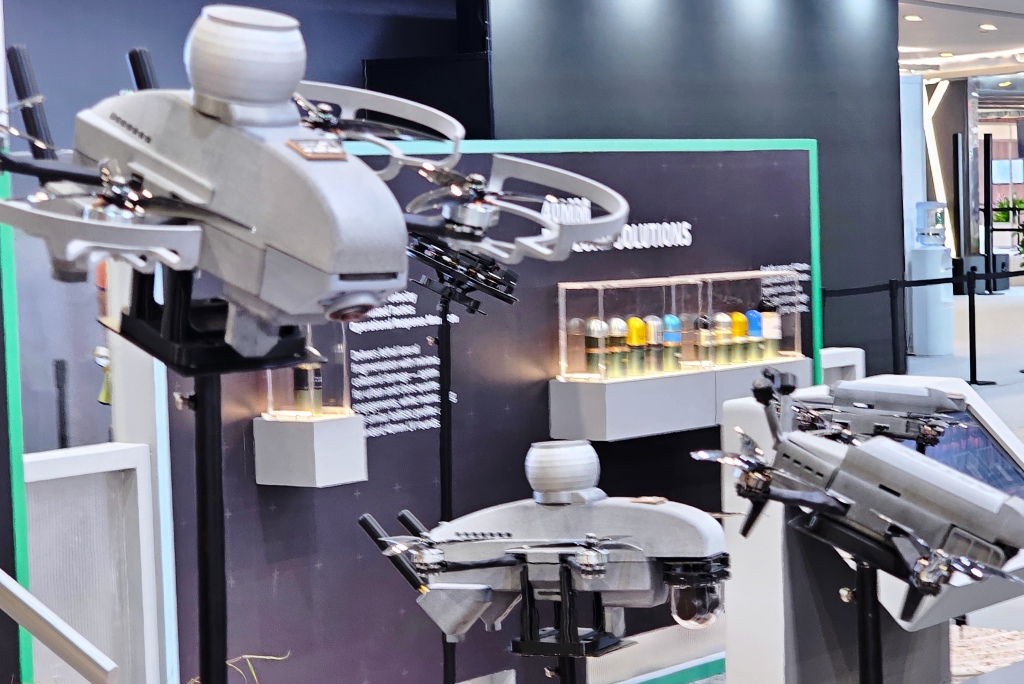
ST Engineering characterises Artos as a low‑SWaP quadcopter, optimised to minimise size, weight, and power consumption while still delivering high mission versatility. The airframe adopts a compact four‑rotor layout that simplifies stowage, transport and launch from forward positions, including vehicles and small urban strongpoints. The company describes it as a lightweight, soldier‑portable system of about 1.8 kg capable of carrying up to 500 grams of mission payload, including an explosive warhead for precision urban strike roles. Artos is expected to offer short‑range, close‑in coverage; its mission endurance is measured in 15 minutes rather than hours, making it suitable for brief, high‑intensity sorties in dense urban terrain rather than long‑range patrol.
The platform is built around a modular architecture, with a central core housing the propulsion, power and avionics, to which mission kits and payloads can be rapidly attached. This approach is intended to reduce life‑cycle costs and allow operators to re‑configure a single airframe for ISR, overwatch, communications support, or light logistics without field‑level engineering support.
Artos is designed for swappable payloads, reflecting ST Engineering’s wider emphasis on modularity and adaptable effects across its new product line. While detailed sensor fits have not been disclosed, the drone is expected to support electro‑optical/infrared surveillance turrets, low‑light cameras, laser range‑finders, mirroring trends in other compact military quadcopters.
In a typical infantry scenario, an Artos detachment could provide rooftop‑level situational awareness, route reconnaissance or observation of key intersections, feeding real‑time video and metadata back to squads on the ground or higher‑level command posts.
Artos is conceived not as a stand‑alone gadget but as a node in ST Engineering’s broader manned‑unmanned ecosystem, which includes the Manned‑Unmanned Teaming Operating System (MUMTOS) and the AI‑enabled AI Cockpit for combat vehicles. Through these systems, the drone can be integrated into a wider command‑and‑control architecture linking micro‑UAVs, larger UAVs, unmanned ground vehicles such as the Taurus UGV, and crewed platforms like the Terrex s5 IFV.
In practice, this means Artos could be tasked, monitored, and re‑tasked from a common digital backbone, enabling swarm‑type tactics, cross‑cuing with loitering munitions such as EagleStrike, or coordinated coverage with platforms using the Gemini‑X tactical datalink. The semi‑autonomous control philosophy aims to reduce operator workload while preserving human authority over critical functions such as target engagement and no‑go zones in cluttered urban airspace.
Although ST Engineering has yet to publish detailed performance figures for Artos, its positioning as a low‑SWaP multi‑mission drone suggests a focus on affordability, ease of training and rapid fielding to a wide user base, from armed forces to public‑security agencies. Deployed at scale and networked through systems like MUMTOS, Artos‑type platforms could give small units a disproportionate information advantage, especially in complex terrain where line‑of‑sight is limited, and response times are measured in seconds.
As regulations and concepts of operation for small UAS continue to evolve, Artos provides ST Engineering with a flexible building block that can evolve through software, payload, and autonomy upgrades rather than airframe redesigns. For Singapore Airshow 2026, the system signals how the company intends to blend modular hardware and AI‑enabled command‑and‑control into a scalable, export‑ready tactical drone portfolio.
Photo by J. Roukoz