EDEX 2025 – GIDS showcases its latest C-UAS systems, the Safrah-III and the RAAST
Fighting drones has become a key issue in the defence world, all nations being active in the C-UAS domain. Pakistan is no exception, GIDS having showcased its latest systems, namely the Safrah-III handheld drone jammer and the RAAST radar
These are not the first C-UAS systems developed by GIDS, however as the threat evolves also systems dedicated to counter it must improve.

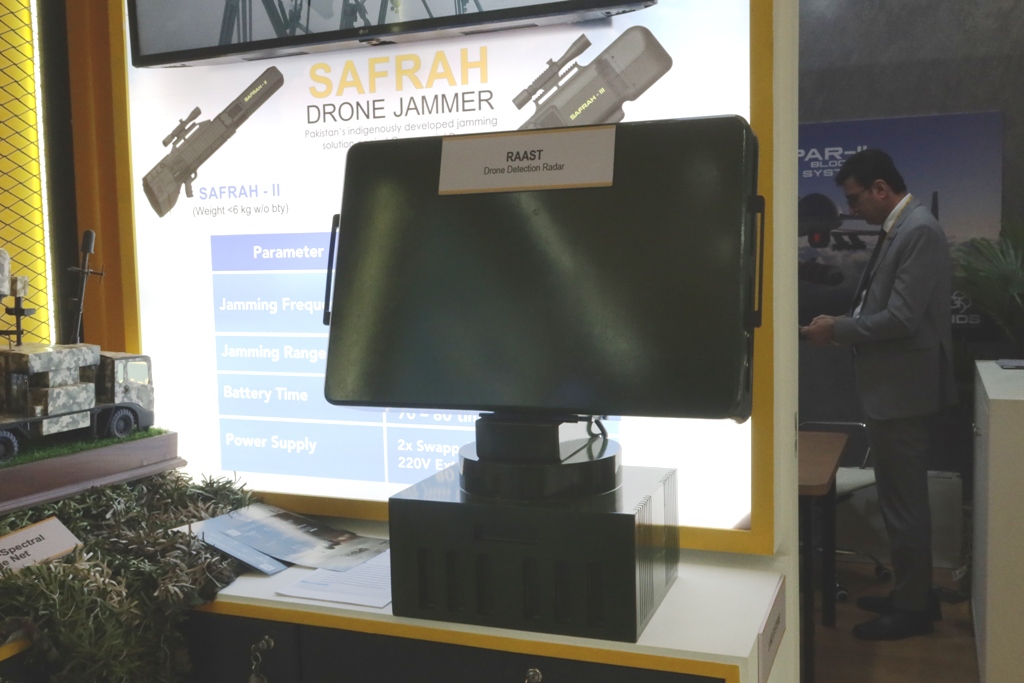
Starting from effectors, the Safrah-III is the typical rifle-like jammer, fitted with a long range scope for accurate aiming. The system is 620 mm long, 114 mm wide and 300 mm high, its mass being under 4.5 kg. It operates in three frequency bands, 1560-1610 MHz, 2400-2500 MHz and 5725-5875 MHz, the output power being 30 W for each band, for a total of 90 W, the company underlining that no harmful radiation is generated. This provides a jamming range of 1,500 metres, impeding the reception of videos and photos via the data link, disabling return-to-home functions, and cutting off all links between the ground base station and the drone.
The power supply is provided by batteries, one set ensuring 35 minutes continuous jamming or 60 to 70 jamming actions. Batteries can be easily swapped, the Safrah-III being also linkable to the power grid for continuous operations in static positions. The system is designed to operate against commercial drones.
The Safrah-III is already in service with Pakistani forces, EDR On-Line understanding that GIDS won several export contracts, no details about customers being provided.

The RAAST is a radar developed to detect very small flying objects. A pulse-doppler radar, it operates in the Ku-band and can pick up a 0.01 m2 radar cross section at around 10 km, minimum detection range being of about 150 metres. The one-dimensional AESA antenna rotates, azimuth scanning being mechanical, while that in elevation is electronic, coverage in elevation being 30°. The scan speed is 2 seconds, coverage in elevation being 30°. According to data provided by GIDS, accuracy 10 metres in range and 3°in angle. Detection probability declared is 85%, the RAAST being able to deal with over 200 targets at the same time. The radar unit mass is 43 kg, dimensions being 780x460x130 mm, while the servo unit has a mass of 32 kg and dimensions of 415x334x502 mm. The RAAST can be deployed in less than 10 minutes. EDR On-Line understood that the radar is already in service with Pakistani forces, EDEX being its first international appearance.
Photos by P. Valpolini