EDEX 2025 – Aselsan details the latest version of its KGK 84, the Mk 84 aerial bomb wing assistance guided kit, now capable to overcome the 100 km mark
At the Cairo exhibition Aselsan, the Turkish defence electronics leading company, detailed the new version of its KGK 84, the wing and guidance kit that once added to a Mk 84 2,000-pound (925 kg), general-purpose, unguided free-fall bomb, allows the latter to reach targets at 100 km distance

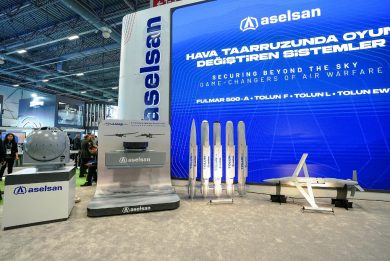
Talking to Aselsan key technical personnel, EDR On-Line understood that the 100 km mark was not reached by the KGK 84 in its original configuration, an example of the latter being exhibited at the Cairo exhibition.
Aiming at becoming the first company to deliver such capability, Aselsan started working to optimise the design to increase range, but considering the lessons learned coming from the Russian-Ukrainian war, where GNSS jamming and spoofing are serious concerns, it also adopted new technologies to counter such threats. The 8-channel CRPA (Controlled Reception Pattern Antenna) antenna is located at the rear of the bomb This is extended also to the inertial navigation system (INS), new algorithms ensuring better dialogue with the wing kit, allowing to increase range and accuracy, EDR On-Line understood.
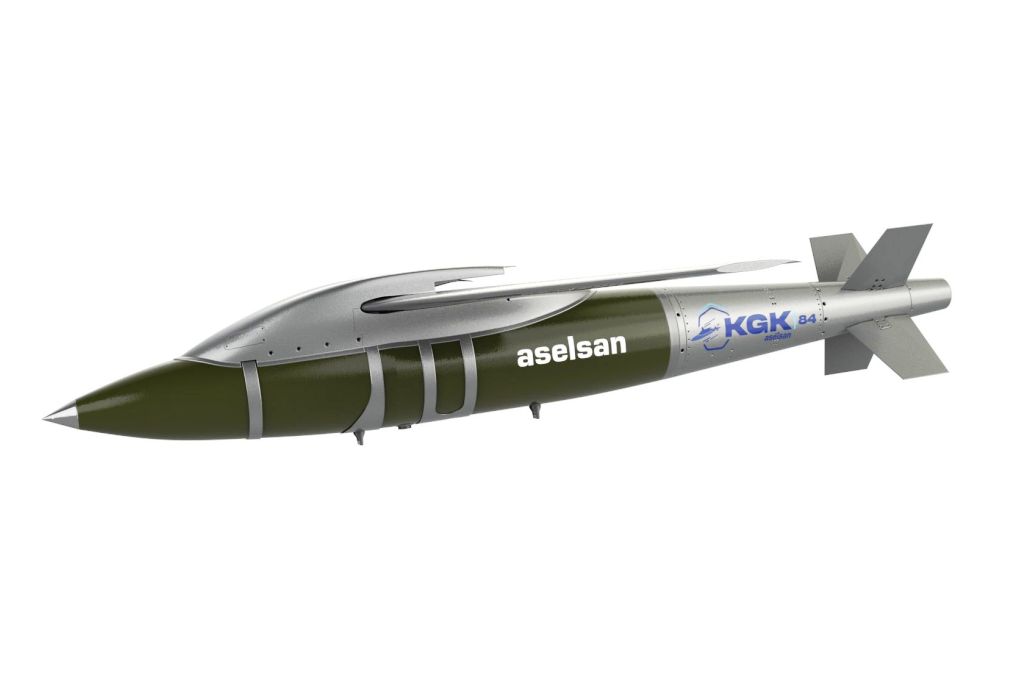
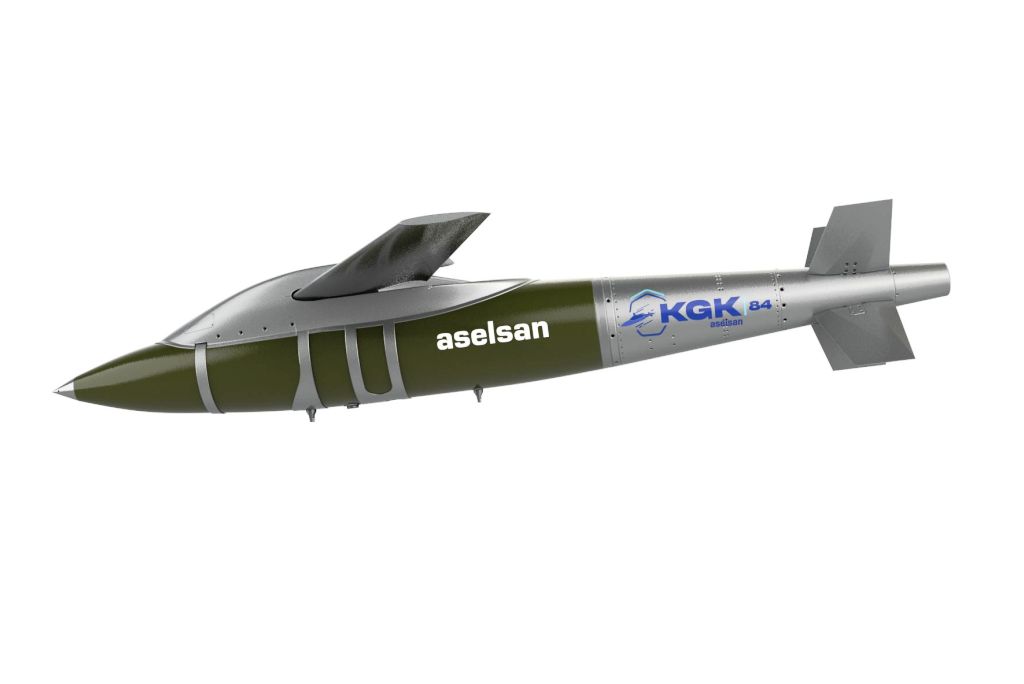
The KRK 84 is fitted to the aircraft pylon upside down, with the folded wings underneath. The 100 km range is obtained when the kitted free-fall bomb is dropped from a fighter aircraft flying at 40,000 ft altitude, minimum dropping altitude being 10,000 ft; once dropped, the bomb turns 180° on its longitudinal axis and wings are spread. It the starts its guided path towards the target coordinates, navigation being made via waypoints. Aselsan declares a CEP (Circular Error Probable) of less than 10 metres.
EDR On-Line understood that the wing kit has been deeply modified, a new profile being adopted while wingspan has been increased, no detailed data being available. This allows reducing drag while maintaining lift, thus allowing a longer glide path. Once fitted with the kit the overall dimensions are 4,040 mm in length and 940 mm in diameter, mass being 1,098 kg.
Being a system that aims at target grids, it is obviously meant for engaging only static targets; before launch the pilot can also insert the required impact angle in order to optimise the hit. Adding systems allowing to hit moving targets would probably add cost, one of the intended parameters being providing customers with a viable cost-effective solution.
The upgraded KGK 84 has been already tested on F-16 fighters, asymmetric configurations having also been proved. Aselsan is targeting the countries possessing considerable arsenals of MK 84 free-fall ordnance, Egypt being one of them. The company also aims at widening the number of fighter models qualified for carrying bobs kitted with the KGK 84, EDR On-Line understanding that the next step should be testing it on the JF-17 fighter of Chinese production.
Graphics courtesy Aselsan, photo by P. Valpolini