IAV 2026 – NMS UK ready to start production, looking at new designs
A subsidiary of the Turkish Nurol group, NMS UK was funded in 2023 to strengthen the Nurol footprint in the United Kingdom, looking at fully entering the UK market, the company planning to start production in 2026
According to information gathered at the 2026 edition of the International Armoured Vehicles conference 2026, organised by Defence IQ, which took place at the Farnborough International Exhibition Centre, 2026 should mark the start of armoured vehicles production at the Nurol UK production facility in Leamington, in the West Midlands.
The company counts a workforce of over 20 people, which should increase considerably during the current year, as the assembly lines in the over 11,000 m2 covered facility dedicated to armoured vehicles production. For the time being the vehicles produced in Leamington will be direct derivatives of those designed and produced by Nurol Makina in Turkey, the company being the 4×4 light armoured vehicle house of the group, while FNSS takes care of heavier armoured vehicles. Three main products are available from the UK company, the Dragon, based on the 14-tonne Ejder Yalçin, the Nomad, based on the 10-tonne NMS 4×4 Yoruk, and the Lurcher, based on the lighter NMS-L 4×4.
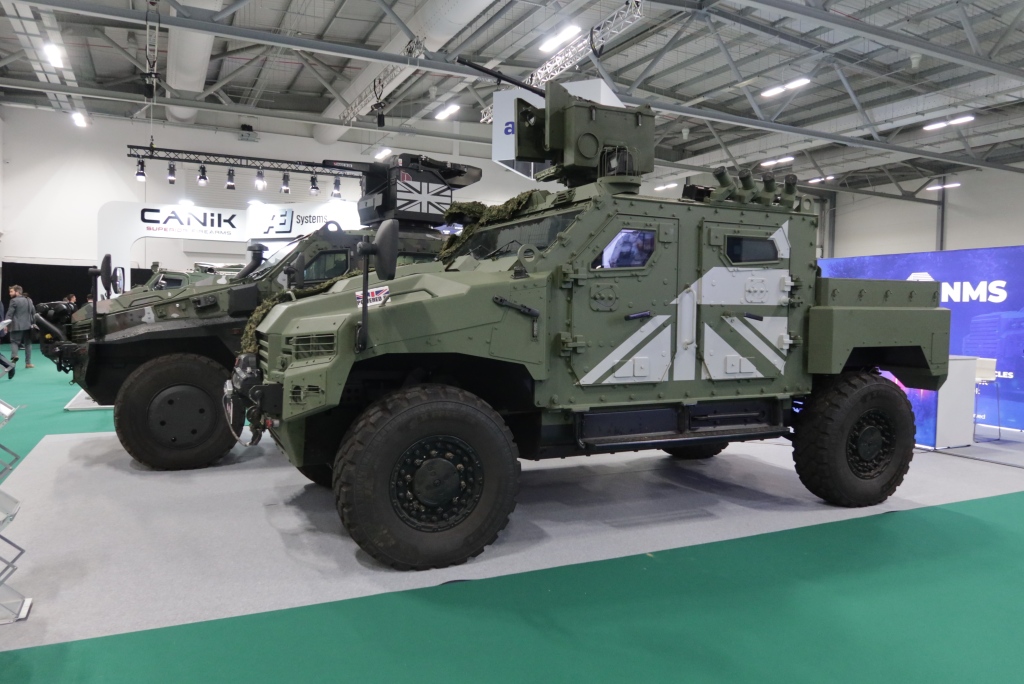
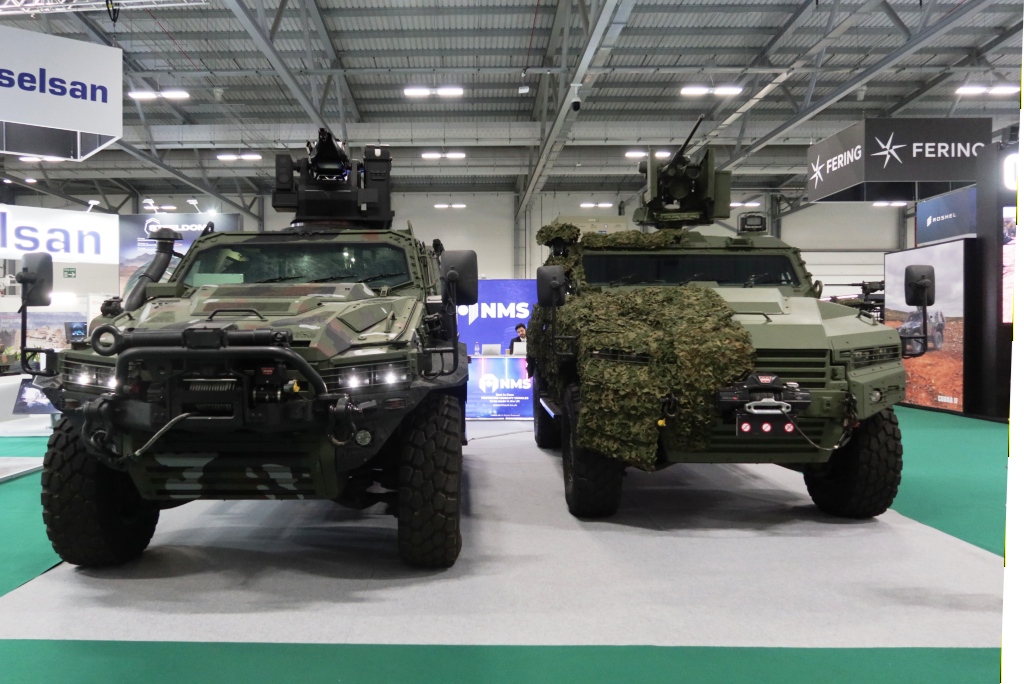
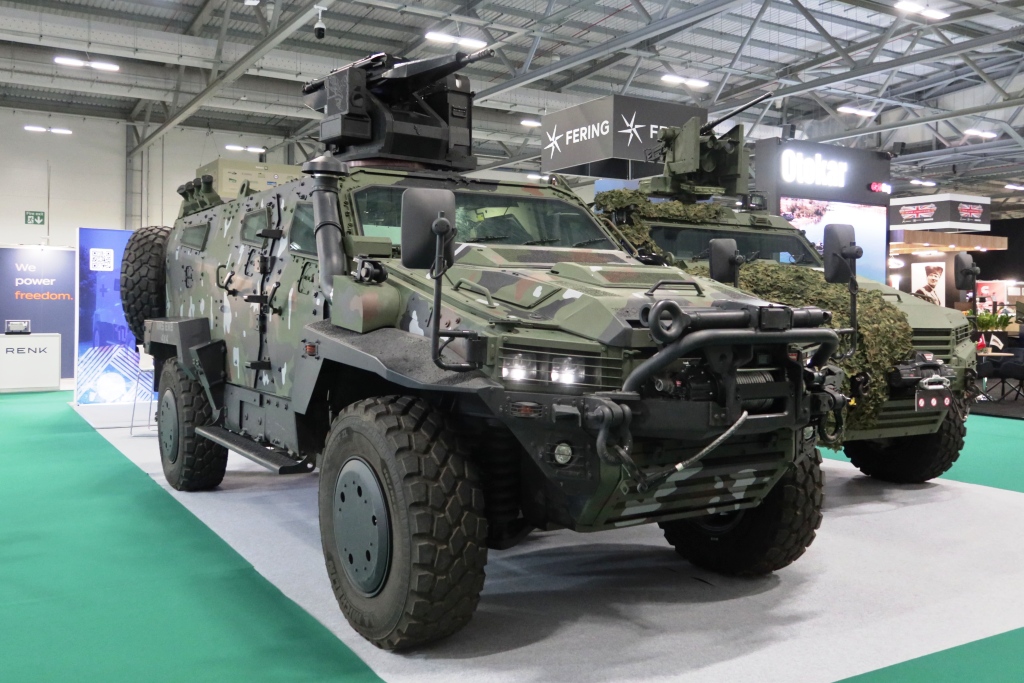
At IAV NMS UK exhibited two of those vehicles, a Nomad and a Lurcher; the Nomad was fitted with a Trakon 30 RCWS armed with the Venom LR (Low Recoil) 30×113 mm revolver cannon, which were exhibited in the nearby Canik stand, the RCWS being produced by Unirobotics and the weapon by AEI Systems, both companies belonging to the Turkish SYS (Samsun Yurt Savunma) group. Using proximity fuse ammunition this provides a counter-UAS capability to the vehicle. The Lurcher, which design constraints asked for sling transportability by CH-47, was fitted with a 12.7 mm RCWS.
In his presentation the NMS UK representative underlined how much armour is of key importance on today transparent battlefield, where threats coming from the third dimension are constant. “Modern armies require protected manoeuvre and a blend of survivability, agility, mass, and industrial realism. Force protection must be addressed through a reframing of force design, rebalancing a baseline level of protection across all battlefield elements,” he stated underlining that
“Armoured and mechanised forces matter more than ever,” something stressed also by most of the speakers at IAV 2026.
The rush towards higher and higher protection, due to the counter-insurgency missions that marked the last two decades was obtained at the expense of mobility, therefore “We must therefore rethink the mobility, protection and firepower triangle. Modern automotive engineering, armouring design and systems integration means that they are no longer mutual trade-offs, but rather mutually supporting. And when well-balanced, they create protected manoeuvre,” he added. “Modern protected platforms can now achieve mobility performance previously considered only in the realm of the unprotected vehicles. This resets the equation. Advanced suspension, toughened chassis, resilient drivetrains and rub-flat tyres come together to give the ability to move unpredictably, exploit terrain and this generates the manoeuvre required to avoid being seen, acquired and hit,” the NMS UK representative said.
Mobility is key to reduce the chances to be hit, however platforms must retain some form of protection at levels between 2 and 4, as well as soft-kill systems, as “Agility is a worthy replacement for firepower in anything other than a tank.” Not only, vehicles must be easy to recover and readily repaired or replaced, which encompass lower mass, easy of production and reasonable cost, deterrence and endurance being linked to the industrial capacity, the latter not being a support but rather a strategic weapon, as UK military top brass underlined during the conference.
“Expensive 8×8 and 6×6 platforms must be focused on their primary role, while complemented by agile and much more cost-effective 4×4 fleets. This is particularly relevant across the combat support and combat service support functions,” the NMS UK speaker stressed, adding that “protection must be distributed across the force, not concentrated at the front, to give all soldiers the adequate baseline of survivability to feel confident and capable of achieving their mission.”
Underlining how technology advances allowed to improve vehicles characteristics he highlighted that “Blending all the experience and lessons from Dragon into the Nomad design has enabled to achieve an optimal balance of protection and mobility: with close to 90% of the protection levels of Dragon but at 70% the vehicle weight.”
NMS UK looks to incoming British Army bids to obtain its first volume successes, leveraging the experience of its Turkish origins coupled to the new UK-based production base and supply chain.
Photos by P. Valpolini