IAV 2026 – Thales UK showcases its latest sensors and crew workload reduction solutions
Gathering information at greater distances than enemy, and processing them providing the crew with a clear view of the situation, algorithms reducing time as well as human workload, is what can give an edge over the adversary, and at IAV 2026 Thales UK showcases some of the solutions proposed
While the International Armoured Vehicles conference, IAV in short, the annual meeting organised by Defence IQ, is firstly focused on armoured vehicles, their effectiveness is not only based on the protection-firepower-mobility triangle, information gathering and target acquisition being also part of the equation, although they might be included in the both the protection and firepower elements.
Platforms, as well as sensors, are designed to last for decades, unless some dramatic technology breakthroughs happen. What is constantly evolving is software, hence the need to provide new algorithms to improve systems performances at regular intervals without changing hardware.
This is the aim of Thales UK DigitalCrew, a set of algorithms that can be easily integrated into any open architecture digital systems. Most of these are mathematical traditional algorithms that do not require high processing capacity, hence they do not need improvements on the system that is being updated.
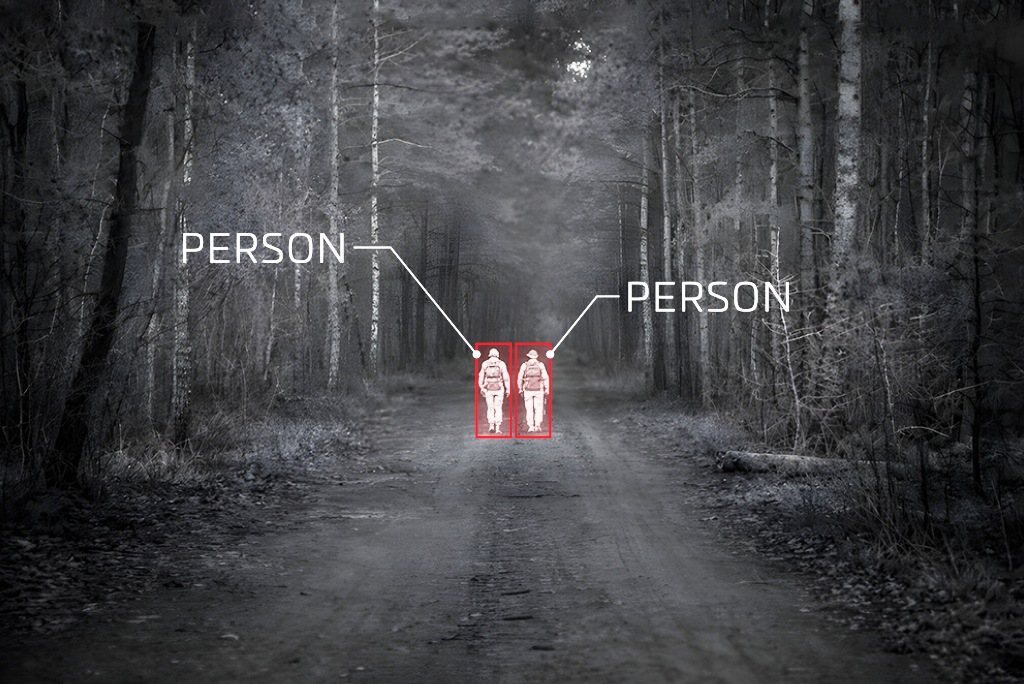
Object detection couples hotspot and moving object detection, a key feature in surveillance missions where crew should monitor the assigned area for long periods of time, knowing well that after some tens of minutes attention starts reducing dramatically.
Manually tracking a land moving target, while your own vehicle is moving cross-country, is not easy task; nowadays remotely controlled weapon stations, when armed with adequate weapons, are often required to cope with the counter-UAS function, and tracking small flying objects which path is quite unpredictable is nearly impossible. Here comes the DigitalCrew target tracking algorithm, a multimodal closed-loop tracker, with a number of user selectable acquisition modes, and is designed to work with any steerable mount.
Video combination provides the crew with a panoramic view obtained stitching together images gathered by a rotating sensor or by multiple sensors, something everybody is familiar with as this is a function available on most smartphones, but here it can be done in visual and thermal bands.
DigitalCrew image fusion allows combining two or more video streams together, day colour and thermal for example. Hotspots can be added to the colour image, or the day and night may be blended should this increase situational awareness. In the same package comes the foveal zoom function, which allows putting together in the same image streams coming from cameras with different fields of view (FoV), the highest resolution image being at the centre as it is in the human eye.
All those functions, EDR On-Line understood, are not based on Artificial Intelligence (AI).
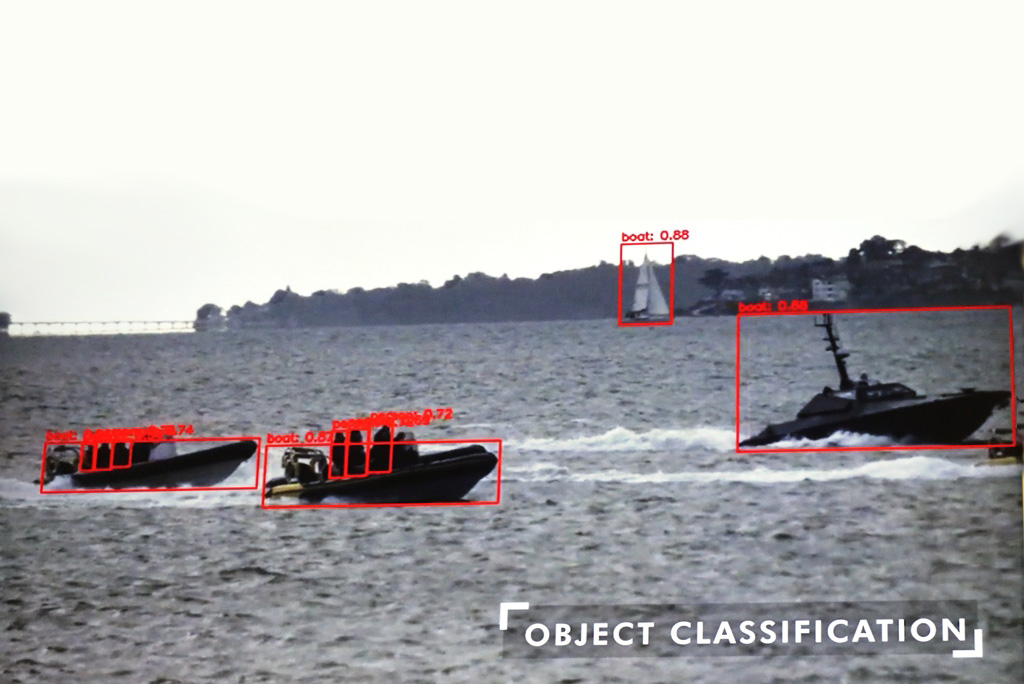
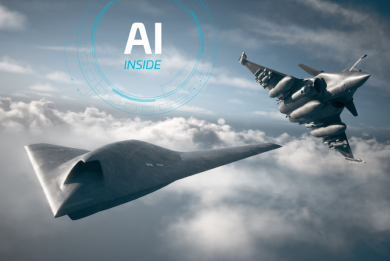
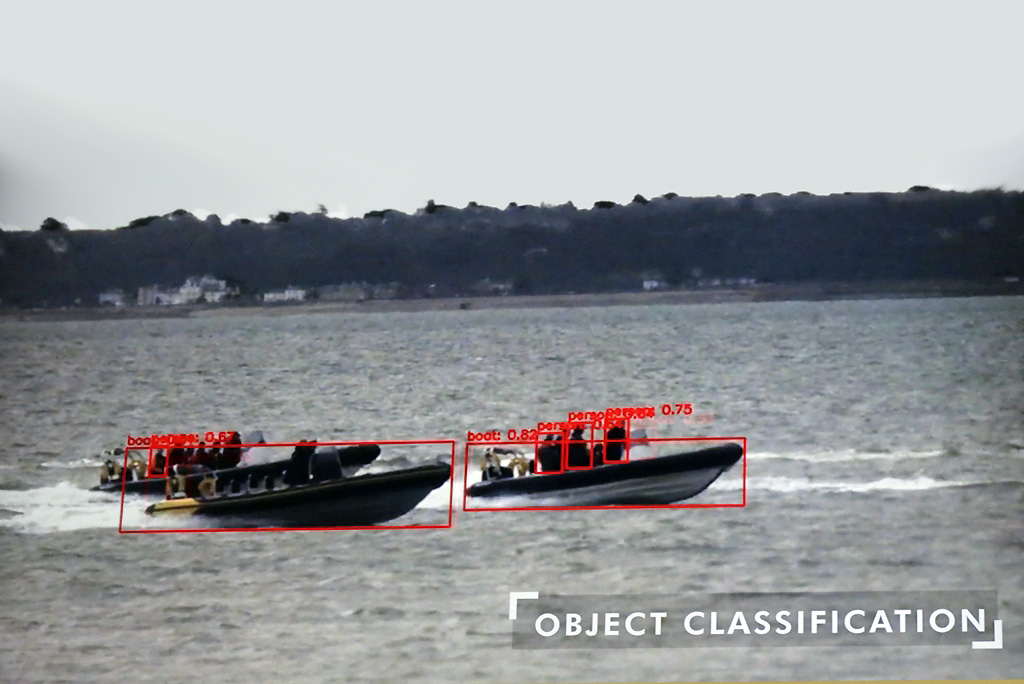
Where AI comes into play is object classification, machine learning being a key part of the solution, as the system must be adequately “trained” to recognise the type of target in different wavebands and situations. Thales trains its systems on a wide variety of targets, however customers can integrate their own targets, data base generated remaining classified.
Last (for the time being) but not least comes the turbulence correction function, an algorithm allowing to considerably improve image quality when vision is disturbed by air turbulence generated i.e by heat. This allows to bring back the sensor system close to the original Detection/Reconnaissance/Identification ranges obtained when operating in clear weather.
A mission support tools package allows to adapt and integrate the different functions, according to customers’ needs.
Thales is considering selling the DigitalCrew algorithms as a service, the company continuing their development, thus being able to provide new releases as the time goes by. Computing power is the real bottleneck as while the use of AI will increase, algorithms will need evolved computers. Thales sighting systems come together with the Sight Processing System (SPS), installed inside the vehicle; this is a general purpose computer with Central Processing Unit (CPU), Graphics Processing Unit (GPU), Peripheral Component Interconnect (PCI) express bus, and video memory; the plan is to develop more powerful SPS every four-five years to cope with the increased computing power needs, maintaining the same form factor and similar power consumption, in order to allow easy replacement.
Thales UK and Thales France are sharing their expertise in AI within the cortAIx initiative with sites also in Canada, Singapore and Germany, that allows avoiding duplication increasing effectiveness within the group.
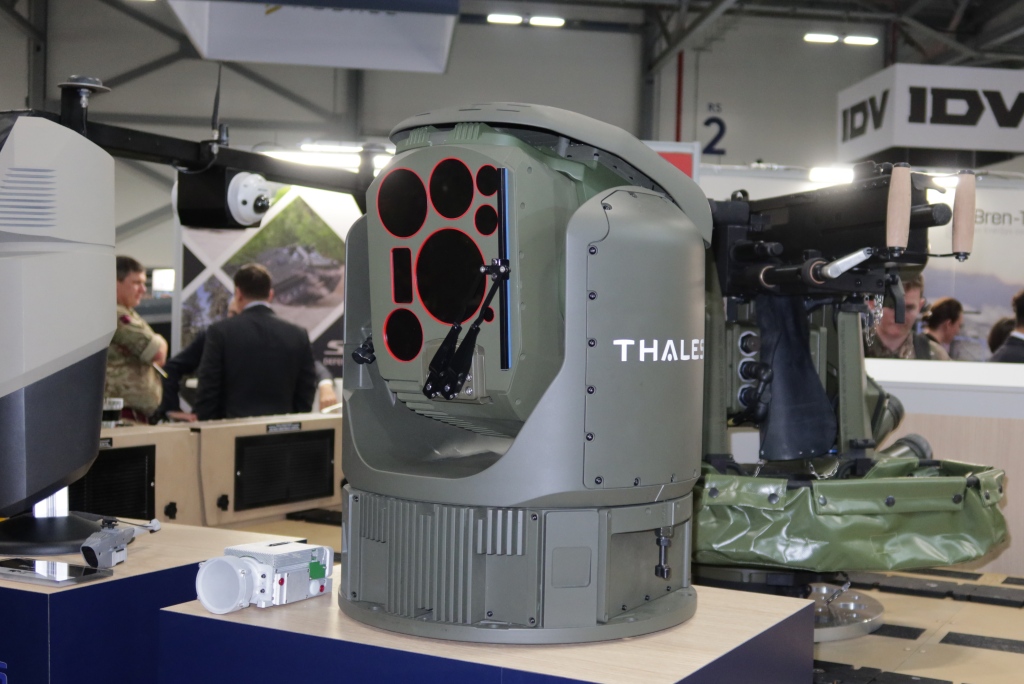
A Thales UK product unveiled at DSEI and showcased at IAV was the TrueHunter. A panoramic above-armour gimbal sight that provides not only target acquisition but also designation and exploits most of DigitalCrew software modules. With an overall mass of 78 kg, the TrueHunter has a 400 mm diameter and is 530 mm high. It covers 360° continuously in azimuth, with an angular speed of more than 2.5 rad/s (over 140°/s), and its elevation is comprised between -25° and +63°, stabilisation being 50 µrad RMS. Looking at the TrueHunter from the front, on the left, top to bottom, we find the laser designator, the laser rangefinder (LRF) and the short wave infrared sensor (SWIR); in the centre on top is on day TV camera while under it is the medium wave infrared sensor (MWIR); on the right, the two small windows are those of the other two day TV cameras, while the even smaller one at the bottom is the laser pointer.
The SWIR thermal sensor has a 640×512 matrix sensor and is fitted with a 2° Narrow FoV lens; it provides laser spot detection in all wavelengths, as well as night thermal image even in bad weather conditions. The MWIR sensor has a much greater resolution, as it is based on a 1280×1024 matrix. The three day channels are based each on a 1920×1080 colour sensor, each fitted with a fixed focal length, for narrow, medium and wide FoV. The Foveal zoom function allows the user to move through the 3 cameras digitally from 2° to 20° FoV remaining in focus regardless of step. So, it is three cameras but appears as one to the user. DigitalCrew can monitor each camera feed simultaneously.
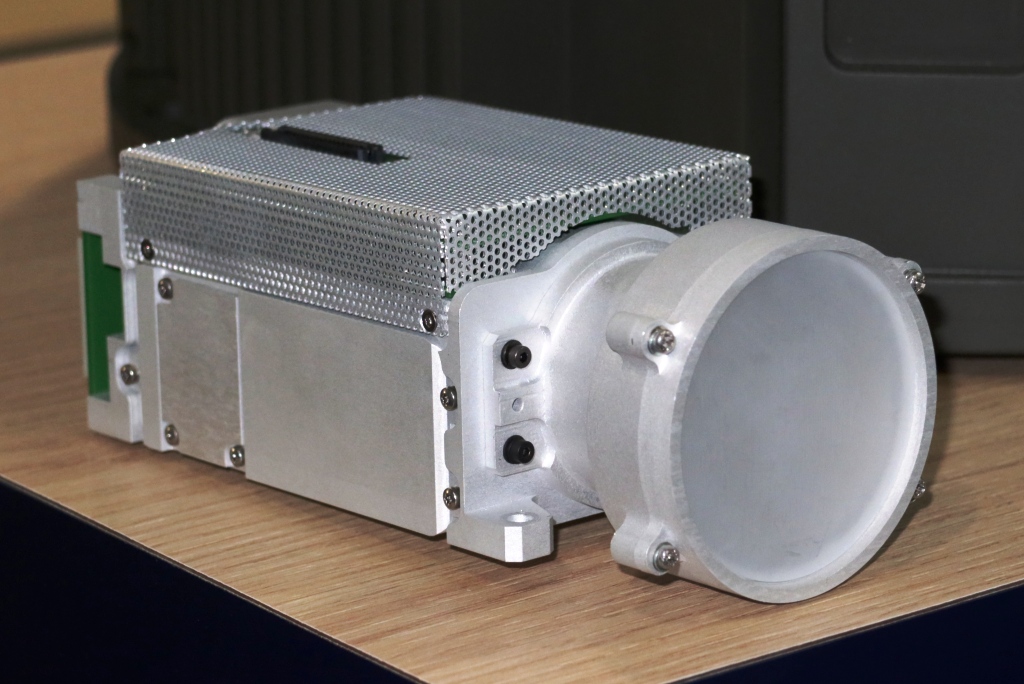
The LRF is a Class 1 eysafe system operating in the 1,595 nm frequency band and has a range of over 10 km, with 1 Hz standard pulse repetition frequency (PRF) and 4 Hz burst PRF.
The most interesting subcomponent of the TrueHunter is the SharpView laser designator. It is available in two versions, the difference being in the beam divergence, 0.3 mrad or 0.5 mrad. The former dimensions are 171 x 78 x 64 mm the mass being under 870 grams, while the latter dimensions are 140 x 78 x 56 mm, the mass being under 760 grams. The SharpView is compliant to STANAG 3733 [1] and operates on the 1,064 nm wavelength with an output energy of over 50 mJ, which makes it a Class 4 laser. According to information the range in the designation mode is around 6 km. Definitely one, if not the lightest and smallest, designator in its category, it exploits diode-pumped rather than flashlamp-based laser technology. It can obviously be used also as a non eyesafe laser rangefinder with respectively a range of over 10 or over 7.5 m, however in the TrueHunter a dedicated eyesafe LRF is used.
It is to note that the TrueHunter is equipped with a wiper that maintains optical windows clean, a critical job when operating in bad weather and muddy terrain. EDR On-Line was told that the wiper has several redundancies, as it must absolutely be in its rest position when systems especially laser ones, are operated.
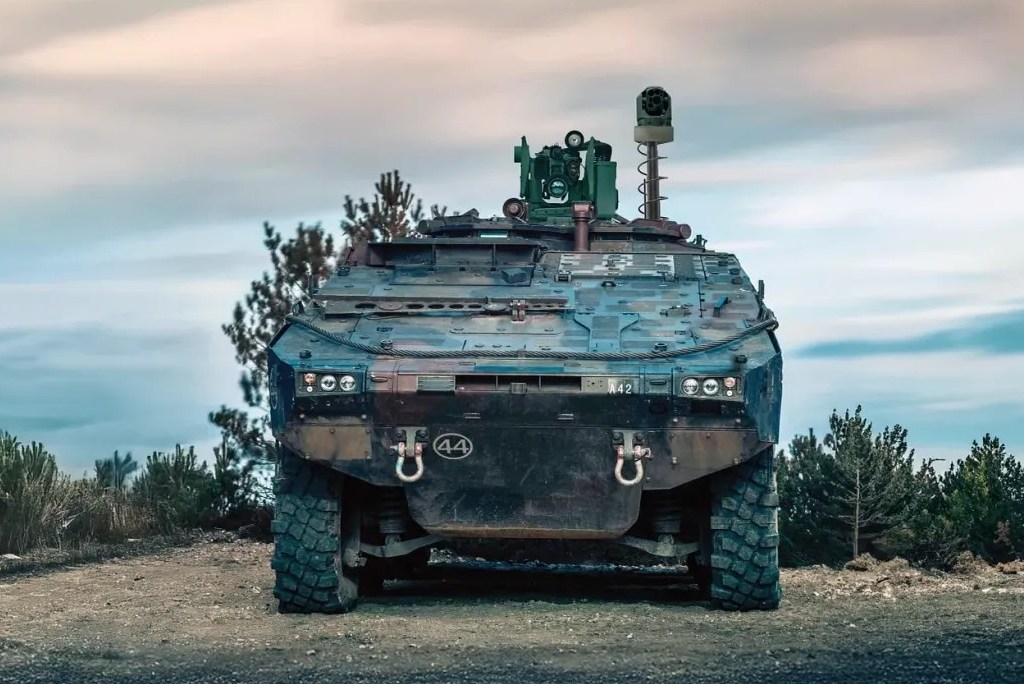
The TrueHunter is being tested by the German Army as the main sensor of the Boxer Joint Fire Support Team variant, the gimbal sight being installed on top of a telescopic mast.
Besides its use in the TrueHunter, the SharpView designator drew a lot of interest from companies developing drone payloads, as it will allow to insert a designator in relatively small gimbals, a 17-inch should host it, increasing tactical UAVs capabilities from target acquisition to target designation. EDR On-Line understood Thales is already in discussion with some companies. The small dimensions might also bring to a manportable designator, the size of a big targeting binocular, the main issue being probably power, power consumption during designation being less than 35 W. We understood that the idea is there, the company checking the market before moving into a development programme.
Another sensor exhibited at IAV was a drone detection device; fully passive, all based on optronics, this system is still at TRL 4-5, so we will probably be able to get more details in due time.
Photos courtesy Crowncopyright, Thales and P. Valpolini
[1] Laser Pulse Repetition Frequencies (PRF) and characteristics of Laser Designators and Markers – Aep-3733 Edition A