DIMDEX 2026 -: China’s debuts Norinco Warrior‑1 anti‑tank contender
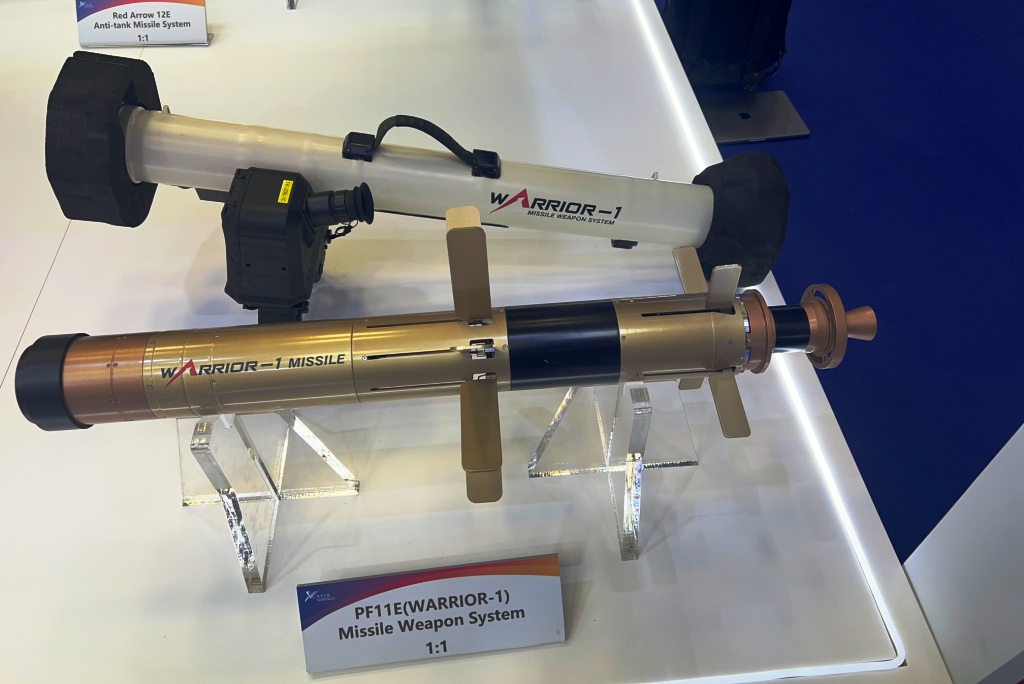
The Chinese Norinco Warrior‑1 anti‑tank missile system is emerging as a new entrant on the international market, and its public display at the DIMDEX exhibition in Qatar underscores the will to position this weapon as a competitive solution for modern land forces. Although detailed official data remain scarce, the system appears to draw heavily on the technological and doctrinal heritage of Norinco’s established Red Arrow and HJ‑series families, combining proven design choices with enhancements tailored to contemporary high‑intensity conflict
At its core the Warrior‑1 is conceived as a ultra-light anti‑tank guided missile (ATGM) designed to defeat tanks along with infantry fighting vehicles, fortified positions and high‑value assets in depth. The missile is housed in a sealed launch canister, simplifying storage and transport while reducing the maintenance burden on front‑line units and enabling rapid deployment from march to firing position. This approach also facilitates the integration on a wide variety of platforms, from man‑portable launchers to remote‑controlled stations on light armoured vehicles.

The guidance architecture of the Warrior‑1 has not been openly disclosed, but its design logic can be inferred from recent Norinco developments such as the HJ‑12, which employs imaging infrared seekers and fire‑and‑forget capability. In operational terms, one can expect Warrior‑1 to offer a combination of day/night engagement via thermal imaging sights, laser range finding for accurate distance measurement, and the option of either command guidance or autonomous terminal homing, depending on the variant and customer requirement. This mix would allow crews to engage targets from covered positions, shorten exposure time on the firing line and increase survivability under counter‑fire.
From a performance standpoint, Warrior‑1 is likely positioned in the 2000-metre range bracket typical of advanced ATGMs, giving infantry and mechanised units the ability to strike armoured formations before they can fully exploit their own direct‑fire weapons. The missile’s flight profile would plausibly support both direct attack and top‑attack trajectories, enabling defeat of heavily protected frontal arcs or exploitation of thinner armour on turret roofs and hull decks. Such flexibility is particularly valuable in complex terrain and urban environments, where lines of sight are constrained and engagement windows can be extremely short.

The warhead configuration of Warrior‑1 is almost certainly based on a multi-function design. In addition to the primary anti‑armour variant, export customers could reasonably expect options such as high‑explosive fragmentation warheads, optimised respectively for destroying field fortifications, bunkers and concentrations of troops or soft‑skinned vehicles. This multi‑effect approach would allow the same launcher system to cover a broader spectrum of targets, enhancing tactical flexibility while rationalising logistics.
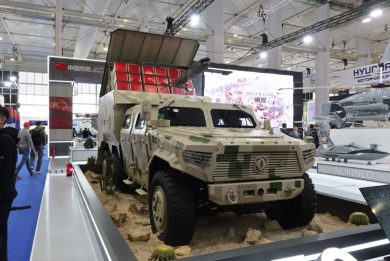
Integration on vehicles is a central pillar of Norinco’s export strategy, and Warrior‑1 fits naturally into this pattern as a scalable effect for reconnaissance, cavalry and infantry fighting platforms. It can be mounted on 4×4, 6×6 or 8×8 armoured carriers, and can be operated from under armour via remote weapon stations or dedicated anti‑tank turrets, thereby combining high mobility, protection and long‑range precision fire. In mixed units, Warrior‑1 launchers could be paired with automatic cannon and sensors to create mobile anti‑armour “pickets” capable of ambushing enemy armour and rapidly displacing before retaliation.
Operationally, the system is clearly tailored to the demands of contemporary conflicts, where armoured vehicles must operate under constant threat from portable and vehicle‑mounted ATGMs. For armed forces seeking to densify their anti‑tank networks at battalion and brigade level, Warrior‑1 offers the prospect of a relatively compact, modern missile aligned with the latest Chinese design philosophies in terms of crew ergonomics, engagement tempo and digital integration. Networking the system with higher‑echelon command‑and‑control, drones or forward observers would allow rapid target designation and coordinated fires, reinforcing its deterrent effect against hostile armour.
The decision to showcase Warrior‑1 at DIMDEX in Qatar is highly significant, as the Gulf region represents a mature market where several advanced Western and non‑Western anti‑tank systems are already in service. By presenting this missile in Doha, Norinco signals its intent to compete head‑on in an arena dominated by NATO‑standard solutions, highlighting not only performance but also cost‑effectiveness, industrial offsets and delivery timelines as levers of influence. For regional and international delegations visiting DIMDEX, Warrior‑1’s presence offers a concrete illustration of how China is expanding its footprint in the high‑end land‑combat segment, with a weapon that aspires to match the capabilities of established Western and Russian ATGMs while remaining firmly oriented toward export customers.
Despite this growing visibility, open‑source documentation on Warrior‑1 remains limited, and many of the system’s parameters still reside in the realm of informed extrapolation from Norinco’s broader portfolio. As additional technical data sheets, firing trials and user feedback emerge, particularly following its appearance at high‑profile events such as DIMDEX, defence analysts will be able to refine their assessment of the missile’s true place within the global anti‑tank ecosystem and its potential impact on future armoured warfare.
Photos by J. Roukoz