
Dubai Airshow 2025 – Azerbaijan showcases its latest UAV developments
At the Dubai exhibition the Azerbaijan stand was dominated by UAVs, most of them quadcopters capable not only to conduct reconnaissance and surveillance missions, but also to hit enemy targets releasing mortar shells
At the Dubai Airshow the Azerbaijan stand was organised by the “MIRAS Military-Industrial Company” LLC, a new entity operating under the Ministry of Defence of the Republic of Azerbaijan, which for the first time represented the country at an exhibition.
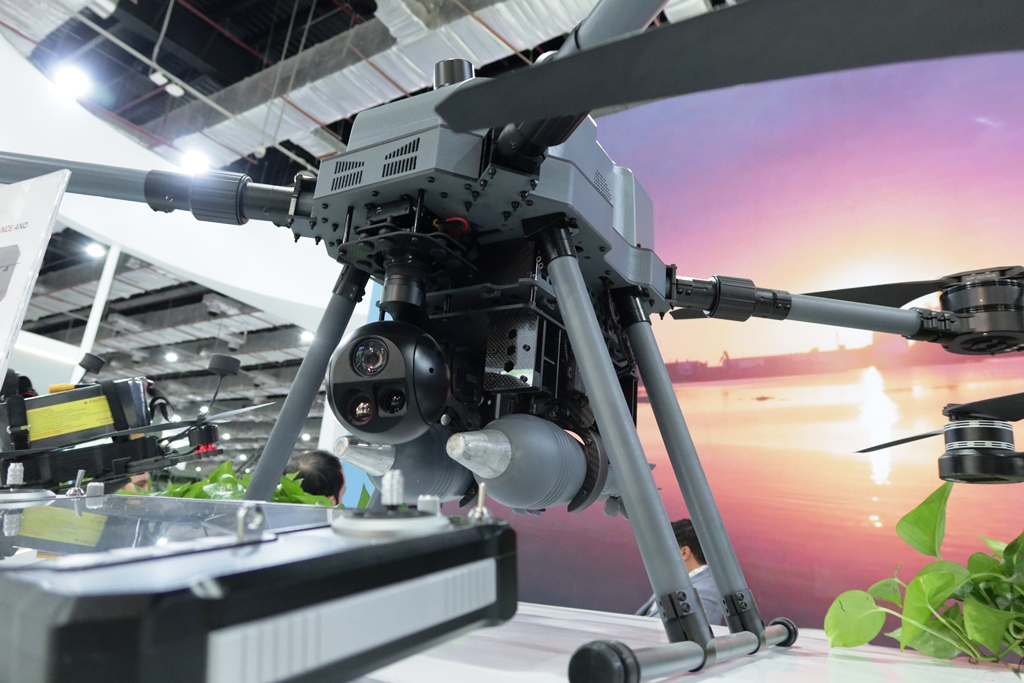
The Qartal is a dual role quadcopter with a maximum take off mass of 19 kg, the UAV empty mass being 8 kg. When loaded with the day/night optronic payload for ISR missions it has a 1-hour endurance, which is reduced to 34 minutes when two 81/82 mm mortar shells, each with a mass of 3 kg, are added. The optronic payload includes a 640×512 pixels uncooled thermal sensor, and a daylight camera with a x10 optical zoom. The Qartal dimensions are 850x850x470 mm; it can reach a maximum speed of 70 km/h, and its operational range is 15 km. Its operational ceiling is 3,500 metres above sea level, operational altitude being 800 metres above ground.
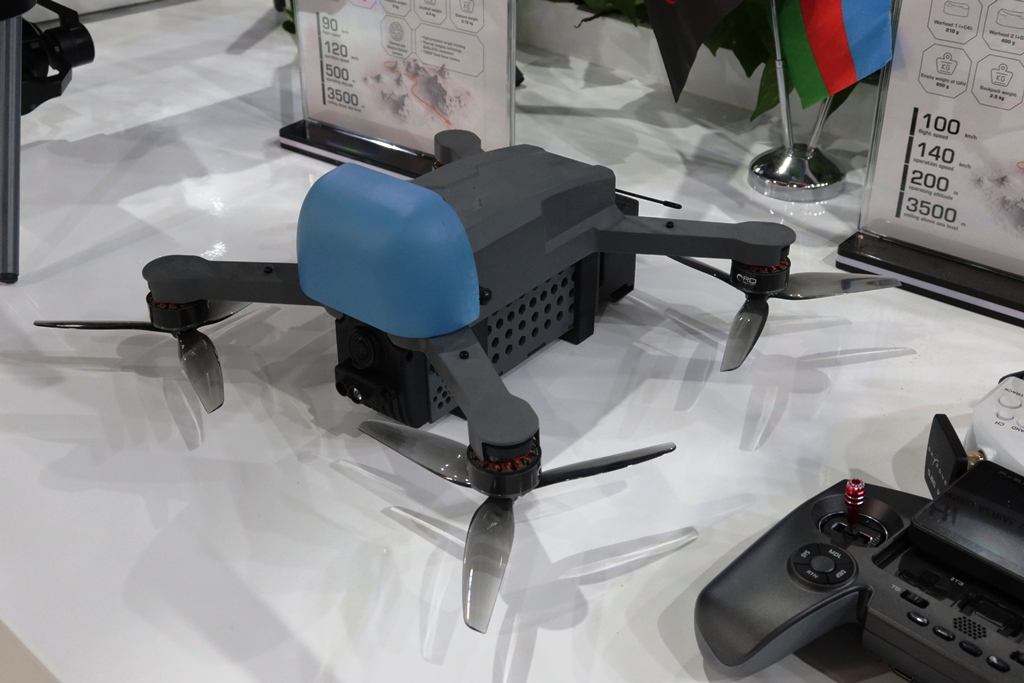
Three loitering munitions were exhibited. The smallest one was the Qirghi, a small quadcopter with a 260x260x120 mm footprint and an empty mass of 850 grams. It can carry two different types of payloads, both mase of C4 explosive, one with a mass of 210 grams and the second with a mass of 400 grams. The Qirghi has a 20-minute endurance (with the smaller warhead this is probably higher) and a 5 km operational range, maximum speed being 140 km/h while operational speed is 100 km/h. Operational ceiling is 3,500 metres above sea level, operational altitude being 200 metres above ground. The Qirghi is launched by hand, the operator controlling the system via data link using a joystick and goggles; weight reduction was among design parameters, the joystick mass being 470 grams, goggles 305 grams and battery 550 grams.
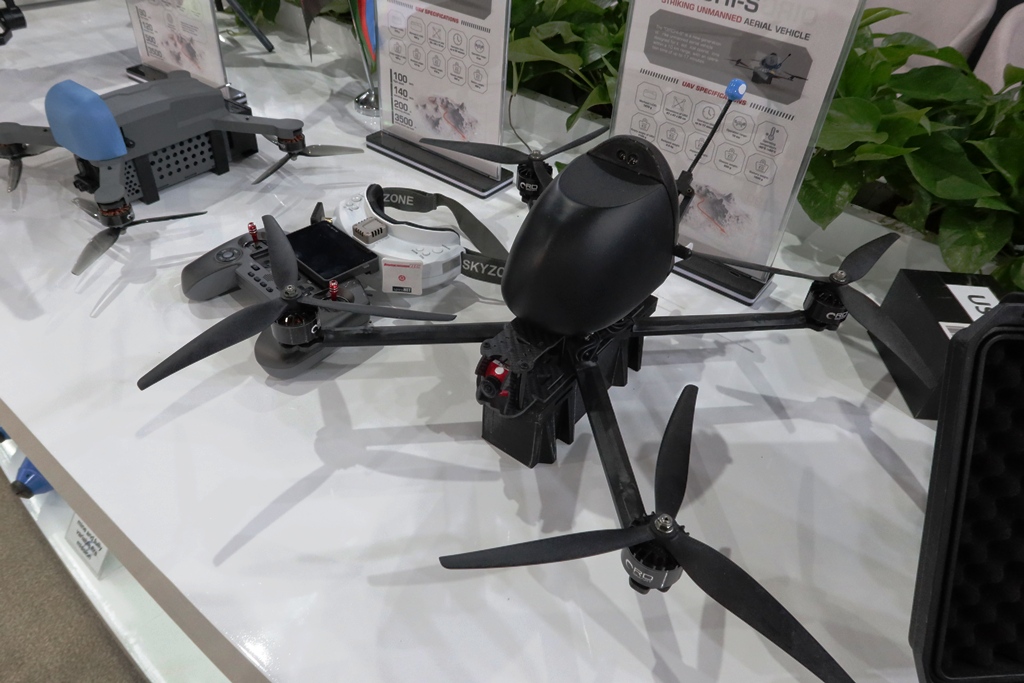
Growing in mass, the Qirghi-S is another quadcopter-based loitering munition which carries a much bigger warhead, 1,470 grams of C4, the airframe empty weight being only 1,100 grams. With a bigger footprint, 470x470x250 mm, it has a 17-minute endurance and a 10 km range, maximum speed being 130 km/h with cruise speed being 90 km/h. Operational ceiling is 3,000 metres while operational altitude is 300 metres. The Qirghi-S uses the same joystick of the smaller Qirghi, while the goggles are bigger, and the battery capacity is higher, respective masses being 600 and 1,600 grams. Both Qirghis are backpackable and are operated by a single soldier.
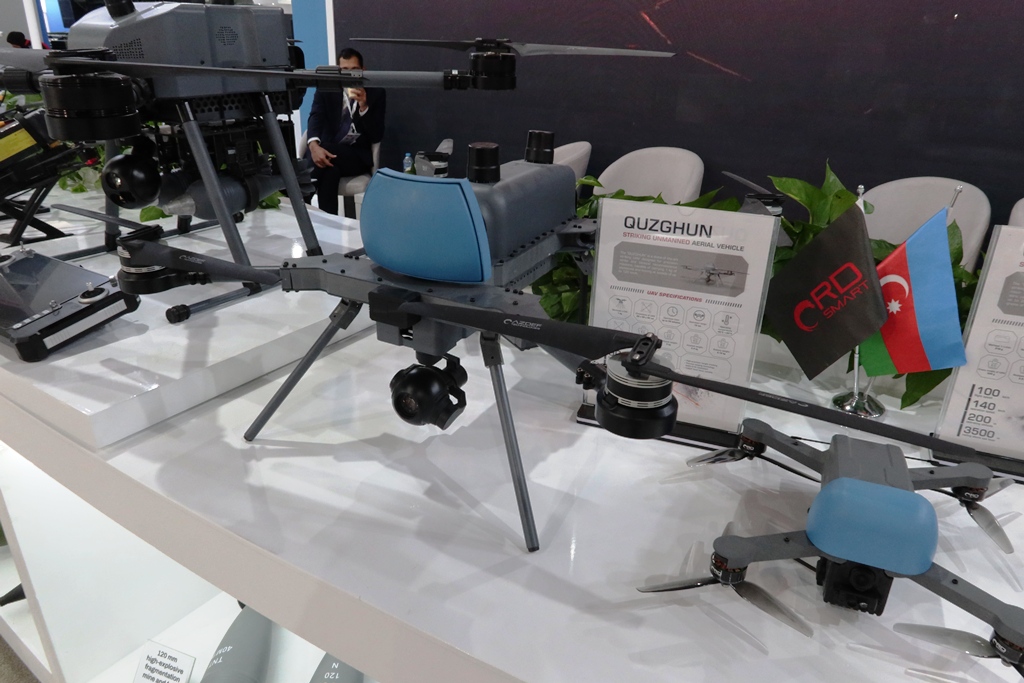
The Quzghun is another quadcopter that can carry a 1 kg C4 warhead, however it is also capable to carry out reconnaissance missions as it carries a comprehensive optronic suite which includes the same thermal imaging sensor adopted by the Quartal, while the day camera has a fixed focus lens, as the Quzghun. The UAV empty mass is 4.1 kg, dimensions being 680x680x400 mm. With a 34 minutes endurance and a cruise speed of 90 km/, dash speed is 120 km/h, the Quzghun operational range is 15 km. Considering the reconnaissance mission, the ground control station is bigger and has a mass of 2.4 kg, battery mass being 2.12 kg. Operational ceiling is 3,500 metres while operating altitude is 500 metres.
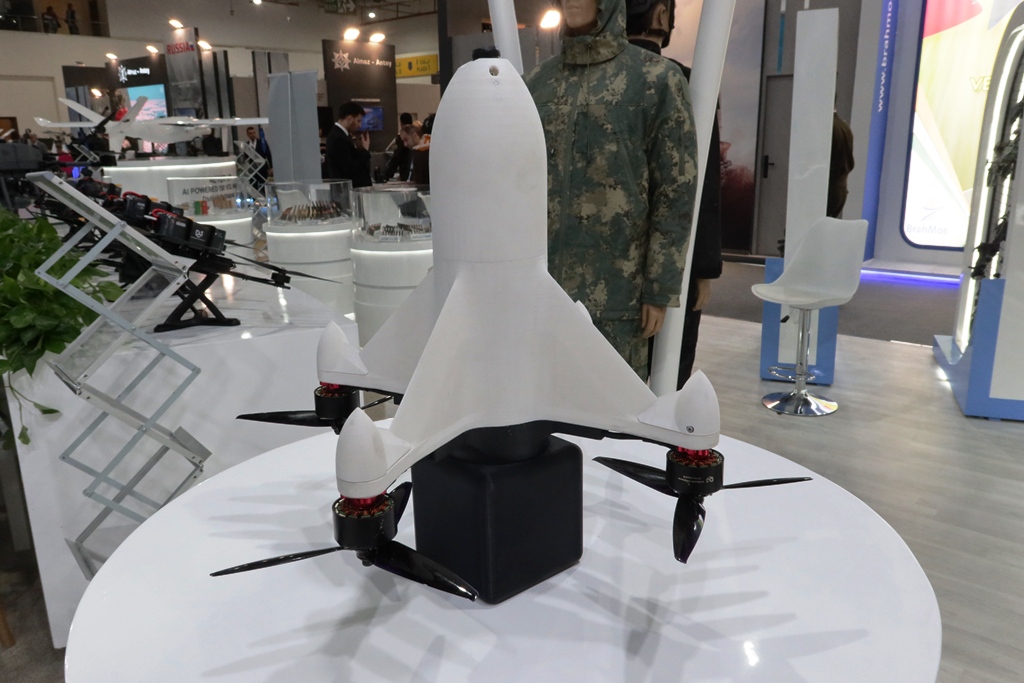
EDR On-Line understood that all those quadcopters are already in production. The only VTOL UAV not yet being produced, but ready to be, was an unnamed drone which shape was very much similar to that of other interceptor drones. A cylindrical fuselage aerodynamically shaped at the front with four delta wings at the rear carrying each an electric motor activating a three-blade propeller, the UAV taking of from a cubic base. No further details were provided, and no dimensions were available, although 500-700 mm should be the length range. Maximum speed declared is 300 km/h, which led company representatives to define it a high-speed First Person View system, although EDR On-Line guess remains that the model seen at EDEX was that of an interceptor drone, UAV-killers of that shape being currently under development in many countries.
While some of the above systems have similarities with similar UAVs and loitering munitions manufactured abroad, notably in Turkey, dimensions and masses are different, showing that Azerbaijan is on the way to become more and more autonomous in this field.
Photos by P. Valpolini