
Eurosatory 2026 – CIO enters the self-propelled howitzers domain with the VBM 155
The increasing importance of artillery, highlighted in the Ukrainian conflict, is leading several companies to add new systems to existing ones. At Eurosatory CIO, the 50/50 consortium between IDV and Leonardo, unveils its VBM 155, which puts together the artillery capabilities of the Leonardo La Spezia facility and the expertise on wheeled chassis of Bolzano-based IDV, recently acquired by the main Italian defence industry group
EDR On-Line readers already had some anticipations on such a project in late November 2025, when Leonardo unveiled the technology demonstrator of a fully automated artillery turret fitted with a 155/52 mm ordnance. The demonstrator was aimed at validating the automatic loading system, which is fully described in the article published at that time. Since then, the design of the turret, now known as HITFIRE 155, has been completed and at La Spezia the prototype is being built. It is now fitted with the 30 rounds magazine on the left and the 30 full charges (180 elements) on the right, and the automatic loader for the primer has been added. The system has been made more compact, loading mechanisms have been optimised for industrialisation, traverse and elevation electric actuators have been added, bringing it as close as possible to a real product, the turret hull also being now fully designed. Only basic functions have been considered in the prototype, some additional functions to be added in a spiral development that will bring to the final production configuration.
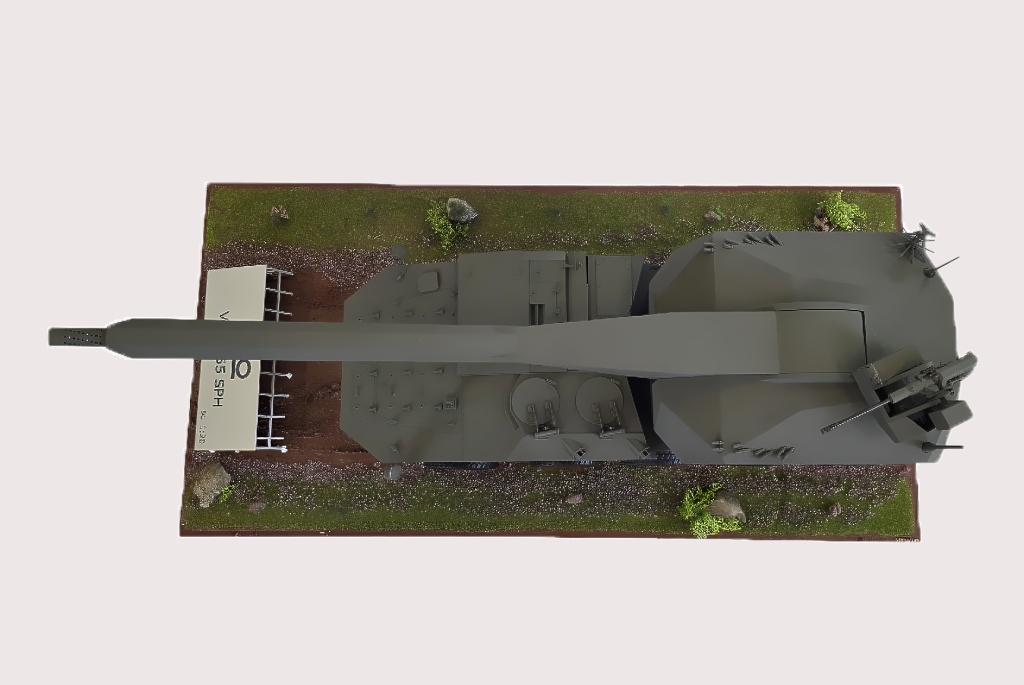
While most was said about the artillery module, the November article was mentioning an 8×8 platform, a derivative of the 8×8 VBM NG, for New Generation, which is being developed under an Italian MoD contract and which was detailed in an EDR On-Line article in early 2025. The main news is that in fact the VBM 155 will have one more axle, as IDV has been developing in the past years a 10×10 version. This is being fitted with the IDV 6V TCA second generation commonrail engine with electronic control which provides 720 hp with a 2,500 Nm maximum torque, coupled to a ZF 1500 HP transmission. The chassis has a 1,650 wheelbase between the first and the second axle, the others being equally spaced by 1,450 mm. The 10×10 chassis is 8.57 metres long, 2.26 metres high and 3.145 metres wide; the VBM 155, considering the turret and barrel, is 11.10 metres long, 4.38 metres high, width remaining the same. The 10×10 chassis dry mass is 18, 000 kg, gross vehicle mass being 40,000 kg, which leaves 22,000 kg for the payload. In the case of the VBM 155, 6,000 kg go for fuel, ancillaries, crew, etc, the turret adding 13,000 kg, which brings the howitzer GVM up to 37,000 kg, leaving a 3,000 kg growth for adding further systems in the future.
Adding a fifth axle benefits mobility, reducing the specific pressure on ground which means a better VCI (Vehicle Cone Index), and a better mobility on soft terrain. The steering remains the same of the VBC, on the two front axles and on the last one, the extra less than half meter in length compared to the VBM NG 8×8 Combat affecting only marginally the steering radius. The minimal length increase was obtained reducing the wheel base between the second, third, fourt and fifth axles. This solution allows to maintain maximum commonality among the fleet. CIO is however considering other steering solutions, should a customer require an even smaller turning radius.
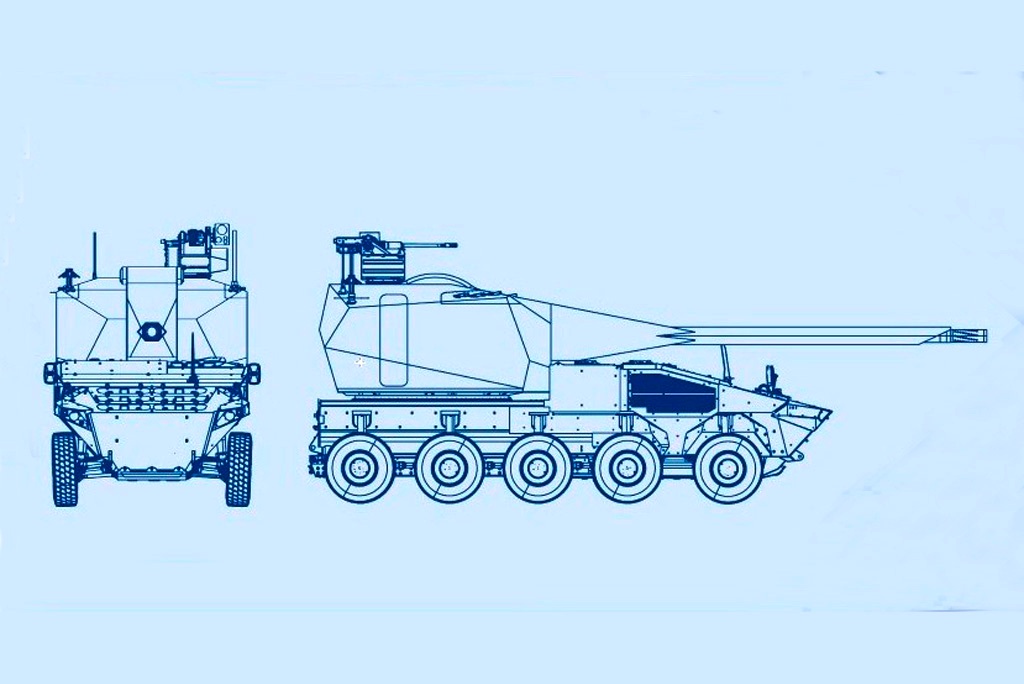
The centre of gravity of the VBM 155 is marginally higher compared to that of the VBM NG 8×8 in combat version, the lowered hull floor at the back allowing to install the turret in a very low position. This has several beneficial effects; first, it allows a maximum speed on paved road in excess of 100 km/h, it reduces the overall height to bring the system within the railway gauge, and finally it lowers the point of application of recoil forces which improves stability, a key factor during sustained firing missions, the VBM 155 having a maximum rate of fire of 10 rounds per minute.
CIO worked on suspensions to make them consistent with the higher GVM; according to the company the VBM 155 will be able to shoot without using spades for increasing stabilisation, which considerably speeds up deployment and redeployment. The first shot can leave the barrel 10 seconds after the SP howitzer has come to a complete stop, and 10 more seconds are needed to leave position, which means that in 150 seconds a fire mission can be conducted shooting more than half the magazine content. CIO is already considering a shoot-on-the-move option.
The VBM 155 will have a two-man crew, located on the left of the chassis, the driver in front and the commander/gunner behind him in a tandem configuration. Their survival cell will be the volume with the highest protection, no details being unveiled, the level being based on customer’s requirement. The two-man option allowed to maintain the vehicle as compact as possible. With the full automated turret and computer support CIO considers that a two-man crew is sufficient to carry out the task; in case of prolonged mission a crew replacement routine will have to be organised, as with only two personnel resting time becomes very limited.
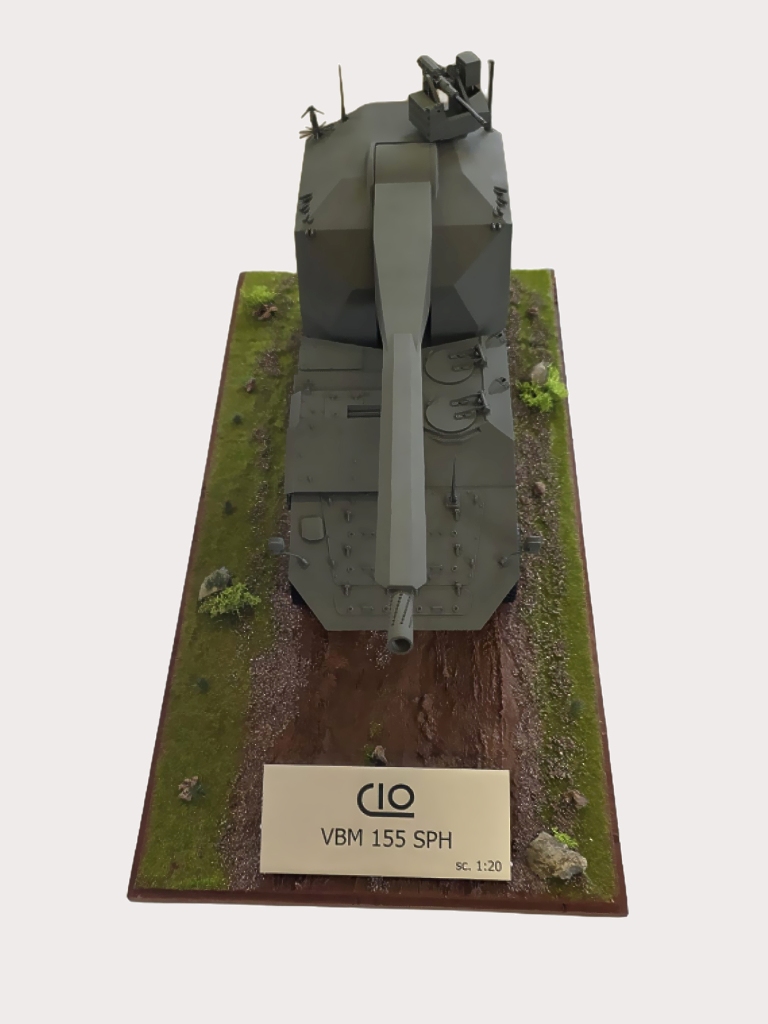
The VBM 155 will be fitted with an NGVA architecture, and will be equipped with an inertial navigation unit, either from Safran (Geonyx family) or GEM, will be capable to host VHF, UHF or SATCOM radios. Its fire control system will be interfaceable with customers’ battle management systems.
With the battlefield now infested by scores of UAVs, many of them of the attack type, the counter drone issue is present at any level. For the VBM 155 CIO proposes and RCWS armed with the Blaze cannon in 30×113 mm produced by the company itself. Known as HITROLE C-UAS, this is another first that Leonardo is showing at Eurosatory.
Both the chassis and the turret prototypes are being produced, Leonardo aiming at integrating them in early Q4 2026, to possibly start some firings before year end. This will not mark the end of development but rather a new start as field experience will certainly lead to adjustments and modifications industrial tests allowing Leonardo to clarify the system’s characteristics, confirm the original requirements, and gradually introduce evolutionary aspects. The 10×10 platform having strong commonalities with the VBM NG, no major issues are expected, and tests might be limited to the strict necessary.
CIO is developing the VBM 155 looking at the export market, however the system might arouse domestic interest considering that the Italian acquisition program is yet to be finalised.
Photos and graphics courtesy CIO