Expodefensa 2025 – Milkor 380, Africa’s MALE powerhouse takes flight
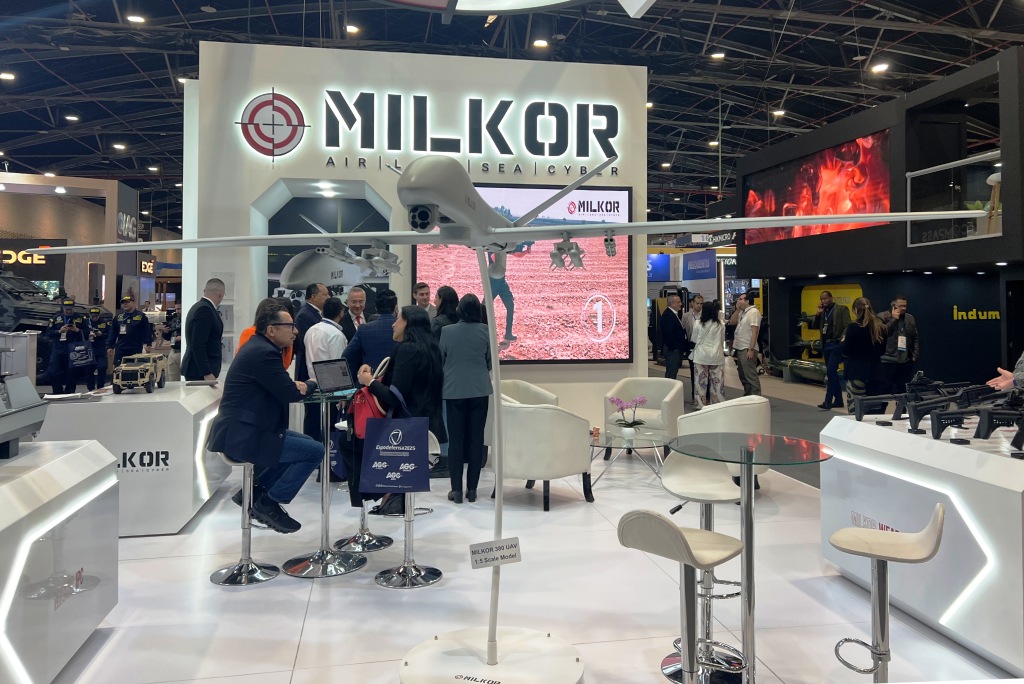
A 1:5 scale model of the Milkor 380 was on display on the South African company stand at ExpoDefensa in Bogotá, where it featured among the key unmanned aerial solutions showcased to the Latin American audience. This presence formed part of the company’s strategy to strengthen the visibility of its MALE drone on the regional market, capitalising on the showcase offered by the exhibition
The Milkor 380 is a fixed-wing MALE (Medium Altitude Long Endurance) UAV in a low-wing monoplane configuration, developed to provide high aerodynamic efficiency and low wing loading, ensuring maximum endurance and performance in all weather conditions. From the outset, the aircraft was conceived as a fully indigenous system that is ITAR free, with key subsystems developed locally to reduce reliance on foreign suppliers and promote South African technological sovereignty.
Measuring approximately 9 metres in length and with a wingspan of around 18.6 metres, the Milkor 380 firmly positions itself in the category of large MALE drones, visually comparable to international standards. The elongated fuselage incorporates a spacious nose dedicated to optronic and radar payloads, while the rear section features a Y-tail and retractable tricycle landing gear that enables safe operations on unprepared airstrips while minimising in-flight drag.
The drone is powered by a four-stroke, four-cylinder turbocharged engine of the Rotax 915 iS type, running on either light aviation fuel, which balances controlled fuel consumption with reliability for extended missions. This propulsion enables a maximum speed of 250 km/h, with a typical cruise speed between approximately 120 and 150 km/h, suited to prolonged ISR mission profiles.
In terms of flight parameters, the Milkor 380 offers an announced endurance of up to 30–35 hours depending on configuration and profile, with a range exceeding 4,000 km. Absolute ceiling approaches 30,000 ft, with routine operational altitude around 20,000–23,000 ft, allowing it to evade many lightweight surface-to-air threats while maintaining good sensor resolution.
Recent technical datasheets and industry communications indicate a maximum take-off mass of approximately 1,500 kg, with an internal and external payload of around 220 kg with a full fuel load of 315 kg, however the fuel load may be reduced for a higher payload capacity at the cost of a reduction in range and endurance. The airframe integrates five hardpoints – two under each wing and one ventral point – enabling the integration of bulky sensor pods or ordnance based on client requirements.
Modular payload compartments, recently highlighted by the manufacturer, facilitate the integration of SIGINT systems, electronic warfare equipment, and specialised communication links without major airframe requalification. This modularity explicitly targets export markets, where armed forces seek platforms capable of swiftly transitioning from surveillance to armed support or communication relay missions.
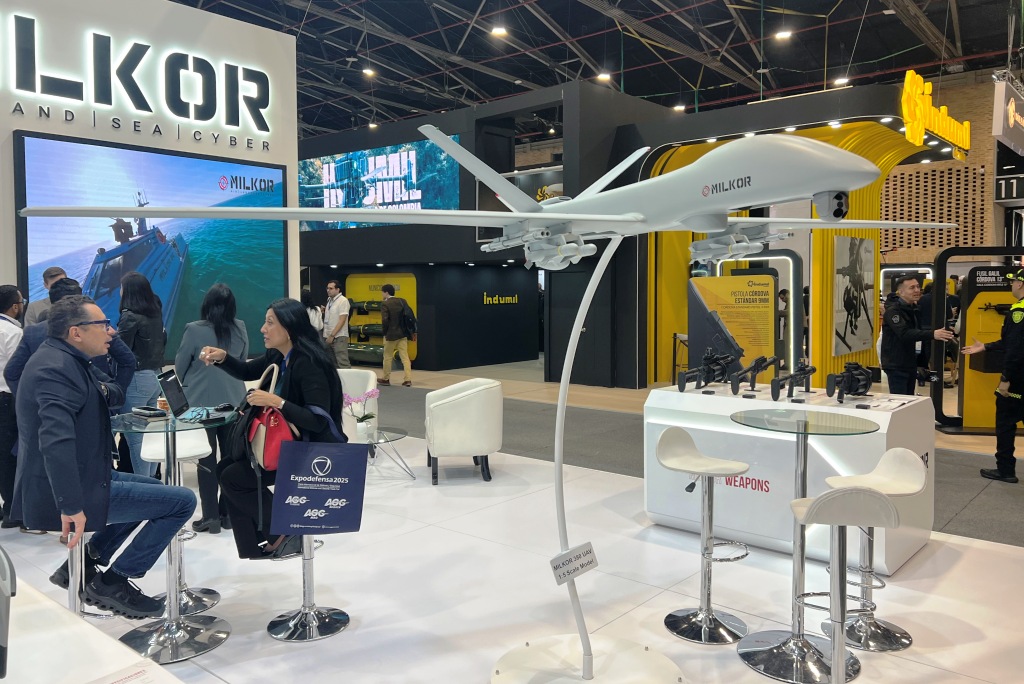
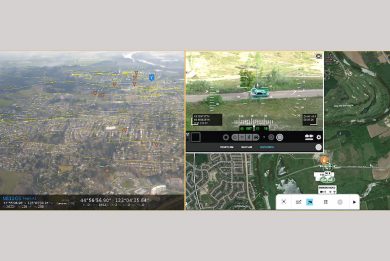
In terms of sensors, the Milkor 380 is optimised around a next-generation EO/IR optronic gimbal mounted in the forward ventral position to maximise fields of view. Recent configurations mention the integration of high-definition multi-sensor systems capable of combining daytime colour channels, low-light TV cameras, mid-wave (MWIR) or long-wave (LWIR) infrared cameras, as well as laser rangefinders and designators for precision munition guidance.
The latest enhancements also emphasise the integration of synthetic aperture radars (SAR) with maritime and ground movement tracking indicator (M/GMTI) modes for detecting maritime and ground-moving targets, ensuring all-weather, day-and-night ISR capabilities. This EO/IR + SAR combination allows the drone to maintain reconnaissance and target acquisition in poor visibility, smoke, or camouflage conditions.
The Milkor 380 relies on an autonomous flight control system enabling automatic take-off and landing, with trajectory management and preprogrammed loiter patterns that significantly reduce operator workload. The manufacturer highlights the use of a Relayed Line of Sight (RLOS) communication architecture, which substantially extends operational range compared to a simple direct radio link.
Communication suites may include secure data links, real-time video streaming, and integration into national C2 or C4ISR architectures to enable target designation and tactical situational awareness sharing with other platforms. This ‘system of systems’ dimension lies at the heart of positioning the Milkor 380 as an ISR node within an integrated defence network.
Although initially presented as an ISR platform, the Milkor 380’s five hardpoints were sized from the design phase to accommodate medium-size precision-guided armaments. Recent documents mention the ability to utilise guided bombs, lightweight air-to-ground missiles, torpedoes or loitering munitions, depending on client requirements and applicable export authorisations.
The integration of optronic gimbals with laser designators, coupled with secure data links, paves the way for mission profiles including close air support, targeted neutralisation, and area denial, while maintaining a more discreet signature than manned aircraft. The manufacturer also leverages EW/SIGINT capabilities for jamming or electromagnetic intelligence collection missions, enhancing the platform’s versatility across modern operational spectra.
Conceived for border surveillance, maritime patrol, anti-trafficking, or ground operation support missions, the Milkor 380 targets both South African forces and export clients in Africa, the Middle East, Latin America, and Asia. Its indigenous design, combined with competitive operating costs and high modularity, makes it a regional alternative to major Western MALE programmes for nations seeking to diversify suppliers.
Recent announcements regarding the promotion of the Milkor 380 and the development of a larger future Milkor 780 demonstrate the company intent to establish a lasting presence in the medium- and long-endurance unmanned aerial systems segment. In this context, the Milkor 380 emerges as a technological showcase for South Africa’s defence aeronautics industry, while addressing growing demand for cost-effective, armed ISR platforms.
Photos by J. Roukoz