
Leonardo unveils “Michelangelo Dome”: the new multi-domain integrated defence system
The Ukraine conflict and the Middle East crisis with the confrontation between Israel and Iran and the Houthi contribution have highlighted the challenging mission to defend a country borders and airspace against salvos of ballistic and first generation of hypersonic missiles of different ranges and swarms of unmanned one-way platforms alongside salvos of rockets coming almost from every direction. To cope with these scenarios and the reduced time to respond due to the development of new generation hypersonic weapon systems coming from land, naval and air platforms, Leonardo has unveiled the “Michelangelo Dome”
“The advanced integrated defence system project developed by Leonardo stems from the need to defend and protect critical infrastructure, sensitive urban areas, territories and assets of national and European interest, through a modular, open, scalable and multidomain solution,” Roberto Cingolani, the CEO and General Manager of Leonardo, summarized after providing the presentation of the Michelangelo Dome project.
“Conceived by the company, the project is being developed by an integrated project team that includes the Italian MoD and Armed Forces. Without their contribution, we would only be talking about a wishful technological exercise. The continuous interfacing and direct involvement of the Armed Forces in designing the system architecture based on their needs and requirements is absolutely essential, especially for programmes of this magnitude,” Roberto Cingolani said, acknowledging the fact the project was presented in recent days to the Minister of Defence, Guido Crosetto, the Chief of Defense Staff, General Luciano Portolano, and all the Chiefs of Staff of the single services.
“The project introduces a new defence paradigm,” according to Cingolani: the simultaneous and integrated management of heterogeneous threats, leveraging the interconnection between air, sea, land and space domains, within a cyber-secure environment supported by a sophisticated artificial intelligence system. “The platform creates a dynamic security dome capable of detecting, tracking and neutralizing threats even in the event of large-scale attacks, across all operational domains: aerial and missile threats – including hypersonic missiles and drone swarms – surface and subsurface attacks at sea, and hostile ground forces,” the Leonardo CEO highlighted .
Thanks to advanced data fusion from multiple sensors and the use of predictive algorithms, Michelangelo Dome can anticipate hostile activity, optimize operational responses, and automatically coordinate the most suitable effectors, the company’s representative continued.
An initial iteration of the Michelangelo Dome architecture (called Dead Zone) is expected to be ready for the Italian MoD by the end of 2027, after its integration with the current integrated air and missile defence (IAMD) architecture and space sensors, in addition to lower layers multi-domain assets, will be finalised. New systems will be available in a follow-on two-year time, while federated solutions with interested allied nations could follow in a four-year timeframe.
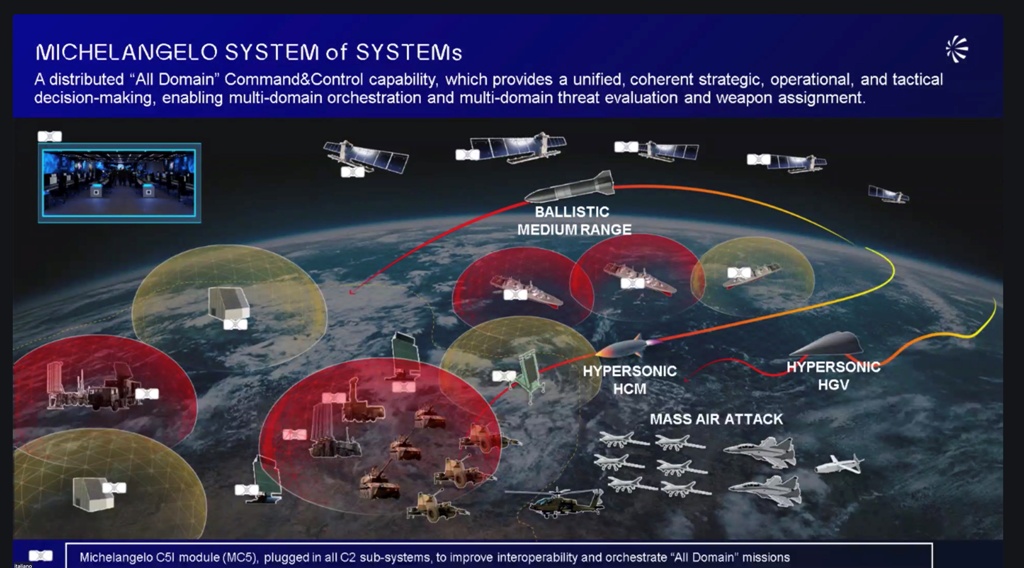
The Michelangelo Dome provides a higher layer C5 system with an architecture designed to be open, meaning fully compatible with the current and future command and control, defensive assets and platforms of other nations and compliant with NATO standards, providing further multi-domain capabilities in the so-called “kill chain”, Cingolani stressed. Basically, a sort of enabler for interconnecting existing systems, even very different ones and not designed to interoperate.
“If a country in Eastern Europe doesn’t have the money to buy the F-35 or the Patriot, but has an anti-aircraft missile system, we can integrate it into the Michelangelo Dome, adding the ability to communicate following NATO protocols and doctrines,” he explained.

Characterized by a modular design and open architecture, the “Michelangelo Dome” is based on a Distributed Joint All Domain C2, empowered by a newly designed C5I module (MC5) which shall be “plugged in” all tactical C2 sub-systems; this enables interaction with existing C2 systems and with current standard links and protocols, allowing multi-domain orchestration through reduced latency links, additional sensitive data sharing, and AI-assisted data distribution and synchronization, to speed up the decision-making process, under a cyber secure global network.
The system is capable of performing computational analyses on data volumes from radar, satellites, infrared detectors and other sensors, amounting to hundreds of terabytes per second, according to Cingolani, and is supported by artificial intelligent (AI) while ensuring the protection of such data through links cyber resilient and secure by design.
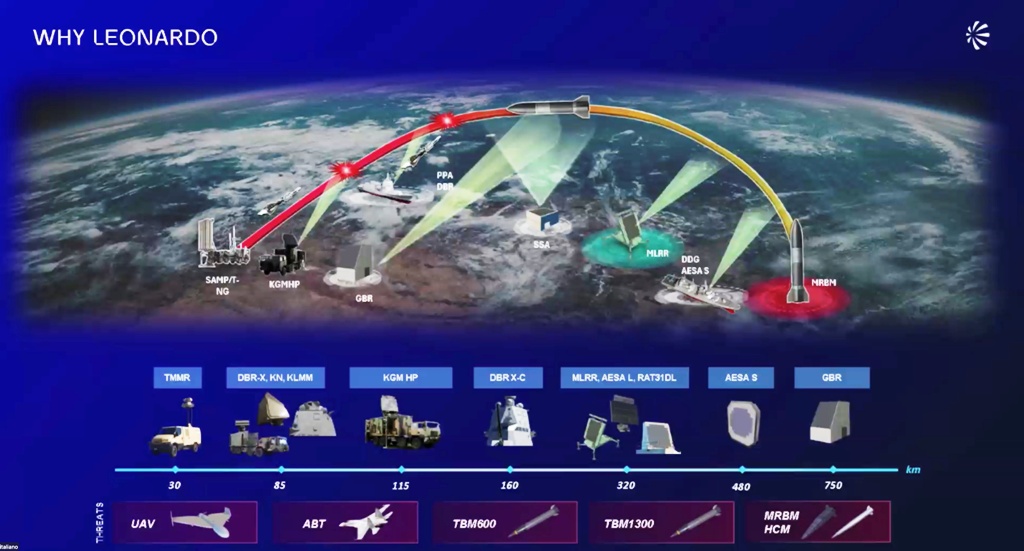
In the Middle East crisis, the distances between the launching and targeted areas allowed time to generate a coordinated defence. A ballistic or hypersonic threat coming from Russia can reach European Capitals in only few minutes, he underlined . New hypersonic weapon systems will further reduce available reaction time. “The Michelangelo Dome architecture has been conceived to provide more time for decision making and increase reaction time,” Cingolani stated.
The MC5 module allows for dynamic real-time decision-making. It adds a global defence orchestration capability, which will continuously assess the course of action in real time, re-evaluate engagement plans of each platform involved, calculate the global optimal solution and distribute the orders to all platforms, wherever land, air and naval.
In essence, it enables the transition from a “kill chain” to a “kill web”, hence, from the “one sensor, one shooter” approach to the “one sensor, best or any shooter” one.

Thanks to the MC5 module the command control of the assets operating in the different domains (ships, SAM systems, air systems, tactical C2, etc.) will be integrated in a distributed architecture that permits the orchestration of multi-domain operations, virtually generating a sensor and an effector grid among which the best combination can be selected. It will enable a global and adaptable interoperability web to interconnect all domains sensors and effectors. The Armed Forces doctrines will drive the web configurations.
Leonardo will partially capitalize on the progress made on existing programmes, and has already initiated developments based on its own investments for the “Michelangelo Dome” project. It is clear, however, that resources will need to be allocated to develop certain capabilities, as already foreseen at the European level, where the Commission has created tools to support Member States’ defence investments in the development of key capabilities such as missile defence and space capabilities.
Looking to the main sensors, effectors and other IAMD systems including the space-based architecture and satellites part of the Leonardo portfolio, the presentation given by Cingolani provided an interesting overall picture including both present and future systems, especially in the space domain, without entering into details.
In addition to the current generation of land and naval based sensors and effectors, including the X-/C-Band AESA Dual-Band Radar (DBR) alongside the MBDA SAAM ESD air defence system with Aster missile family for naval applications, and the Kronos Grand Mobile High Power (KGMHP) AESA multi-function radar used by the land-based SAMP/T NG air defence system, Leonardo is developing a new generation S-band radar for Italian Navy’s new air defence destroyers and a fixed land-based L-band large antenna AESA radar for IAMD applications. Based on the naval Kronos Power Shield architecture and latest technologies, the L-band GBR (Ground-Based Radar) will be capable of long-range detection (more than 2,000 km) of ballistic and hypersonic threats, with a cluster of these radars being capable to defend national borders. During the event, Leonardo representatives confirmed these developments will be ready by 2029. The Italian MoD has a requirement for such an IAMD capability alongside the latest generation of FADR long-range air surveillance radar and the new L-band MLRR system (Kronos Ground Shield) being offered by Leonardo.
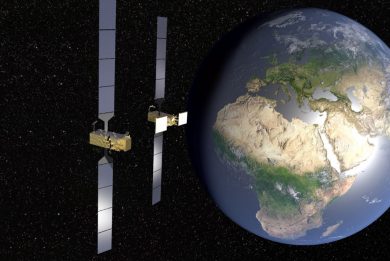
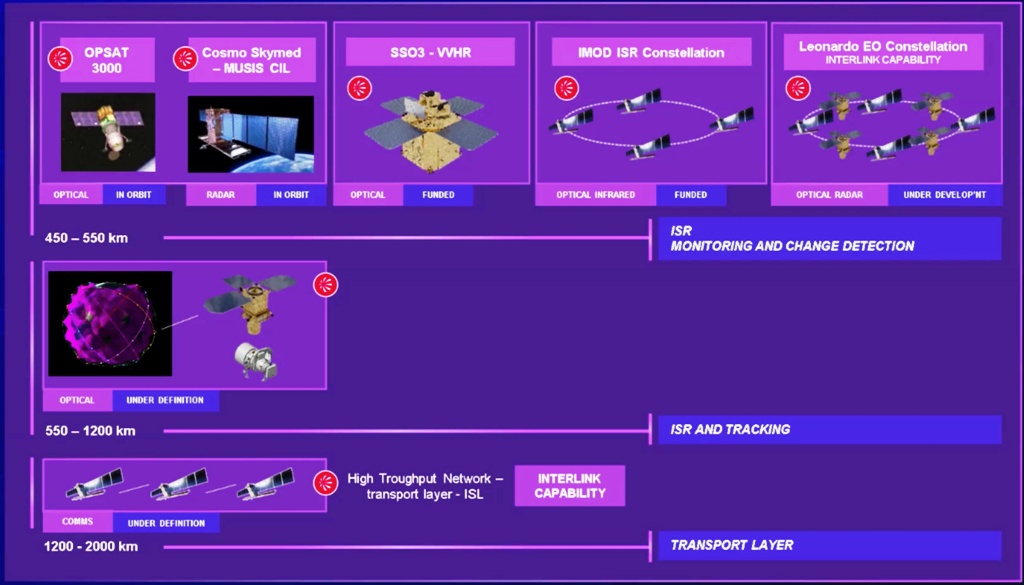
The presentation also provided first but limited details about the company’s space-based sensors and capabilities. In addition to the current OPSAT 3000 optical satellite and the Cosmo SkyMed Second Generation X-band synthetic aperture radar constellation, of which the third satellite (out of a four system constellation) will be launched by the end of 2025, the slide also showed a new optical satellite capability already-funded and known as SSO3-VVHR, which EDR On-Line understood indicating a sun-synchronous orbit-based satellite with very high resolution optical sensor, alongside two new satellite constellations. The first is the already-funded Italian MoD’s ISR constellation including satellites fitted with infrared and radar sensors, no further details being available, as well as the under development Leonardo EO Constellation with interlink capability including both optical and radar sensors. In addition to these satellites devoted, according to the slide, to ISR monitoring and change detection, in orbits ranging from 450 to 550 km, the slide also highlighted an optical satellite capability under definition for ISR and tracking, to be placed in orbits between 550 and 1,200 km. At higher distance from earth (1,200-2,000 km) a satellite communications constellation with high throughput network is under-definition, to serve as a transport layer with interlink. A comprehensive space-based capability is under development which Leonardo and Italian authorities expect to further detail in the coming weeks and months.
Leonardo product portfolio already includes platforms, with the exception of the naval domain [1], command, control and communications, sensors and effectors [2] in every domain. Looking to additional key capabilities of Leonardo supporting the Michelangelo Dome development, “Leonardo has not only quickly expanded its business in cyber domain, passing from 400 million euro to more than one billion euro, but it followed operational and technical requirements which will be key to the data exchange security required by the project we are presenting. Cyber defence together with artificial intelligence and other key technologies will be essential to counter the hybrid threats that Italy is confronting today and much more in the future.”
The company has made huge investments in the High Performance Computing with the Da Vinci machine, “which is planned to double its computing power in few months,” Cingolani said, while more than 2,000 engineers and 200 developers are involved in the artificial intelligence domain which is key to speed up the assessment phase and decision making support.
Wherever the capability wasn’t available or its development would have required too much time and funding, in a global scenario where the speed of reaction is key to success, the company created partnerships in different sectors, such as the LRMV joint venture with Rheimentall for tracked armoured vehicles, LBA Systems JV with Baykar for unmanned platforms, surveillance to adjunct/cooperative, while reinforcing the strategic joint-ventures with Thales in the space domain. The European Bromo space giant under a three companies partnership with Airbus and Thales will further strength Leonardo position as a leading player in the field of Global Security.
Presentation screenshots by EDR On-Line
[1] In the naval sector, platform are provided by Fincantieri while Leonardo supplies the Command Management System (CMS) with sensors and weapon systems, Orizzonte Sistemi Navali joint venture between the two companies providing the whole naval package.
[2] The effectors are provided through MBDA missile systems company, in which Leonardo has a 25% share alongside BAE Systems and Airbus.