
Omnisys introduces the next step in BRO™ C-UAS counter-drone mission planning and threat mitigation
12 January 2026 – Omnisys is expanding its BRO™ (Battle Resource Optimization) suite with a next-generation Counter-Unmanned Aircraft System (C-UAS) mission planning platform that shifts counter-drone defense from reactive interception to proactive, model-driven prevention. The current solution is an evolution of the proven BRO-CUAS system, further leveraging advanced technologies to enable operational users to understand their arena in depth, anticipate likely UAS attack paths, and significantly improve mission effectiveness against small drones, FPV strike platforms and loitering munitions using existing Counter-UAS assets.
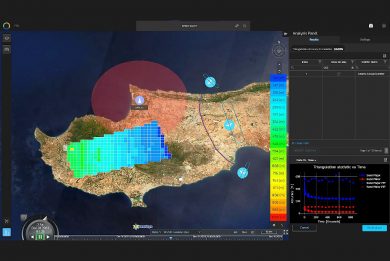
Leveraging a physics-accurate digital twin of the battlespace, BRO™ C-UAS reveals low-altitude approach corridors and coverage gaps caused by terrain, buildings and vegetation, and computes actual detection, tracking and engagement envelopes for sensors and effectors. This enables planners to identify vulnerabilities, close blind spots, prioritize critical sites and routes, and deploy scarce radars, RF sensors, jammers and interceptors where they deliver the highest operational impact under real terrain and spectrum conditions.
The platform’s AI-driven optimization engine evaluates alternative deployment options and operational concepts, recommending courses of action that enhance coverage and interception probability while reducing mutual interference and redundant overlaps. The platform operates as an independent planning tool to support mission-critical decisions that complements existing command-and-control and sensor-control systems, focusing on mission logic and optimization rather than real-time device control. By modeling operational behavior, constraints and enemy courses of action, BRO™ C-UAS supports mission understanding – beyond mission awareness – and helps commanders reach better, faster decisions to cope with the intense challenges of the dynamic battlespace.
BRO™ C-UAS is fully vendor-agnostic, allowing customers to model mixed fleets of radars, EO/IR sensors, RF detectors, jammers and kinetic effectors from multiple suppliers, as well as known or generic hostile systems. User-sensitive performance parameters are configured locally through a secure configurator. This ensures that all classified or proprietary information about own forces and hostile systems stays under sovereign user control, while still enabling accurate modeling, simulation and optimization without dependence on an external party.
Beyond current operations, the system supports training, readiness and long-term force development by providing a realistic environment for complex counter-drone scenarios and data-driven after-action reviews. Acquisition and force-development authorities can assess and compare alternative Counter-UAS architectures, quantify operational trade-offs and identify the most cost-effective combination of sensors and effectors for each mission profile and budget.
Photo courtesy Omnisys