Saab unveils new Sirius Compact L24R R-ESM family member with first customer
The latest member of Saab tactical Sirius Compact R-ESM (Radar-Electronic Support Measures) sensor family has been unveiled at the AOC EW Europe symposium in Helsinki: it is the L24R model which represents an extension specifically built “for persistent, fixed-suite surveillance, offering wide-area strategic coverage,” said Carl-Johan Bergholm, Head of Saab’s Business Area Surveillance. The new system is already under contract for an unidentified NATO launch customer, with deliveries planned for around the middle of next year
The Sirius Compact is “a family of modular and scalable passive EW sensors, providing a true force-multiplier by enhancing situational awareness through silent detection, classification and prioritization of radar emissions,” said Mathew Willmot, Saab Sales Director said, during a conference call with a selected group of media
The new L24R adds to a family of four existing tactical models: the L20R and the A20R for respectively land and airborne applications and the more performing L21R and A21R also for the same two domains, to which add the more capable Sirius L500R and Sirius L200RC for respectively ELINT and both tactical R-ESM and Communication ESM (C-ESM) duties, the Saab Sales representative explained. The Sirius Compact family of sensors also includes the L20C model for tactical CESM capable of tactical deployment and fixed/transportable use.
The L24R model, where “L” means Land and “R” stands out as R-ESM, inherits the technology developments of the successful family of tactical Sirius Compact products, “already sold to at least around 10 international customers mostly of which NATO countries,” Willmot added, without providing further details. All the Sirius Compact family of R-ESM and other tactical electronic warfare systems were developed and built at Saab’s facilities in Finland, “which also provides naval combat management software,” Pekka Halme, Saab product manager in Finland, said. In Finland Saab is headquartered in Helsinki with an office in Turku and the Technology Centre and Production facility in Tampere; it has an overall workforce of 309 employees, which has grown by 30% from 2024.

“In addition to the vicinity of Finland to Sweden, the reason for establishing the unit in Finland was the availability of RF and microwave engineers, which were difficult to find to work in Sweden at that time,” Halme said. Because of this engineering background and strong heritage in the EW area, the main focus of Saab Finland has also been to build compact tactical EW systems. The facility in Tampere, according to the information provided to the media, “is a very modern, highly automated facility,” with activities ranging from component production to testing. “It is dimensioned to meet demand…but it has a flexible capacity, which allows scaling up production quickly if demand increases,” he continued.
The Sirius Compact is a family of passive surveillance systems for tactical applications which detects, tracks and classifies radar emissions, and priorities them in real-time. These networked, compact and mobile RESM sensors have high precision Direction Finding (DF) and geo-location capabilities. They were conceived as self-contained compact sensors with integrated IMU/GNSS, being platform and datalink-agnostic, and capable to be rapidly deployment within minutes. Interestingly, all the family has no sensitive threat library data stored in the sensor, significantly increasing the safety of the system. The family do not incorporate a power source, as power is provided by batteries carried by the soldier or available on ground or airborne platforms. While all the system’s functionalities are incorporated into the lightweight transportable and manageable system units, the Sirius Compact requires a PC or tablet to provide emitters identification through the threat library, and their visualization on terrain maps. They are compliant to various NATO standard such as SAPIENT and CESMO, and feature Ethernet/14-32 VDC external Interfaces and sensor recording memory of 100 GB/8 GB. All the systems are NATO Stock Number (NSM).
With a mass of 5.2 kg, a height of 460 mm and a diameter of 150 mm, the Sirius Compact L20R for land applications incorporates a digital channelized receiver with a frequency coverage of 2-18 GHz and a 360° azimuth coverage; it provides emitters geolocation through triangulation with a Direction Finding (DF) accuracy of respectively less than 3° rms (in the 2-4 GHz range) and less than 2° rms (4-18 GHz range). Although no information was provided on the system sensitivity, Saab representatives said the Sirius Compact can complete its mission also against low probability of intercept radars.
During the conference call, the Saab representatives presented a series of applications of the Sirius Compact family of systems, from the tripod one manned by a single soldier, to the system mounted on 4×4 protected or soft-skinned vehicles, alongside installations on board unmanned ground vehicles remotely operated by a single soldier. The land model is also being used on board vessels of different dimensions, from RHIBs to unmanned surface vehicles of small dimensions, alongside Combat Command boat, Combat Boat and vessels. This in addition to complementing multi-sensor systems for Ground Based Air Defence (GBAD), Coastal and Border Surveillance and other sensors networks.
The A20 R airborne version for small unmanned but also airship applications, as unveiled by Saab, has more compact dimensions of respectively 350 and 150 mm in term of height and diameter while its mass reaches 3.3 kg only.
Based on the developments of the first iteration of the Sirius Compact products and customers feedback, thanks to further activities and latest technologies, the Finnish Saab team was able to further enhance the capabilities with the L21R and A21R models for respectively land and airborne applications. They have a frequency coverage of 1-18 GHz and both can reach a DF accuracy of respectively less than 3° rms (in the 2-4 GHz range) and less than 2° rms (in the 4-18 GHz range). Both the L21R land and A21R models are respectively higher (480 and 370 mm) with the same diameter (170 mm) and a mass reaching respectively 5.8 and 3.9 kg.
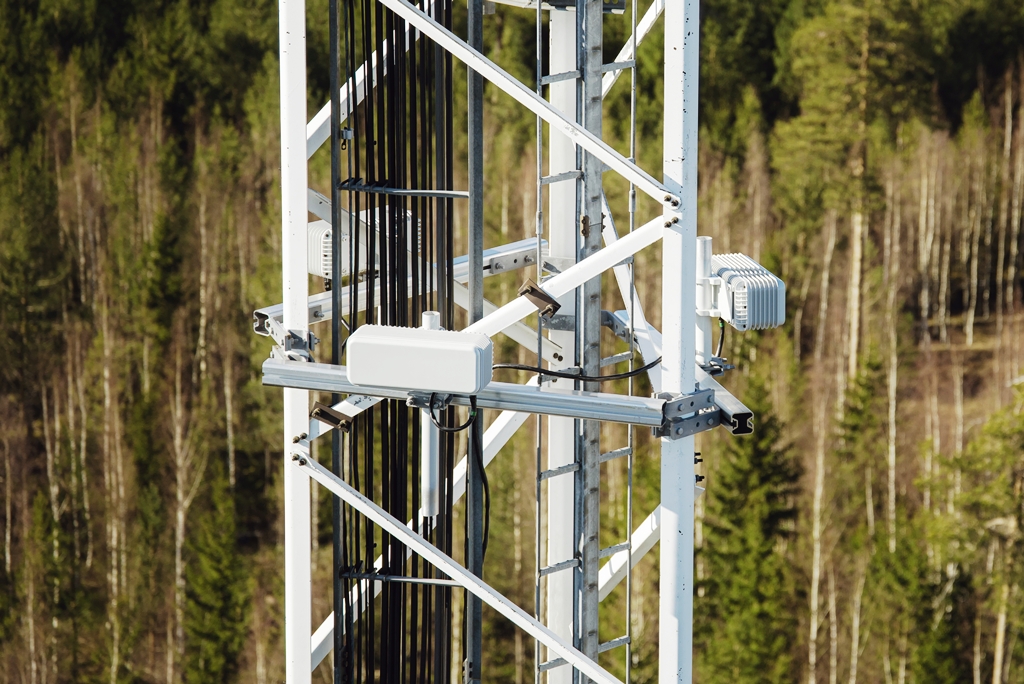
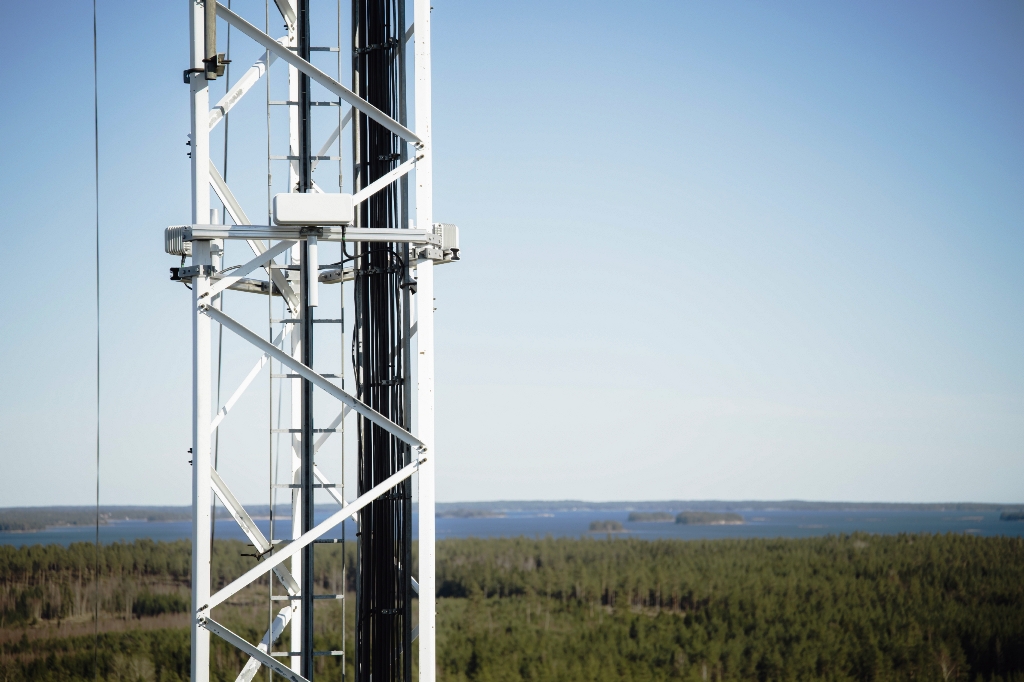
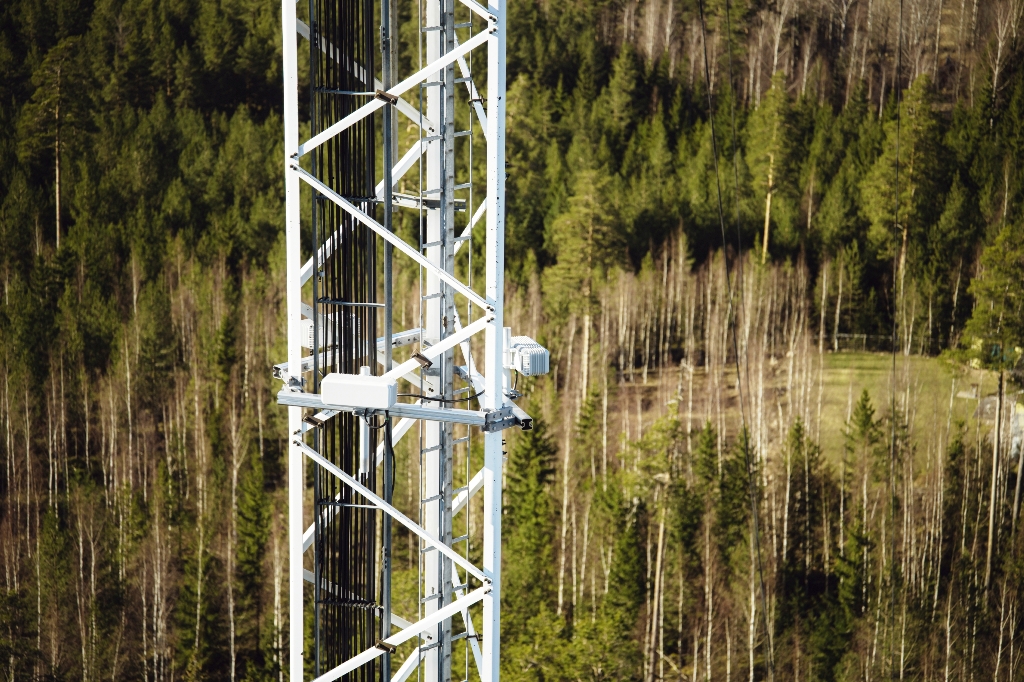
Based on the feedback coming from the customers and the limiting factor that these systems have a line of sight coverage and that in most cases the “mast top” is unavailable for continuous surveillance duties such as in a network of border or coastal sensors, Saab team has developed the new L24R model as a solution composed of fixed panels for sector surveillance, where usually three or more provides a 360° coverage. “The L24R comes as an add-on for existing infrastructures such as towers with sensors where the mast top is unavailable,” being generally occupied by surveillance radars with rotating antennas which cannot be installed lower in the elevated tower.

The new L24R comes therefore based on fixed panels for sector surveillance with very high precision DF, as part of a wide-scale distributed sensor network. It is a low size, weight and power solution where each panel has 450 (L) x 170 (H) x 170 (D) mm dimensions, a mass of 8 kg and a typical power consumption of 65W.
With a frequency coverage of 1-18 GHz, an IBW of 500 MHz and azimuth coverage of 120°, each panel has a DF accuracy of less than 1° rms in a typical case, presents standard single-cable interfaces and do not requires external cooling.
Saab representatives have shown a maritime border application for the new L24R model where a significant number of towers with the system panels were positioned along the coast to ensure 24/7 coverage and high precision geolocation in such a small water surface with limited spaces such as the Baltic Sea.
As already mentioned, Saab representatives have also presented the more capable Sirius L500R based on a containerized module with operator consoles and an extendable mast for the surveillance sensor. The latter provides ELINT capabilities with high gain ESM and high sensitivity in fixed or transportable versions. The Sirius L200RC comes as a tool for maritime or land border surveillance with RESM and CESM which support ELINT duties with high accuracy geo-location, also in a fixed or transportable application.
Photos courtesy Saab