WDS 2026 – Rosoboronexport unveils the BTR-22 armoured personnel carrier
At the Saudi exhibition Rosoboronexport, the Russian export organisation for defence equipment, unveiled the BTR-22, an armoured personnel carrier that marks a break with former BTRs architecture
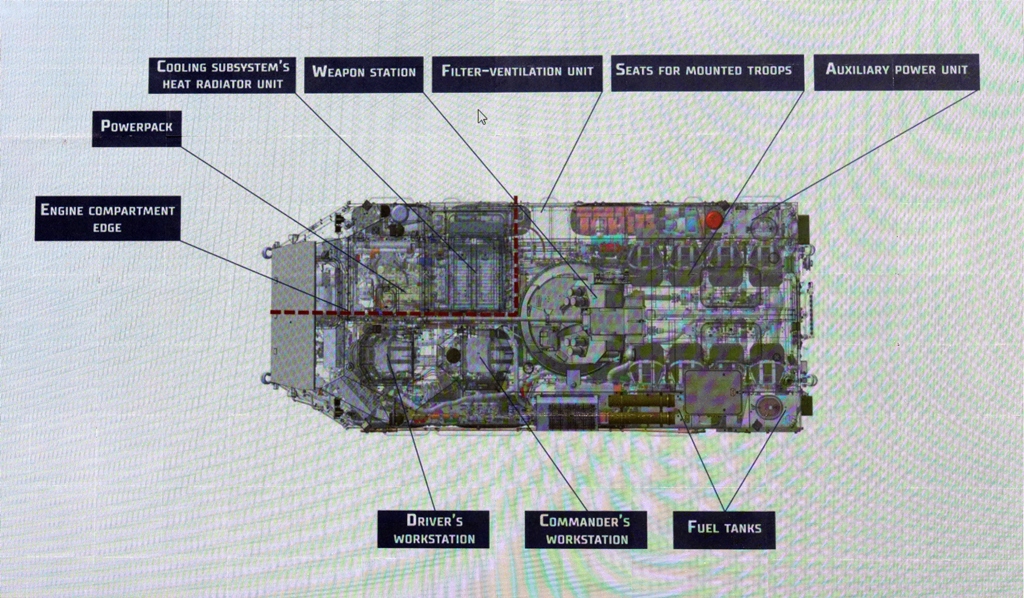
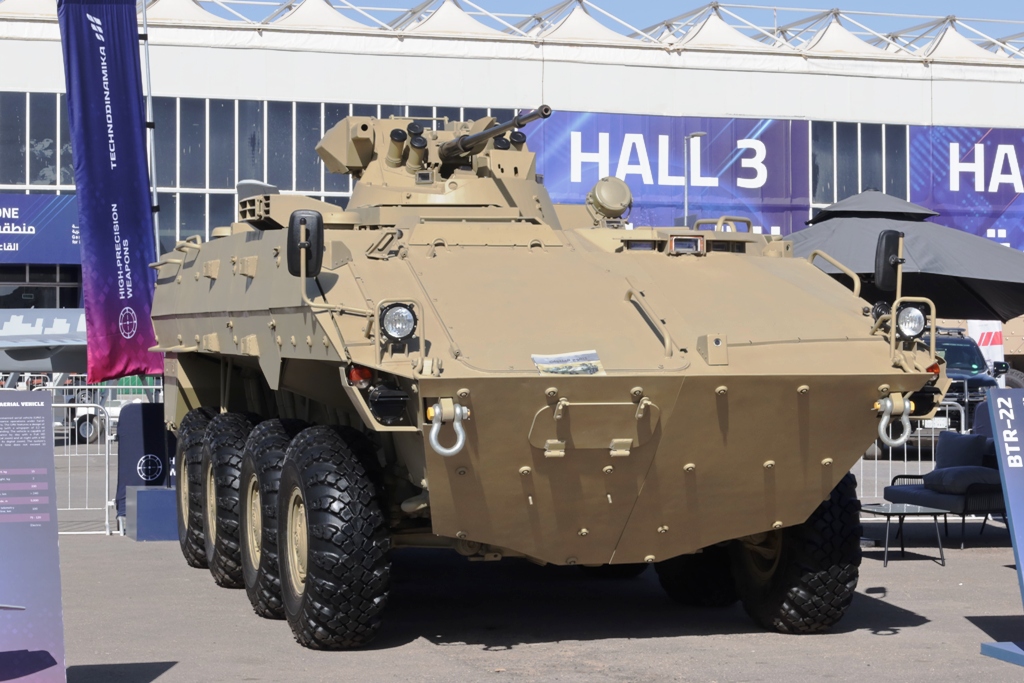
Exhibited in sand colour camouflage, the only thing that the BTR-22 maintains with its predecessors, the BTR-80 and BTR-82, is the acronym, standing for Bronetransporter, for troop transport, and the general shape. The new vehicle architecture is much more similar to that of western products of the same category, with the engine at the front-right, and the troop compartment at the rear. Dismounts enter and exit the vehicle via two doors at the rear, a step allowing better access and egress considering the height from the ground, as ground clearance is 430 mm. The new layout offers increased safety, debussing from the rear allowing maintaining cover from the enemy, who usually is in front of the vehicle, and is kept at bay by the main armament installed on the BTR, the old models having two lateral openings of reduced dimensions leaving personnel exposed to fire from the front.
The BTR-22 gross vehicle mass is 20 tonnes, dimensions being 7,560 x 3,070 x 3,110 mm. It is powered by a YaMZ-53603 inline 6-cylinder multi-fuel engine with two stage turbocharger providing 330 hp (243 kW) of power, which gives a power-to-mass ratio of 16.5 hp/t, lower than western standards, coupled to a mechanical gearbox. The 300 litres fuel tank and the 143 grams/(hp.h) specific fuel consumption ensure a cruising range of 700 km on road. To reduce fuel consumption as well as acoustic and thermal signatures, a AD2-P28, 5-1VM VP2401auxiliary power unit is installed, which provide over 5 kW to power all on-board systems.
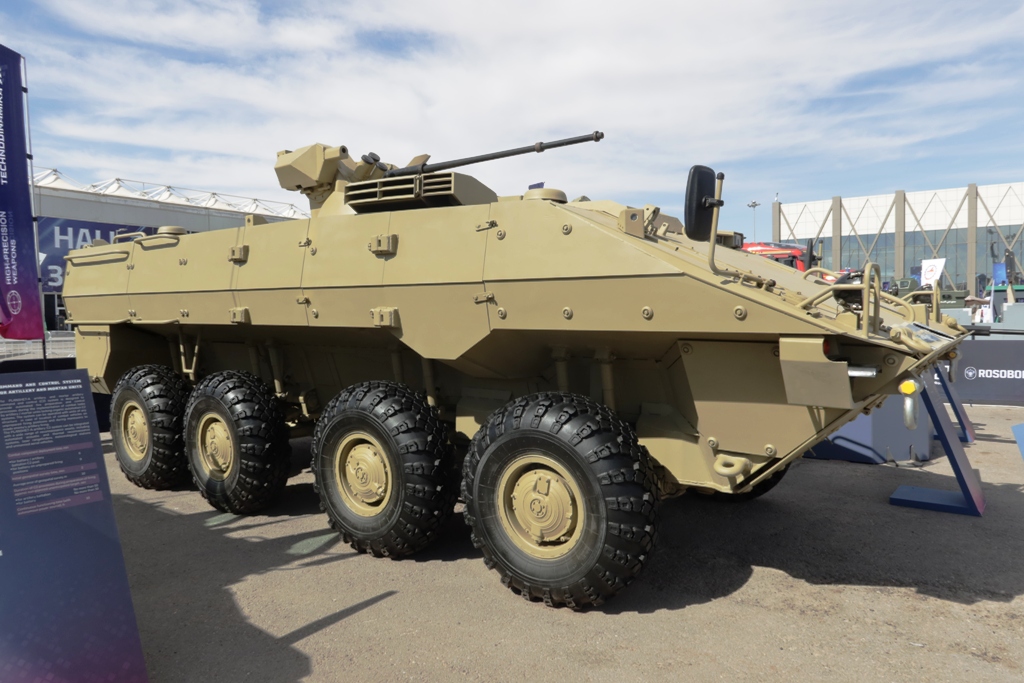
The BTR-22 maximum speed on road is 85 km/h, the vehicle being fully amphibious, powered by two with water jets that allow a top speed when afloat of up to 10 km/h. The BTR-22 can climb a 30° gradient (around 60%), travel on a 25° side slope (over 45%), overcome a 0.5 metres vertical obstacle and a 2 metres wide trench. The new Russian APC is fitted with independent suspensions of the torsion bar type with hydraulic dampers.
No precise data on ballistic level protection were provided during the briefing given to the media on Day 2 of WDS, Rosoboronexport representatives saying that the vehicle is protected “all round against heavy machine gun rounds”, which should mean Level 3-4 according to STANAG 4569; beside its passive spaced armour, which thickness of course varies depending on the part of the vehicle, the engine itself being at the front protects transported troops, not the driver who seats at the left of the engine compartment, another advantage of the new architecture. A spall-liner is installed to avoid fragments wounding personnel in case of hit. The BTR-22 paint helps reducing IR, UV and radar signatures. The “V” shaped bottom contributes to mine protection, which is said being affective against a 6 kg TNT explosion under belly or under wheel, equivalent to Level 2a/b in western standards. Slat armour can be added against RPG-type threats. To counter the increasingly present threat from UAVs, the BTR-22 can be fitted with a top protection kit against unmanned aerial vehicles and with a jammer. A full 360° situational awareness system is installed.
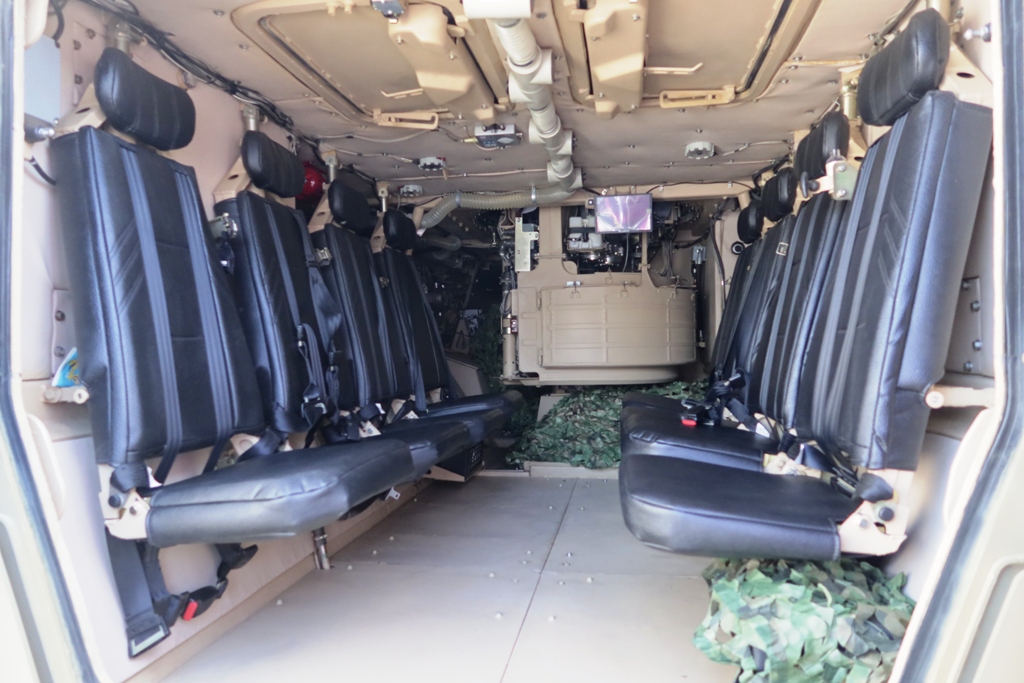
One thing that is considerably improved compared to previous BRTs is comfort; now the eight dismounts, as well as the three-man crew, are installed in energy absorbing seats, that no, it only increase comfort but also safety in case of mine or IED explosion. The troop compartment is much wider, even when the standard one-man turret is fitted which means the turret basket takes quite some space at the front of the troop compartment, behind the powerpack. An air conditioning system further increases comfort.
Coming to firepower, the BTR-22 is armed with the same weapon station of the BTR-82A. Its main armament is the 2A72 dual feed automatic cannon, 300 30×165 mm rounds being available in two chutes; the PKT-M 7.62x54R mm coaxial machine gun is added with 2,000 rounds, while six ready-to-use 81 mm smoke grenade launchers completing the ammunition. Beside a day channel, a PNK thermal imager is installed.
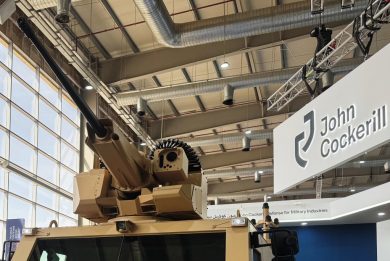
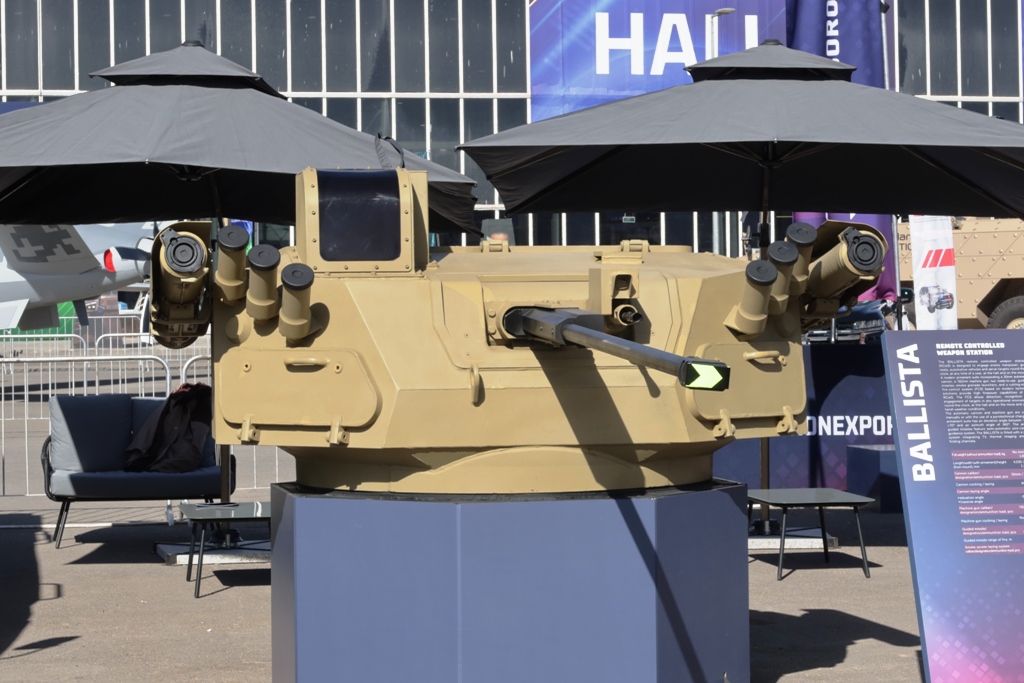
On the right of the BTR-22 a new turret was exhibited; known as Ballista, this remotely operated turret is armed with the 2A42 30 mm automatic cannon with 300 rounds, a PKT-M 7.62 mm coaxial machine gun with 2,000 ammunition, two 9M113M Konkurs-M SACLOS anti-tank guided missiles, and six Tucha smoke grenade launchers. The sighting system includes a daylight TV camera, the PNK thermal imager, and a laser rangefinder. Elevation angle is -5°/+70°, the latter a key factor when operating in urban scenarios. The Ballista is offered as an option to the older BTR-82A turret, the new unmanned turret having a mass of 1,650 kg without ammunition.
EDR On-Line understood that the BTR-22 is currently in the test phase, no additional details if these are still company tests or military evaluation tests being provided. As for the Ballista unmanned turret, Rosobornexport said that tests are concluded.
Graphics courtesy Rosoboronexport; photos by P. Valpolini