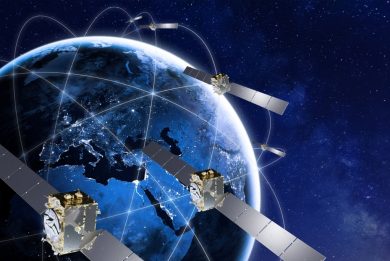

Leonardo’s Space Guardian: the first proprietary space constellation for Earth observation
On occasion of the presentation of the Industrial Plan 2026-2030, the CEO and General Director of Leonardo, Roberto Cingolani, has provided some more details on the development and timeframe of implementation of the Group’s first proprietary constellation for Earth observation named “Space Guardian”, which initial launch window is planned for the end of 2027. EDR On-Line obtained additional information on the space programme aside of the presentation event, with a document provided by Leonardo after requests of information submitted since its unveiling in March 2025
A next-generation space infrastructure, “unique of its kind also thanks to its convergence with digital technologies, supported by an internal investment of approximately half a billion euros,” the first proprietary constellation for Earth observation, marks “a technological leap for the space industry and strengthens Leonardo’s role in the development of digital and sovereign space capabilities,” the document states.
The constellation is “conceived as a complete digital space infrastructure capable of ensuring control over the entire data chain: from acquisition through radar and optical sensors – potentially integrating additional sensor types in the future – to in-orbit processing and final distribution to end users.” This model goes beyond the traditional paradigm of satellites as simple data-collection platforms and introduces a network of intelligent nodes capable of processing and analysing information before transmitting it to the ground. “Although its primary application is Earth observation, the system represents an infrastructure supporting digital sovereignty, data security, and infrastructural resilience.”
It can support a range of missions including monitoring of critical sites, maritime security, defence and intelligence, civil protection, and emergency and crisis management. As remarked by Leonardo CEO, during the presentation of the Industrial Plan 2026-2030, data from the constellation will support the ISR (Intelligence Surveillance and Reconnaissance) component of the Michelangelo Dome, the company advanced integrated defence system. According to the document, “Leonardo positions itself not only as a space player capable of providing integrated and complete space infrastructures and services but also as a provider of strategic data”.
The programme includes “around 20 next-generation multi-sensor satellites designed to integrate supercomputing and advanced communication capabilities directly in orbit.” These satellites will in fact host high-performance computing (HPC) capabilities, along with optical intersatellite links that will allow to exchange data in real time among them. “This approach drastically reduces latency, enables immediate information processing, and enhances the security and resilience of the entire system, including protection against cyber threats.”
Leonardo unveiled that the first nine satellites have already been contracted to Thales Alenia Space; they will be produced at the Assembly, Integration and Testing facility at the Space Smart Factory in Rome, “a next-generation space manufacturing facility and an example of digital and automated space manufacturing.”
The satellites will be distributed across two orbital planes: the first, according to Leonardo, will include the nine satellites already ordered. Six of them will be equipped with SAR (Synthetic Aperture Radar) payloads, two with Very High Resolution (VHR) optical instruments, and one will be a communications satellite acting as an orbital router; satellites are fitted with optical links allowing high speed data exchange among them, the communication satellite ensuring data downlink to Earth. “We’re going to launch end of 2027, begin of 2028,” Leonardo CEO announced. With all nine satellites in orbit, the programme will reach the Initial Operational Capability (IOC) around Q2/2028. “The radar-optical combination will enable observations under all weather conditions, day and night, ensuring operational continuity and high performance,” Leonardo stated.
The second orbital plane, scheduled for launch at the end of 2028 to be achieved by 2029, will complete global coverage with an additional 9–12 satellites, a step termed as Full Operational Capability (FOC). The nature of the related sensors is still being defined. The ground segment, designed by Telespazio, will include two proprietary stations: one in Scanzano (Palermo, Sicily), the second being currently defined, both expected to be operational by 2027.
According to the presentation provided by Roberto Cingolani on the Michelangelo Dome roadmap, “other constellations are expected to be integrated with tracking and early warning capabilities,” from 2030 on, significantly boosting the overall system architecture capabilities and performances.
The Leonardo Space Guardian proprietary constellation will be modular, scalable, and federated with third-party systems, as it will be interoperable with national and European programs such as Copernicus, IRIDE, and COSMO-SkyMed, thereby strengthening the positioning of Leonardo, Italy, and Europe in the domain of Earth observation and integrated, resilient space infrastructures.
Graphics courtesy Leonardo